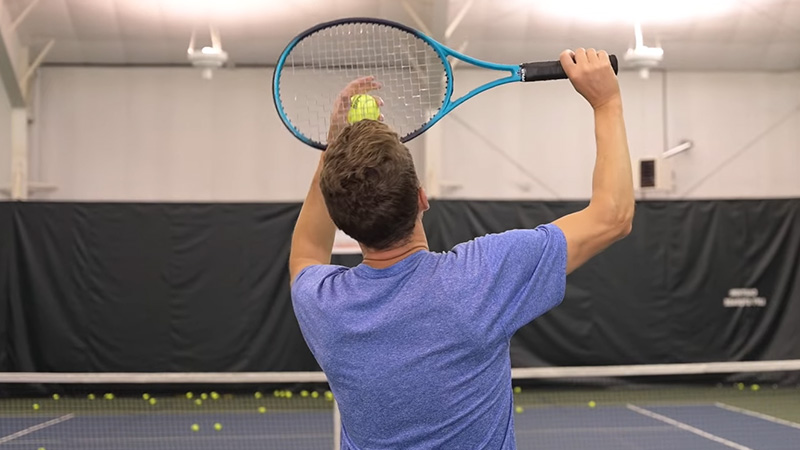
The serve is often described as the most complex stroke in tennis, a choreographed sequence of kinetic links that must fire in perfect unison to produce power and precision.
At the heart of this complexity lies a common misconception that plagues intermediate players and even some advanced competitors: the idea that the ball should be spun or “flicked” during the toss to assist with the eventual spin of the serve.
However, elite technical standards dictate a clear mandate: you should never intentionally spin the ball during your toss.
Your primary objective is to deliver the ball into the air so it ascends with zero rotation, creating a “dead” or still ball that remains stationary relative to its own axis.
This technical choice is not merely a preference but a fundamental requirement for high-level consistency and predictable ball-striking.
The Technical Case for the Still Toss
The quest for a perfect serve begins with the elimination of variables. When a player introduces spin during the toss—often through a flick of the wrist or a roll of the fingers—they introduce chaos into a motion that requires absolute repeatability.
1. Enhanced Visual Tracking and Focus
The human eye is remarkably adept at tracking movement, but its ability to calculate the exact center and trajectory of a sphere is significantly enhanced when that sphere is not rotating. A still ball is much easier to track as it reaches its apex.
When the ball is “dead” in the air, the brain can more accurately process its height and distance, allowing for a more precise adjustment of the swing path.
Conversely, a rotating ball can create visual illusions or subtle “wobbles” that cause the player to misjudge the optimal contact point.
2. Predictability and the Elimination of the “Wobble”
Flicking your fingers or snapping your wrist during the toss creates a wobbly, unpredictable ascent. In a match environment, where pressure and external factors like wind already threaten your rhythm, adding internal inconsistency via a spinning toss is a recipe for double faults. A still ball is a predictable ball, and predictability is the cornerstone of a reliable second serve.
3. Absolute Control Over the Contact Point
The goal of a high-performance toss is for the ball to land in the same spot every time if allowed to drop to the court. Achieving this level of “grooved” mechanics is nearly impossible if the release involves intricate hand or finger manipulation.
By keeping the toss still, you ensure that the ball remains a stable target, helping you hit a consistent serve regardless of whether you are aiming for the “T” or out wide.
Understanding the Source of Spin: Racket vs. Hand
A frequent point of confusion for developing players is the belief that pre-spinning the ball with the hand will help generate more topspin or slice.
This is a fundamental misunderstanding of tennis physics. The source of all effective spin is the interaction between the racket strings and the ball at the moment of impact, not the toss itself.
Instead of attempting to manipulate the ball with your hand, you must allow your racket to do all the spinning during the swing.
The racket head travels at a significantly higher velocity than your tossing hand, making it the only efficient tool for generating the revolutions per minute (RPM) necessary to move the ball through the air.
How the Racket Creates Topspin
To execute a heavy topspin or “kick” serve, the racket must move in an upward and outward path. You create this spin by hitting up and over the back of the ball.
This brushing motion imparts forward rotation, which utilizes the Magnus effect to cause the ball to dive sharply down into the court and bounce high away from the receiver.
If the ball is already spinning unpredictably from the toss, the strings cannot “grip” the felt as effectively, leading to a loss of both spin and control.
How the Racket Creates a Slice
For a slice serve, the mechanics shift to a lateral brushing motion. You hit the outside of the ball, brushing the strings sideways against the felt. This imparts side-spin, making the ball curve through the air and slide away from your opponent upon impact with the court.
Again, this requires a still target to ensure the strings make contact with the exact side-section of the ball needed to produce the desired curve.
The Anatomy of the Perfect Still Toss
Achieving a rotation-free toss requires a shift in how you view the tossing arm. Rather than seeing it as a limb that “throws” the ball, you should view it as a mechanical elevator that “places” the ball in the sky.
1. The Fingertip Grip
Many players make the mistake of “palming” the ball or holding it deep in the hand. To avoid unwanted friction and rotation, you should hold the ball with your fingertips, not your palm.
This “egg-shell” grip ensures that when the hand opens, there is minimal surface area for the ball to catch on, allowing for a clean, still release.
2. The Straight-Arm Lift
The most common cause of a spinning toss is a “flick” generated by the elbow or wrist. To counter this, you must keep your arm straight throughout the entire motion.
The lift should be driven smoothly by the shoulder, which acts as a stable hinge. By keeping the elbow locked and the wrist quiet, you eliminate the secondary joints that typically cause the ball to spin or deviate from its path.
3. The Eye-Level Release
Timing the release is critical for height and stability. You should open your hand to let the ball go right at eye level. At this point, the arm has reached a position where the ball can continue its upward momentum vertically.
Crucially, you must let the ball go by simply opening your fingers—without using a wrist flick or any snapping motion. Think of it as the hand simply “stopping” while the ball continues its journey.
Common Pitfalls and How to Correct Them
Even experienced players can fall into bad habits that introduce rotation into their toss. Identifying these “power-leaks” is the first step toward a professional-grade serve.
- The “J-Toss”: This occurs when the tossing arm moves in a circular path rather than a straight line, often caused by the arm starting too far across the body. This lateral movement almost always forces the fingers to “roll” the ball at the release point to compensate.
- The Palm Release: If the ball rolls off the palm rather than being released by the fingers, it will almost certainly pick up backspin or side-spin. Focus on the fingertip grip to ensure the ball departs from the hand cleanly.
- The Late Release: Releasing the ball above the head often leads to the player “pushing” the ball, which introduces instability. Releasing at eye level is the “sweet spot” for a vertical, still trajectory.
Professional Drills for a “Dead” Ball Toss
To master the still toss, you must build muscle memory that prioritizes the shoulder hinge and the “quiet” hand.
The “Fence Drill”
Stand about six inches away from a fence or a wall. Practice your tossing motion, keeping your arm straight and your hand moving parallel to the fence.
The goal is to release the ball so that it travels straight up and down without touching the fence and without any visible rotation. If the ball spins, you are likely flicking your wrist.
The “Drop Test”
Perform your full tossing motion, but do not swing. Let the ball reach its apex and fall back to the court. A still ball should land in the same spot every time. If the ball is landing in different areas or shows heavy rotation as it falls, revisit your fingertip grip and shoulder-driven lift.
The “Seam Watch”
Hold the ball so the seams are clearly visible to you before you toss. When you release the ball, watch the seams as it ascends. If the seams appear blurred, the ball is spinning. If you can see the seams clearly throughout the flight, you have achieved the professional standard of a still toss.
Conclusion: The Path to Serving Excellence
In the modern game, where the serve is the ultimate weapon, technical efficiency is non-negotiable. While it may feel intuitive to try and “help” the ball spin with your hand, the physics of the sport prove otherwise.
By committing to a still toss, you provide yourself with a predictable, easy-to-track target that allows your racket to perform its job with maximum efficiency.
The “dead” ball toss is the hallmark of a disciplined player. It demonstrates a commitment to the fundamentals of predictability and control.
By holding the ball with your fingers, lifting with a straight arm, and releasing at eye level without a flick, you set the stage for a serve that is not only powerful but remarkably consistent.
Stop spinning the ball with your hand and start letting your racket generate the elite-level topspin and slice that will dominate your opponents.