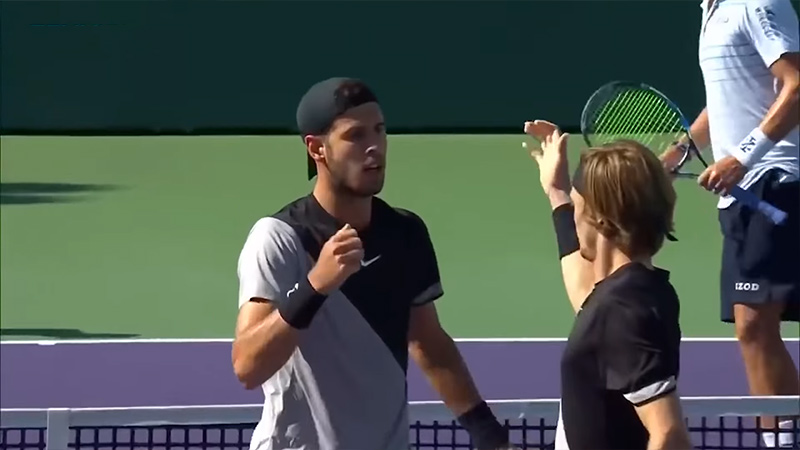
In the high-stakes environment of competitive doubles tennis, the line between strategic mastery and a technical foul is often drawn not by a racket, but by the voice.
Whether you are navigating a local club tournament or competing at a higher recreational level, understanding the verbal boundaries of the court is essential for maintaining both your competitive edge and your reputation for sportsmanship.
One of the most frequent questions from developing players centers on the legality of verbalizing mid-match: Are you allowed to talk between points in doubles tennis?
The short answer is a resounding yes. In fact, not only is it allowed, but it is also one of the most critical components of a winning partnership.
However, the nuances of when you can speak, what you can say, and how your words might be interpreted by an opponent are governed by a complex blend of official regulations and long-standing etiquette.
The Strategic Value of the “Between-Point” Huddle
Talking to your partner between points is fully permitted and serves as the heartbeat of a doubles team. This window of time is your opportunity to reset, recalibrate, and align on the next phase of play.
Between points, you are encouraged to:
- Discuss Court Positioning: Coordinating where each player will stand during the serve or return to exploit an opponent’s weakness.
- Refine Strategy: Analyzing patterns in the previous point to decide if a change in tactics—such as more frequent poaching or lobbing—is necessary.
- Offer Encouragement: Building psychological momentum is just as important as physical execution. A simple “great shot” or “we’ve got the next one” can shift the energy of a match.
While the rules are permissive between points, the complexity increases the moment the ball is in play. To dominate on the court, you must master the delicate balance of the “Moving Ball” rule.
The Legal Framework: Talking While the Ball is in Play
The distinction between a helpful teammate and a “hindrance” is defined by the direction of the ball. According to The Code, paragraph 34, there are specific restrictions that every doubles player must memorize to avoid losing unnecessary points.
1. The Directional Rule
You are legally allowed to communicate with your partner only when the ball is moving toward your side of the court.
During this phase, you are permitted to use brief, descriptive language to coordinate your defense or offense. For example, yelling “Yours!” or “Bounce it!” while a lob is descending on your side is perfectly acceptable.
2. The Hindrance Threshold
Conversely, talking when the ball is moving toward your opponent’s court is strictly prohibited. The rationale is simple: any noise made while an opponent is preparing to strike the ball can be considered a distraction.
If your speech interferes with an opponent’s ability to play the ball, they have the right to claim a hindrance. A successful hindrance claim results in you losing the point immediately.
A common mistake is hitting a weak shot and yelling “Get back!” to a partner; if this shout happens while the opponent is about to hit, they can stop play and take the point.
3. Singles vs. Doubles Standards
It is worth noting that the standards for singles and doubles are vastly different. In singles, players are generally expected to remain silent during points.
The allowance for verbal coordination is a unique feature of the doubles game, provided it adheres to the “moving toward you” requirement.
Mastering Court Vocabulary: What to Say and When
Effective communication is not just about volume; it is about using the correct terminology to ensure clarity for your partner without providing grounds for an opponent’s complaint.
The “Out” Call Controversy
One of the most common points of friction in recreational tennis involves yelling “Out!” before a ball has actually landed.
As noted in the experiences of many 3.0 and 3.5 level players, using the word “Out” prematurely is a significant breach of etiquette and a potential rule violation.
- The Risk: “Out” is a definitive officiating call. If you yell “Out” to warn your partner about a deep lob, but the ball happens to land on the line, you have technically made a false call.
- The Penalty: Under the Code, Paragraph 12, if a player calls a ball out and then realizes it was actually good, the call is reversed, and the point is awarded to the opponent—it is not replayed.
- The Solution: Instead of “Out,” use phrases like “Bounce it!” or “Watch it!”. These signals tell your partner that you suspect the ball is heading out of bounds, but they should remain prepared to play it if it stays in.
Signaling Possession: “You,” “Help,” and “Mine”
When a ball is played into a “no-man’s land” between partners, rapid-fire communication is required to prevent a collision or a missed shot.
- Yielding the Ball: If you cannot reach a ball, you must signal your partner immediately. While some players prefer the word “Help,” others find “You” or “Yours” to be more direct. The key is consistency within your partnership so that there is no ambiguity about who is responsible for the return.
- Claiming the Ball: Yelling “Mine!” is the standard way to take ownership of a shot. However, doubles is a game of quick reactions. If both partners believe they have a better play on the ball, it is not uncommon for rackets to clash.
- The Racket Clash Rule: Rule 24 states that a point is only lost if both players actually touch the ball with their rackets. If your rackets hit each other but only one person makes contact with the ball, the play is legal (USTA Comment 24.6). In many cases, both players should go for the ball rather than neither to move out of fear of interference.
Safety and Emergencies: Handling External Interruptions
Beyond strategic talk, players must also use their voices to maintain safety on the court. The most common scenario involves a ball from an adjacent court rolling into your field of play.
According to Rule 23, a ball rolling onto the court during a point constitutes a “let”. When this happens:
- Stop Play Immediately: You must alert your partner and opponents as fast as possible to prevent injury.
- Use Clear Verbal Cues: While “Let!” is the official term, yelling “Ball!” “Stop!” or “Wait!” is equally effective in the heat of the moment.
- Replay the Point: Once a let is called due to outside interference, the entire point is replayed, and the server is entitled to a first serve, even if they had previously served a fault.
Advanced Partnership Etiquette: Beyond the Rulebook
While the rules provide the skeleton of on-court behavior, etiquette provides the soul. Being a “polite” partner and opponent involves more than just following the letter of the law; it involves fostering a respectful environment that allows for competitive play.
Dealing with Critical Opponents
Occasionally, you may encounter opponents who are overly critical of your team’s communication. If an opponent complains about your partner yelling “Watch it!” on a lob, remember that as long as the ball was moving toward your side, you were within your rights.
However, keeping “Out” calls strictly for balls that have already touched the ground is the best way to avoid these disputes entirely.
Building Natural Communication
For many players, especially those new to the 3.0 or 3.5 levels, verbalizing on court feels forced or distracting. However, as skills advance, these responses become a natural extension of the game.
The goal is to reach a stage where you and your partner have a shared “shorthand” that allows you to navigate complex points with minimal confusion.
Frequently Asked Questions (FAQ)
Q: Can I talk to my partner while the opponent is hitting the ball?
A: No. You should only speak when the ball is moving toward your side of the court. Talking while the ball is moving toward the opponent’s side can be ruled a hindrance, causing you to lose the point.
Q: Is it okay to yell “Mine” even if it’s my partner’s forehand?
A: Yes. Doubles is about whoever has the best play on the ball in that specific moment. While it is good to respect “territory,” it is generally better to be aggressive and communicate “Mine” than to let a ball drop between you.
Q: What happens if I yell “Out” but the ball hits the line?
A: If you made the call, you must reverse it. The point is then awarded to your opponents. This is why it is critical to use phrases like “Watch it” or “Bounce it” instead of “Out” for balls that are still in the air.
Q: Can my partner and I talk about the score between points?
A: Absolutely. Confirming the score and discussing strategy between points is encouraged and helps ensure the match proceeds smoothly.
Communication Quick Guide
| Scenario | Allowed? | Recommended Phrase | Reason |
|---|---|---|---|
| Between Points | Yes | “Let’s try a lob next.” | Strategy and alignment. |
| Ball moving toward YOU | Yes | “Yours!” / “Bounce it!” | Coordination and warning. |
| Ball moving toward OPPONENT | No | (Silence) | Avoids hindrance penalty. |
| Stray ball on court | Yes | “Let!” / “Ball!” / “Stop!” | Essential for safety (Rule 23). |
| Ball in the air (maybe out) | No (“Out”) | “Watch it!” | Prevents a reversed call penalty. |
Conclusion: Elevating Your Game Through Dialogue
In the world of doubles tennis, your voice is a tool as powerful as your serve. By adhering to the guidelines outlined in The Code and the official rules of tennis, you protect yourself from technical errors while building a stronger, more cohesive partnership.
Remember the three pillars of court communication:
- Timing: Speak only when the ball is moving toward you or between points.
- Terminology: Use “Watch it” instead of “Out” to avoid the risk of a reversed call.
- Safety: Never hesitate to call a let if a ball from another court creates a hazard.
By mastering these verbal bounds, you ensure that your focus remains where it belongs: on the strategy, the execution, and the joy of the game.
Whether you are playing for a trophy or just for the love of the sport, clear and legal communication is the hallmark of a world-class competitor!