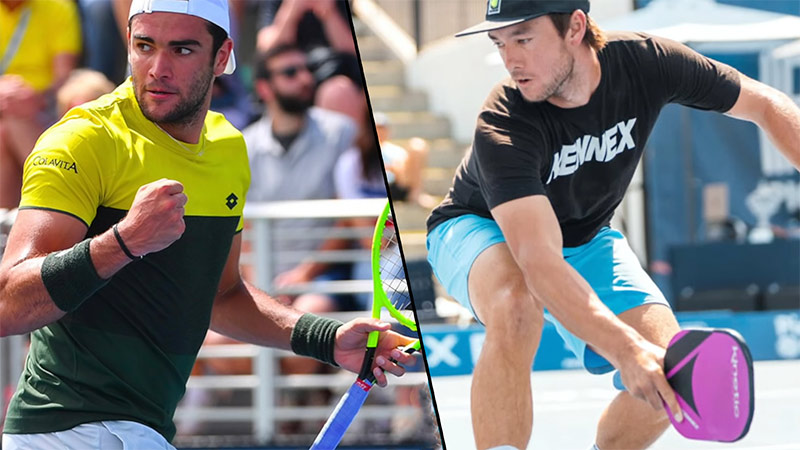
The landscape of American racket sports is undergoing a seismic shift. As community centers and private clubs across the globe reallocate resources from traditional courts to the smaller, high-intensity dimensions of pickleball, a central question has emerged among competitive circles: Are tennis players inherently better at pickleball?
The answer is nuanced. While a background in tennis provides an unparalleled technical foundation, the transition involves a rigorous process of unlearning as much as it does refinement.
For the elite athlete or the club enthusiast, understanding this transition is the difference between a frustrating plateau and competitive mastery.
The Immediate Competitive Edge
When a seasoned tennis player steps onto a pickleball court for the first time, they often appear to be playing a different game than the average beginner.
This is because their biological and technical “software” is already pre-loaded with the requirements for high-level racket sports.
1. Elite Ball Tracking and Spatial Awareness
In tennis, players spend years developing the ability to read the ball the moment it leaves an opponent’s racket. This translates directly to pickleball. Tennis players possess a refined ability to track a ball in the air and time their swings with surgical precision.
They can predict trajectories, understand the bounce of the ball, and adjust their body positioning before their opponent has even finished their follow-through.
2. The Mechanics of Spin and Control
Tennis is a game of physics. Players who understand how to manipulate a felt ball with topspin or backspin find that these skills translate effectively to the perforated plastic ball used in pickleball.
Whether it is a dipping passing shot or a biting slice, the tennis player’s existing understanding of shot-making and control allows them to dictate the tempo of the game immediately.
3. Superior Footwork and Kinetic Chain Efficiency
Tennis requires explosive lateral movement and precise recovery to the center of the court. These athletes are already accustomed to moving quickly and finding the “right position” to execute a strike.
While the pickleball court is smaller, the requirement for balanced, efficient footwork remains. A tennis player’s ability to use their legs to generate power and stability gives them a physical advantage that few other “crossover” athletes can match.
The “Roadblock” – Why Power Has a Ceiling
Despite an explosive start, many tennis players find themselves hitting a developmental wall within three to six months of play.
This “roadblock” usually occurs when they begin competing against experienced pickleball specialists who may not have the same athletic pedigree but possess a deeper understanding of the game’s unique geometry.
The “Kitchen” Trap
The most significant hurdle for any tennis player is the Non-Volley Zone, colloquially known as “the kitchen.” In tennis, the baseline is a place of power and safety.
In pickleball, staying at the baseline is a tactical error. Experienced opponents will force a tennis player to engage in a slow, soft, and highly strategic game called “dinking” near the net.
For a player used to ending points with a 90-mph groundstroke, the patience required to “dink” until an opening appears can be mentally and strategically taxing.
The Problem of Over-Hitting
The dimensions of a pickleball court are significantly smaller than a standard tennis court. A common mistake for the transitioning athlete is applying the same swing speed and follow-through they would use on a baseline drive in tennis.
This almost inevitably causes the ball to fly out of bounds. The tennis player must learn to shorten their backswing and prioritize placement over raw velocity.
Audience Profiling – Who is Making the Move?
To understand the growth of this sport, we must look at the personas driving the transition.
The Competitive Optimizer
This individual is typically 35–55, formerly played collegiate or high-level club tennis, and is looking for a sport that offers the same competitive “fix” but with a shorter time commitment. Their pain point is the “unlearning” of the full-swing mechanic.
The Longevity Athlete
Often 60+, these players are transitioning to pickleball to reduce the wear and tear on their joints. The smaller court requires less sprinting, but their tennis-honed “hands” at the net make them formidable opponents in doubles play.
The Strategic Roadmap to Mastery
To move from a “tennis player playing pickleball” to a “pickleball player,” athletes must master three specific technical shifts.
1. The Third Shot Drop
While the “drive” is a staple for tennis players, the “Third Shot Drop” is the most important shot in pickleball.
This is a soft, lofted shot hit from the baseline that lands in the opponent’s kitchen, allowing the serving team to move forward to the net safely. Mastering this requires a level of touch that contradicts the “smash” instinct.
2. Resetting the Point
Tennis players are coached to be aggressive on any ball that feels attackable. In pickleball, being overly aggressive on a low ball often leads to a counter-attack. Learning to “reset” a fast ball by softly neutralizing it back into the kitchen is a hallmark of an elite player.
3. The Shortened Backswing
In tennis, a long, loopy backswing creates power. In pickleball, where the ball comes back much faster due to the proximity of the players, a long backswing is a liability. The “compact” game is the winning game.
Performance Data and the Economic Shift
From a broader perspective, the influx of tennis players into pickleball is driving a massive surge in the sports equipment market.
Leading manufacturers who once focused solely on strings and rackets are now pivoting to carbon-fiber paddles and specialized footwear.
The “tennis advantage” has created a premium market for high-performance paddles that mimic the “feel” of a tennis racket.
These paddles often feature longer handles for two-handed backhands and surface grits designed to maximize the topspin that tennis players naturally produce.
Frequently Asked Questions
Is pickleball easier than tennis?
Physically, the court is smaller, which may be less taxing on the cardiovascular system. However, the strategic depth and the speed of volleys at the kitchen line require a different kind of mental and reflexive intensity.
Why do I keep hitting the ball out?
You are likely “over-hitting”. Because the pickleball court is much shorter than a tennis court, you must reduce your power by 20–30% and focus on a more upward trajectory for your groundstrokes.
How long does it take for a tennis player to become a top-tier pickleball player?
With consistent play, a high-level tennis player can often reach a 4.0 or 4.5 rating (advanced) within months. However, reaching the professional level (5.0+) requires mastering the soft game and the “dinking” strategies that are not present in tennis.
Conclusion: The Bottom Line for the Tennis Athlete
The evidence is clear: tennis players do have a massive head start. Their coordination, footwork, and understanding of the ball’s flight path give them an immediate edge over the general population.
However, the “Bottom Line” is that the very skills that make you great at tennis—the big serves, the heavy baseline drives, and the aggressive smashes—can become your greatest weaknesses if you do not adapt.
The most successful players are those who can marry their tennis-born athleticism with the strategic patience of the pickleball “soft game.”
Whether you are playing for fitness, social connection, or the thrill of competition, the transition to pickleball is not just a change of court—it is an evolution of your athletic identity.