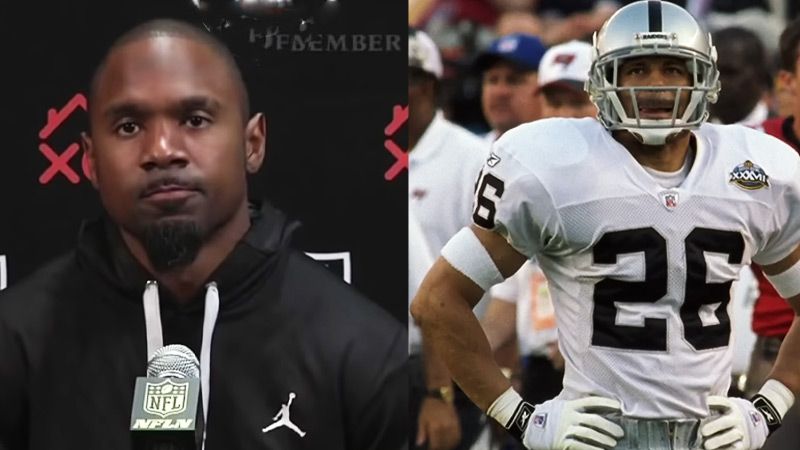
In the storied history of the National Football League, certain names carry a weight that transcends the back of a jersey.
They become synonymous with a specific style of play, a level of tenacity, and an era of dominance. Perhaps no name in the modern era of defensive football carries more prestige than “Woodson.”
For over three decades, the name sat atop leaderboards, appeared in consecutive Pro Bowl rosters, and was etched into the bronze busts of Canton, Ohio.
However, the sheer excellence associated with the name has led to one of the most persistent questions in sports history: Are Rod and Charles Woodson related?
For fans who watched Rod Woodson redefine the cornerback position in the late 1980s and 1990s, followed immediately by Charles Woodson’s arrival as a Heisman-winning phenom in 1998, the connection seemed obvious.
They shared the same surname, played the same defensive back positions, and eventually both donned the iconic Silver and Black of the Raiders franchise.
Despite these uncanny parallels, the reality of their lineage is quite different from what many enthusiasts assume.
The Definitive Answer: A Parallel of Talent, Not Blood
To address the central inquiry with absolute clarity: Rod Woodson and Charles Woodson are not related. Despite their shared last name and remarkably similar career trajectories, they possess no blood relation whatsoever.
The confusion is understandable given the statistical anomalies that link the two. In a league where talent is often concentrated in families—think of the Mannings, the Kelces, or the Watts—it feels natural to assume that two of the greatest defensive backs to ever play the game must share a genetic foundation.
This narrative was furthered by media figures and broadcasters who, during the height of their overlapping legacies, would occasionally joke about the two being “cousins” during live broadcasts.
While these comments were made in jest to highlight their shared greatness, they inadvertently planted a seed of misinformation that persists in the digital age.
The truth is that the “Woodson Dynasty” is a product of individual brilliance and an extraordinary historical coincidence.
The Hall of Fame Blueprint: Two Careers, One Standard
While they do not share a family tree, Rod and Charles Woodson share a professional resume that is almost indistinguishable in its excellence.
Both men are enshrined in the Pro Football Hall of Fame, a distinction reserved for the top fraction of one percent of those who have ever played the game.
The Pioneer: Rod Woodson
Rod Woodson entered the NFL in 1987 as a world-class athlete out of Purdue. Known for his Olympic-level hurdles speed and a physical playing style that intimidated wide receivers, Rod became the gold standard for the “shutdown corner.” Over a 17-season career, he didn’t just play the position; he evolved it.
As he aged, Rod made a successful transition from cornerback to safety, a move that requires an elite understanding of the game’s geometry.
This transition allowed him to extend his career and continue his ball-hawking ways well into his late 30s. His ability to read quarterbacks and jump routes became legendary, setting the stage for the next great namesake to follow.
The Prodigy: Charles Woodson
In 1998, as Rod was entering the veteran stage of his career, Charles Woodson entered the league with a level of hype rarely seen for a defensive player.
Having won the Heisman Trophy at the University of Michigan—the only primarily defensive player to ever do so—Charles arrived in Oakland with immense expectations.
Charles mirrored Rod’s career in almost every qualitative way. He possessed the same instinctive ability to find the football, the same physical toughness in the run game, and eventually, the same longevity.
Like Rod, Charles also successfully transitioned from a lockdown corner to a high-impact safety later in his career, maintaining his relevance and dominance across two different decades.
The Statistical Mirror: Why the Confusion Persists
The reason the “related” myth continues to circulate isn’t just about the name; it’s about the numbers. It is rare for two players to share a surname and be good; it is statistically staggering for them to be identical in their impact.
According to historical records and career data, both Rod and Charles Woodson are tied for some of the most elite defensive records in NFL history. Specifically, they share a uncanny knack for the “defensive touchdown” and high-volume turnovers.
When a fan looks at the list of all-time leaders in interceptions returned for touchdowns (pick-sixes), both names appear at the very top.
This shared ability to not only take the ball away but to transform into a scoring threat the moment the ball touched their hands is the hallmark of the Woodson name.
They were both star defensive backs who played with the mindset of an offensive playmaker.
The Raiders Connection: A Shared Home
Another significant factor contributing to the public’s confusion is their shared tenure with the Raiders franchise.
Both Rod and Charles Woodson spent significant and productive portions of their careers playing for the Las Vegas (formerly Oakland) Raiders.
For a period in the early 2000s, the Raiders’ secondary was anchored by these two legends. Seeing “Woodson” and “Woodson” on the same depth chart, playing the same positions, and wearing the same jersey colors solidified the idea of a family connection in the minds of the Raiders’ “Silver and Black” faithful. It felt less like a coincidence and more like a calculated acquisition of a family’s defensive heritage.
Enhanced FAQ
Q: Did Rod and Charles Woodson ever play on the same team?
Yes. During the 2002 and 2003 seasons, both Rod and Charles Woodson were members of the Oakland Raiders. This overlap is a primary reason why many fans assume they are father and son or cousins, as they occupied the same defensive backfield simultaneously.
Q: Are there any other famous Woodsons in the NFL?
While Rod and Charles are the most prominent, the name Woodson has appeared elsewhere. Darren Woodson, for instance, was a legendary safety for the Dallas Cowboys and is also a member of the Ring of Honor.
Like Rod and Charles, Darren Woodson is also unrelated to the other two, further proving that the name “Woodson” simply seems to attract elite defensive talent.
Q: What specific records do they share?
Both players are among the all-time leaders in career interceptions and defensive touchdowns. Their ability to score points from the defensive side of the ball is what truly separates them from other Hall of Fame defensive backs.
Q: Why did broadcasters call them cousins?
During live games, commentators often use shorthand or humor to describe the chemistry between teammates. Because they played so similarly and shared a name, calling them “The Woodson Cousins” was a way to acknowledge their joint dominance on the field, even though it was factually incorrect.
Conclusion: A Dynasty of Excellence
In the final analysis, the story of Rod and Charles Woodson is a testament to the idea that greatness does not always require a shared bloodline. While they are not related by birth, they are brothers in arms within the pantheon of football history.
They redefined what it meant to be a defensive back, proving that a cornerback or safety could be just as much of a “game-changer” as a quarterback or a star running back.
Their shared history with the Raiders and their mirrored statistical achievements created a narrative so compelling that the truth—that they are simply two unrelated men with the same name—almost feels less interesting than the myth.
However, recognizing them as individuals actually enhances their legacy. It suggests that the “Woodson” standard wasn’t just a matter of genetics, but a matter of two separate athletes pushing the boundaries of their craft until they met at the pinnacle of the sport.
They remain the gold standard for defensive excellence, proving that while you can’t inherit a name’s greatness, you can certainly earn it.