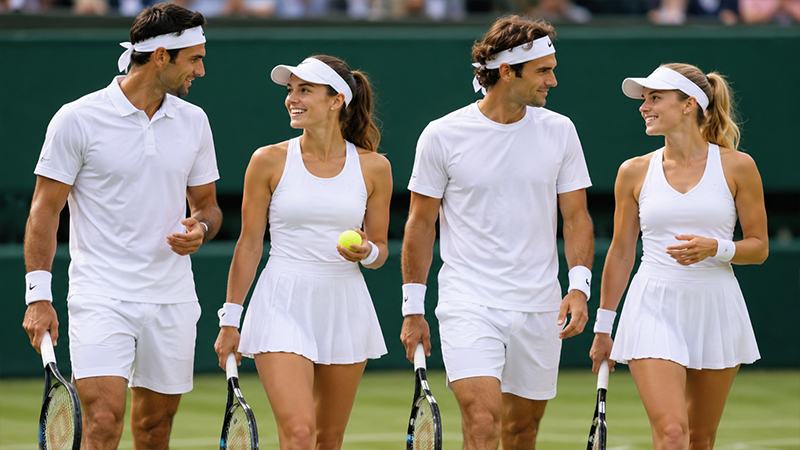
The visual landscape of a modern Grand Slam tournament often presents a striking paradox. While tennis is one of the most individualistic sports in the world, the athletes on court frequently appear as part of a synchronized corporate fleet.
Fans watching the Australian Open or Roland Garros often remark on the “sea of salmon” or “monochrome waves” where dozens of different players compete in identical color palettes and patterns.
This phenomenon is not a lack of imagination by designers; it is a calculated execution of global marketing strategy and a fundamental component of the professional tennis economy.
To understand why elite athletes would compromise their visual identity for a shared kit, we must look at the intersection of retail psychology, contractual mandates, and the harsh financial realities of the professional tour.
The Corporate Architecture of “Team Kits”
Professional tennis operates on a “collection” model. Major manufacturers like Nike, Adidas, and Lacoste do not design individual outfits for every athlete they sign.
Instead, they produce a seasonal line—often referred to as a “team kit”—that is distributed across their entire roster of sponsored athletes.
The Billboard Effect: Repetitive Exposure
From a branding perspective, uniformity is about frequency. In marketing, the “rule of seven” suggests a consumer needs to see a brand or product multiple times before it registers.
By dressing thirty players in the same “hot lava” or “salmon” kit, a brand ensures that every time a viewer switches channels or scrolls through social media, they see the same product.
If a brand were to provide a unique design for a player who loses in the first round, that design receives almost zero return on investment.
However, if fifty players wear the same kit, the brand is guaranteed visibility from the opening match through to the finals.
| Marketing Objective | Strategic Implementation | Consumer Outcome |
|---|---|---|
| Brand Saturation | Massive roster wearing identical seasonal colors. | High recall of the specific product line. |
| Retail Efficiency | Production of 2-3 variants (light/dark) per season. | Reduced manufacturing costs and clearer retail focus. |
| Identity Association | Linking a specific “look” to the tournament’s energy. | Fans associate the color with the event (e.g., “The Paris Look”). |
| Risk Mitigation | Distributing the kit across many players. | Protection against early-round upsets of star athletes. |
The Economic Divide: Who Gets to Be Different?
While the “rank-and-file” players are mandated to wear the team kit, a tiny percentage of the elite are granted the privilege of bespoke or signature lines. This creates a visible hierarchy on the tour.
- The Signature Elite: Icons such as Roger Federer, Rafael Nadal, and Serena Williams have historically commanded enough market power to have their own unique clothing lines. These designs are exclusive to them and are often built around a personal brand logo (like Federer’s “RF” or Nadal’s “Raging Bull”).
- The Marketing Rationale: These players have fanbases large enough to sell a unique line without needing ten other players to advertise it.
- The “Next Gen” and Middle Tier: Even high-ranking players who have not yet reached “legend” status are typically placed in the team kits to build broader brand awareness for the commercial line.
The Financial Survival of the Professional Player
To the casual observer, it might seem “uninspired” or even “weird” for a top-50 player to wear the same outfit as their opponent. However, for the majority of professional tennis players, these clothing contracts are not about fashion—they are about financial solvency.
The Financial Burden of the Tour: Outside of the elite top 20, the costs of being a professional tennis player can be astronomical. Players are responsible for:
- International Travel: Constant flights for themselves and their team (coach, physio).
- Coaching Salaries: Paying a full-time professional coach and often a fitness trainer.
- Accommodation: Hotels for roughly 30 to 40 weeks a year.
- Medical Expenses: High-level physiotherapy and injury rehabilitation.
Many players outside the top 50 would actually operate at a negative income if it were not for their clothing and equipment sponsorships.
For these athletes, the sponsorship check is the “lifeline” that allows them to continue their careers.
As a professional career typically ends between the ages of 30 and 35, athletes are under immense pressure to maximize every revenue stream possible while they are still competitive.
Accepting a “uniform” kit is a small price to pay for the financial security provided by a major corporate partner.
Retail Psychology and the “Consumer Surplus”
There is a sophisticated psychological element to why brands want players in the same gear. It involves creating a “relatable” product for the recreational player.
Creating the “Melbourne” or “New York” Memory: When a fan sees a specific shirt on every court for two weeks, that garment becomes synonymous with the tournament itself.
One interesting theory is that this creates a “consumer surplus”—the satisfaction a fan feels when they can relate to an outfit.
For example, a fan might walk into a retail store and think, “That is the shirt Federer wore when he won the 2017 Australian Open”.
This emotional connection drives sales far more effectively than a fragmented strategy where every player wears something different. The shirt becomes an identifiable “artifact” of a specific moment in sports history.
Tournament Regulations and Constraints
Beyond corporate strategy, certain external factors force a level of uniformity that players and brands cannot avoid.
1. The Wimbledon Tradition
The most famous example of forced uniformity is Wimbledon’s strict “all-white” dress code. This regulation is so thorough that even off-white or cream are prohibited, and there are limits on the size of brand logos and color accents.
This effectively levels the playing field for fashion, making it nearly impossible for a brand to stand out visually through color.
2. Day and Night Variations
Most Grand Slams utilize a “day” and “night” kit strategy. Typically, brands will provide their roster with a lighter version for the heat of the day and a darker or more “electric” version for night sessions under the lights.
While this offers some variety, it still results in dozens of players wearing the exact same two variants throughout a fortnight.
3. Superstition and Routine
Tennis is a sport of extreme psychological margins. Many players are notoriously superstitious and will refuse to change a kit if they are on a winning streak.
This can lead to a player wearing the same shirt—sometimes even the same physical garment, washed daily—throughout a seven-match run to a title.
The “Rebel” Outliers: Individual Expression in a Corporate World
Despite the dominance of the major brands, some players find ways to break the mold. Fabio Fognini is an example of a player who often wears non-traditional, “angsy” designs, such as those from the brand Hydrogen (featuring skull logos), which stand out against the more corporate looks of Nike or Adidas.
However, these outliers are rare. Most brands have found that “mixing it up” with different colors for different players—while a popular suggestion among fans—is simply not as cost-effective as the unified “billboard” approach.
Strategic Summary: The “Why” Behind the Uniform
| Factor | Description |
|---|---|
| Production Costs | It is significantly cheaper to mass-produce three designs for 100 players than 100 unique designs. |
| Contractual Obligations | Players sign away their fashion autonomy in exchange for guaranteed six or seven-figure checks. |
| Media Impact | Repetitive imagery across televised courts creates a stronger brand association for the consumer. |
| Career Longevity | Players must prioritize guaranteed sponsorship income over personal style to fund their travel and coaching. |
Conclusion: The Future of Court Fashion
The “uniformity” of tennis is a direct reflection of the sport’s evolution into a high-stakes global business. While fans may occasionally find the lack of variety “uninspired” or even “hurting their eyes,” the strategy is undeniably effective from a commercial standpoint.
By treating the tennis court as a premium advertising space and the athletes as brand ambassadors, manufacturers have created a self-sustaining cycle.
The revenue from the “salmon shirt” you see on twenty different players eventually trickles down to fund the coaches, trainers, and travel that make the professional tour possible for the next generation of stars.
As long as the “billboard” model remains more profitable than individual expression, the sea of identical kits will remain a staple of the Grand Slam experience.