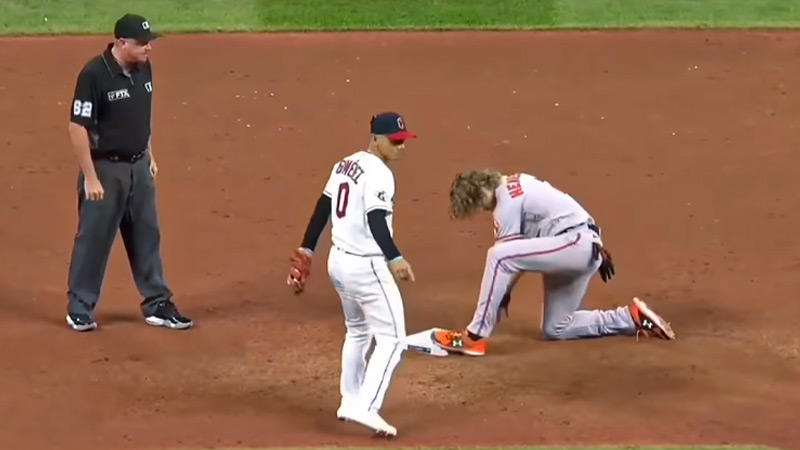
In the world of baseball statistics, the successful stolen base (SB) is often celebrated as a pure act of athletic daring and strategic advantage.
However, modern, data-driven analysis dictates that the simple count of successful steals is insufficient for measuring a player’s true contribution to run scoring.
To accurately assess the value (or harm) a player introduces on the base paths, we must move beyond vanity metrics and focus intensely on the Stolen Base Percentage (SB%).
Stolen Base Percentage is a foundational baseball statistic that quantifies a player’s rate of success when attempting to steal bases.
This seemingly simple metric holds the key to differentiating an elite base runner from a statistically detrimental risk-taker.
This in-depth analysis will serve as a definitive guide, dissecting the SB% calculation, establishing the crucial break-even point, and introducing the advanced metric, Stolen Base Runs (SBR), which reveals the surprisingly low contribution of most base-stealing attempts to overall offensive production.
Traditional Insight: Calculation and Definitions of SB%
Stolen Base Percentage (also referred to as “stealing percentage” or “steal percentage” in common usage) acts as a straightforward barometer of success, integrating both positive and negative outcomes of base-stealing attempts.
The Mathematical Foundation
The calculation for Stolen Base Percentage involves dividing the total number of successful stolen bases (SB) by the total number of base-stealing attempts (which equals the sum of stolen bases and times caught stealing, CS):
$$ SB% = \frac{SB}{SB+CS} $$
A player’s SB% is an essential tool for evaluation because those who lead the league in total successful stolen bases often simultaneously accumulate a high number of times thrown out, thus diminishing their net value.
The Counterpoint: Caught Stealing (CS)
While SB is the numerator, the denominator introduces Caught Stealing (CS)—the statistical penalty. The concept of SB% exists specifically because the negative impact of CS is statistically far greater than the positive impact of SB.
The Statistical Gap: Quantifying Harm Versus Help on the Base Paths
A common intuition in baseball suggests that gaining a base is inherently good, and losing a base is bad. While true, sabermetric analysis has demonstrated a significant asymmetry: a caught stealing is generally much more harmful to a team’s run production than a successful stolen base is helpful. This insight is the crucial gap that SB% seeks to bridge.
Establishing the Crucial Break-Even Point
Due to the disproportionate negative impact of being thrown out, a player must maintain a considerably high success rate just to avoid hurting the team.
If an attempt to steal is statistically neutral—meaning it neither helps nor hurts the total runs scored—it has reached the break-even success rate.
Based on numerous statistical studies, particularly those conducted by Total Baseball, the data indicates that the break-even success rate for stolen bases is approximately 67%, or roughly two-thirds of the time.
The Management Benchmark: 75% Success
To provide true offensive value, a base stealer must exceed the break-even threshold. In established baseball circles, a generally accepted rule of thumb is that a base stealer must maintain an SB% of 75% or higher to be consistently helping his team by attempting to steal.
Any attempt below this 75% mark introduces a progressively higher degree of statistical risk that outweighs the potential reward.
Advanced Metrics: The True Quantification of Base-Stealing Impact
To precisely estimate the quantifiable impact of base-stealing beyond a simple percentage, Total Baseball developed an advanced related statistic: Stolen Base Runs (SBR).
Introducing Stolen Base Runs (SBR)
SBR is designed specifically to translate base-stealing activities (SB and CS) into estimated run value. The core insight derived from SBR analysis is that each successful steal adds only about 0.3 runs to a team’s total runs scored, which is substantially less than often perceived by traditional observers.
The formula for Stolen Base Runs powerfully illustrates the imbalance between success and failure:
$$ SBR = (0.3 \times \text{Stolen Bases}) – (0.6 \times \text{Caught Stealing}) $$
Interpreting the SBR Weights
The weights assigned in the SBR formula—a positive multiplier of 0.3 for SB and a negative multiplier of 0.6 for CS—directly confirms the foundational statistical finding: a player being caught stealing is approximately twice as detrimental to run expectancy as a successful steal is beneficial.
This rigorous statistical framework underscores why, aside from the most elite performers, the annual impact of base-stealing rarely amounts to more than a few runs per team.
Player Evaluation and Strategic Implications
The SB% metric is crucial for defining base-stealing latitude and informs both in-game strategy and personnel decisions.
Situational Awareness Over Raw Speed
It is a statistical truth that players who do not possess “great speed” or high raw stolen base totals can still achieve elevated stolen-base percentages.
This achievement is generally a direct result of a superior understanding of game situations and possessing the judgment to know precisely when it is a good time to take the risk.
High SB% is often less about innate physical speed and more about calculated risk management and high Baseball IQ.
The Elite Standard
The historical standard for base-stealing success demonstrates that only a rarefied group of players consistently maintain the requisite efficiency over a long career:
Rank | Player | Career SB% | Context | Source |
|---|---|---|---|---|
1 | Carlos Beltrán | .864 | Highest career SB% (Minimum 300 attempts) |
|
2 | Tim Raines | .847 | Second highest career SB% (Minimum 300 attempts) |
|
These percentages far exceed the 75% benchmark, solidifying their reputation as base-stealing savants who consistently created positive run value rather than offsetting their gains with unnecessary outs.
Consequences for Player Management and Fantasy Value
Team strategy is directly linked to a player’s SB%.
Low SB% Consequences: A player exhibiting a low stolen-base percentage will likely be asked by team management to attempt fewer steals, recognizing the statistical harm. For fantasy baseball purposes, this results in a reduction of stolen base opportunities, hurting the player’s overall fantasy value.
High SB% Latitude: Conversely, a player who maintains a high stolen-base percentage—provided they remain active on the bases—will typically be granted more latitude or freedom to attempt steals in future opportunities by coaching staff. This latitude translates directly into increased statistical opportunity and enhanced real-world and fantasy performance potential.
Conclusion: SB% as the Ultimate Measure of Base-Running Discipline
The Stolen Base Percentage is far more than a simple descriptive statistic; it is a critical analytical tool that exposes the severe statistical cost of poor judgment on the base paths.
For teams committed to data-driven decision-making, the message is clear: raw stolen base totals are a distraction.
Focus must be placed on the successful deployment of base-stealing attempts above the 75% efficiency threshold to ensure a positive contribution to overall run expectancy.
By utilizing SB% and its advanced derivative, SBR, organizations can accurately predict and manage the net run impact of their base-running activities, ensuring that speed is deployed as a strategic weapon, not a statistical liability.