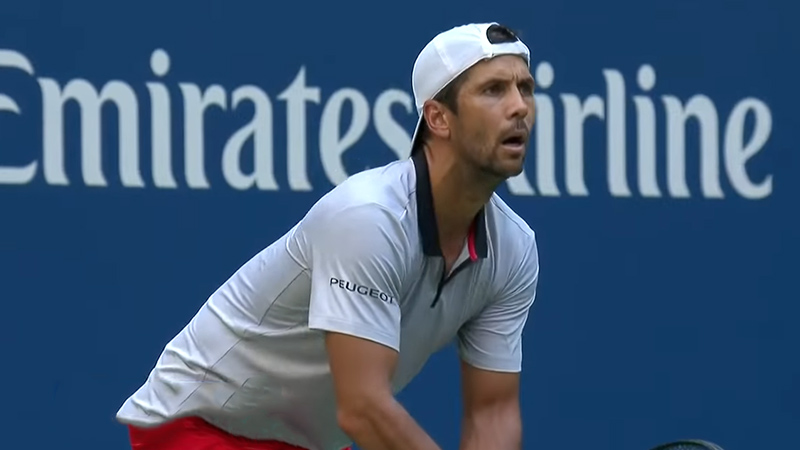
Fernando Verdasco was an exceptionally high-caliber professional tennis player, reaching career highs of World No. 7 in singles and World No. 8 in doubles.
Over a career spanning more than two decades, he secured 15 ATP titles, including a prestigious season-ending doubles championship in 2013.
Known as the “Iron Man” for his record 67 consecutive Grand Slam appearances, his explosive left-handed forehand and elite physicality allowed him to compete against the greatest legends in history.
While a Grand Slam title eluded him, his 559 singles wins cement his status as a truly elite athlete.
Analyzing the Career Statistics of Fernando Verdasco
To understand if a player is truly “good,” one must look at the objective data accumulated over decades of high-level competition.
Verdasco’s resume is one of the most robust in the modern era, characterized by high-volume winning and financial success that places him among the top earners in the sport’s history.
| Statistical Category | Singles Achievement | Doubles Achievement |
|---|---|---|
| Career Victories | 559 Wins | 307 Wins |
| Win Percentage | 55.6% | 55.3% |
| ATP Titles | 7 Titles | 8 Titles |
| Finals Reached | 23 Finals | 13 Finals |
| Career High Rank | World No. 7 | World No. 8 |
| Total Prize Money | $18,368,908 | Combined Total |
The Consistency of an Elite Performer
Verdasco’s ability to maintain a winning record in both singles and doubles is a rarity on the ATP Tour. His 559 singles wins put him in an exclusive club of players who have remained competitive well into their late 30s.
This longevity is not merely a matter of showing up; it reflects a consistent ability to defeat high-ranking opponents across different surfaces, including clay, hard, and grass.
Financial and Title Milestones
With over $18 million in career prize money, Verdasco’s financial success mirrors his on-court production. His 15 total titles are distributed across major global cities, showing he was a threat in any environment.
Notably, his success in doubles, particularly winning the 2013 ATP World Tour Finals in London, demonstrates a tactical versatility that many singles specialists lack.
What Made Fernando Verdasco’s Forehand So Special?
The centerpiece of Verdasco’s game was undoubtedly his left-handed forehand. It was often cited by commentators and peers as one of the most dangerous weapons on the circuit, capable of ending points from defensive positions with sheer velocity and heavy rotation.
The Straight-Arm Technical Innovation
Technically, Verdasco utilized a rare straight-arm hitting technique at the point of contact. This biomechanical approach allowed him to create a massive lever, generating incredible whip and pace.
While most players use a bent-elbow “double-bend” technique for more control, Verdasco’s straight-arm style gave him a unique advantage in terms of raw power, making his ball exceptionally difficult to return when he was in rhythm.
Heavy Topspin and Baseline Dominance
Beyond just speed, Verdasco’s forehand was characterized by heavy topspin. This allowed the ball to dive into the court at the last second, pushing opponents deep behind the baseline.
This aggressive baseline style was his primary identity, allowing him to dictate play against almost any opponent. However, the high-risk nature of this shot was a double-edged sword; when his timing was off, it could lead to high unforced error counts.
The “Iron Man” of Professional Tennis
Longevity is often the ultimate metric of a player’s quality. In an era where physical demands have reached all-time highs, Verdasco’s ability to remain healthy and eligible for the world’s biggest stages for nearly twenty years is a historic achievement.
A Historic Grand Slam Streak
Verdasco earned the “Iron Man” nickname by appearing in 67 consecutive Grand Slam main draws between 2003 and 2020. This streak is a testament to his supreme athletic fitness and professional discipline.
To play in every major tournament for 17 straight years requires not just talent, but an elite level of physical conditioning and injury prevention that few in history have matched.
Physical Conditioning and Stamina
His reputation for physical fitness was built on his performance in grueling, five-set marathons. Verdasco possessed incredible lung capacity and stamina, which allowed him to survive and thrive in matches lasting over four or five hours.
This physicality was the engine that powered his heavy baseline game, ensuring that he rarely “faded” physically, even if his mental consistency occasionally wavered.
How Good Was Verdasco Against the Big Four?
The true measure of a player in the 21st century is how they fared against the legendary quartet of Roger Federer, Rafael Nadal, Novak Djokovic, and Andy Murray.
While Verdasco never reached their heights in terms of major titles, he was one of the few players who could legitimately threaten them on a consistent basis.
The Competitive Record Against Legends
Verdasco played in the most competitive era in men’s tennis history. While his head-to-head records against the “Big Three” are lopsided, the fact that he secured multiple wins against Djokovic and Nadal is significant.
- vs. Novak Djokovic: 4 wins – 11 losses. He defeated Djokovic at major events like the 2006 US Open and back-to-back Masters 1000 events on clay in 2010.
- vs. Rafael Nadal: 3 wins – 17 losses. He claimed victories over the “King of Clay” on various surfaces, including a win in Madrid in 2012 and a thrilling upset at the 2016 Australian Open.
- vs. Andy Murray: 4 wins – 13 losses.
- vs. Roger Federer: 0 wins – 7 losses. Federer remained the only titan Verdasco could never overcome.
The 2009 Australian Open Masterpiece
Verdasco’s peak performance is widely considered to be the 2009 Australian Open semifinal against Rafael Nadal. The match lasted 5 hours and 14 minutes and is frequently cited as one of the greatest tennis matches ever played.
Although Verdasco narrowly lost (6-7, 6-4, 7-6, 6-7, 4-6), his level of play during that tournament was considered “Top 1” quality, proving that at his absolute best, he was as good as anyone to ever pick up a racket.
Verdasco’s Impact on Spanish Tennis History
While his individual career was stellar, Verdasco’s legacy is also deeply tied to his contributions to his country. In Spain, a nation with a rich tennis pedigree, Verdasco is regarded as a national hero for his performances in team competitions.
Three-Time Davis Cup Champion
Verdasco was a cornerstone of the Spanish national team, helping them secure Davis Cup titles in 2008, 2009, and 2011. His most famous contribution came in the 2008 final against Argentina.
Playing in a hostile away environment, Verdasco won the deciding, high-pressure match to clinch the trophy for Spain. This “clutch” gene defined his international career, where he amassed 29 total wins for his country.
Success as a Doubles Specialist
His ability to adapt his game for doubles was a major asset for Spain and his own professional standing. Reaching World No. 8 in doubles and winning 8 titles shows a high level of tactical intelligence.
His victory at the 2013 ATP World Tour Finals alongside David Marrero, where they defeated the legendary Bryan brothers, remains one of the high points of his career, proving he could excel at the highest level of team-based tennis.
Frequently Asked Questions About Fernando Verdasco
Why did Fernando Verdasco never win a Grand Slam?
Despite his immense talent, Verdasco played during the peak of the Federer-Nadal-Djokovic era.
His high-risk playing style, while effective for upsets, often led to mental consistency issues and unforced errors that made it difficult to win seven consecutive matches at a major. His best chance came in 2009, where he fell just short against Nadal in the semifinals.
When did Fernando Verdasco retire?
Verdasco officially retired from professional tennis in February 2025. His final appearance took place at the Qatar ExxonMobil Open in Doha, where he chose to conclude his journey on the ATP Tour playing doubles alongside his longtime contemporary, Novak Djokovic.
What is Verdasco’s background and personal life?
Born in Madrid in 1983, Verdasco began playing at age four on the hard courts at his family home. His parents owned traditional restaurants in Madrid, providing a stable foundation for his career.
He is married to Ana Boyer, and they have two sons, Miguel and Mateo. Throughout his life, he has remained a passionate supporter of the Real Madrid football club.
The Final Verdict: How Good Was He?
Fernando Verdasco was much more than just a “good” player; he was an elite competitor who defined a generation of Spanish tennis. His career-high ranking of World No. 7 and his 15 combined titles only tell part of the story.
The true measure of his quality lies in his 67 consecutive Grand Slam appearances and his ability to push the greatest players in history to their absolute limits.
He possessed one of the most feared forehands in the game and a level of physical conditioning that made him a nightmare opponent in five-set matches.
While the lack of a singles Grand Slam title might keep him out of the “all-time great” conversation, his status as a Davis Cup legend and an ATP Tour fixture for two decades ensures his place in tennis history is secure.
For those who value longevity, power, and the ability to perform under the highest pressure, Fernando Verdasco remains a gold standard of professional excellence.