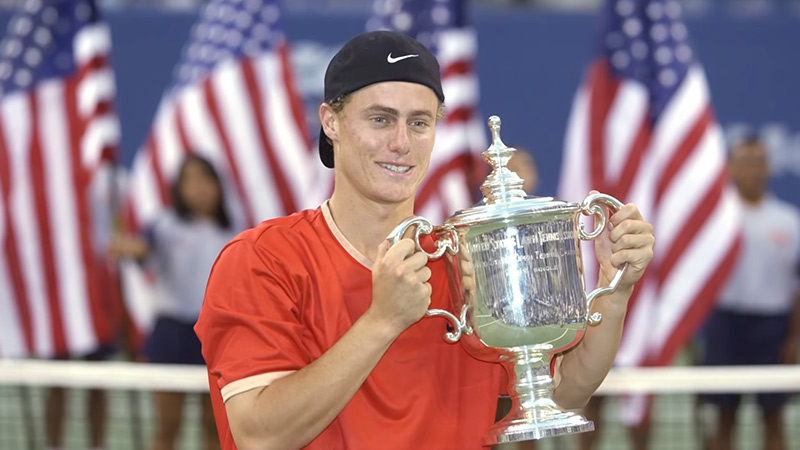
Lleyton Hewitt won three Grand Slam titles during his illustrious professional career, consisting of two singles championships and one men’s doubles title.
His singles victories occurred at the 2001 US Open and the 2002 Wimbledon Championships, while his doubles triumph came at the 2000 US Open.
Hewitt’s ascent to the top of the sport was historic; in 2001, he became the youngest male player ever to reach the World No. 1 ranking at just 20 years of age.
Beyond his titles, Hewitt reached two additional major singles finals and displayed remarkable longevity across two decades.
Summary of Lleyton Hewitt’s Grand Slam Championships
To understand the magnitude of Lleyton Hewitt’s career, one must look at the specific years and divisions where he secured his major trophies. He was a force on both grass and hard courts, proving his versatility early in his tenure on the professional tour.
| Year | Tournament | Division | Opponent / Partner | Final Score |
|---|---|---|---|---|
| 2000 | US Open | Men’s Doubles | Max Mirnyi (Partner) | 6–4, 5–7, 7–6(7–5) |
| 2001 | US Open | Men’s Singles | Pete Sampras | 7–6(7–4), 6–1, 6–1 |
| 2002 | Wimbledon | Men’s Singles | David Nalbandian | 6–1, 6–3, 6–2 |
The 2001 US Open: A Changing of the Guard in Tennis
The 2001 US Open remains one of the most significant moments in modern tennis history, marking the arrival of a new generation led by the tenacious Australian.
Hewitt entered the tournament with rising momentum, eventually reaching the final to face one of the greatest players of all time.
The Final Victory Over Pete Sampras
In the championship match, Hewitt faced the legendary Pete Sampras, a player known for his dominant serve-and-volley style. Hewitt dismantled the American veteran in straight sets with a scoreline of 7–6, 6–1, 6–1.
This victory was not just a personal milestone but a tactical masterclass in baseline counter-punching. By neutralizing Sampras’s weapons, Hewitt secured his maiden singles Grand Slam and sent a message to the rest of the tour that a new era had begun.
The Path to Becoming the Youngest World No. 1
This specific Grand Slam victory was the primary catalyst for Hewitt’s ascent in the international rankings. Shortly after his triumph in New York, he became the youngest male player in history to reach the World No. 1 spot at the age of 20.
His success at the 2001 US Open followed a strong performance the previous year, where he had reached the semifinals in singles and won the doubles title. This period of dominance established him as the premier player of the early 2000s.
Wimbledon 2002: Dominance on the Grass of London
Hewitt’s success was not limited to hard courts, as he quickly transitioned his gritty style to the faster grass courts of the All England Club.
His performance during the 2002 Wimbledon fortnight is often cited as one of the most efficient runs to a title in the tournament’s history.
The Clinical Final Against David Nalbandian
In the 2002 Wimbledon final, Hewitt faced Argentina’s David Nalbandian in a match that highlighted the Australian’s superior movement and return game. Hewitt dominated the encounter from start to finish, winning in straight sets: 6–1, 6–3, 6–2.
The match was a testament to Hewitt’s ability to minimize unforced errors while putting constant pressure on his opponent’s service games.
This victory remains his only Wimbledon singles title, though he had previously reached the mixed doubles final at the same venue in 1999.
Solidifying a Legacy of Versatility
Winning on the grass of Wimbledon significantly bolstered Hewitt’s reputation as a complete player capable of winning on any surface.
While many specialists struggled to adapt their game between the US Open and Wimbledon, Hewitt’s baseline consistency proved effective in both environments.
This victory allowed him to join an elite group of players who have won majors on both major fast-court surfaces. His grass-court prowess was a hallmark of his prime years, characterized by a “never say die” attitude that resonated with fans worldwide.
The First Major Title: 2000 US Open Men’s Doubles
While Hewitt is primarily remembered for his singles achievements, his first taste of Grand Slam glory actually came in the doubles circuit. This early success provided him with the confidence and big-match experience necessary to eventually conquer the singles draw.
Partnering with Max Mirnyi in New York
In 2000, Hewitt teamed up with Max Mirnyi to compete in the Men’s Doubles division at the US Open. The pair displayed excellent chemistry and tactical awareness throughout the tournament, navigating a difficult draw to reach the final.
In the championship match, they faced the formidable duo of Ellis Ferreira and Rick Leach. The match was a tightly contested affair that required a third-set tiebreak to decide the winner.
Securing the Championship in a Tiebreak
Hewitt and Mirnyi eventually emerged victorious with a final score of 6–4, 5–7, 7–6(7–5). This win marked Hewitt’s first-ever Grand Slam title in any category.
It was a pivotal moment in his career, demonstrating that he could perform under the intense pressure of a major final. The experience gained from this doubles run likely contributed to his singles breakthrough at the same tournament just one year later.
The Near Misses: Grand Slam Runner-Up Finishes
Despite his three titles, Hewitt’s career was also defined by several “near misses” where he reached the final stage but fell just short of the trophy. These runner-up finishes often came against other legendary players who were also at the peak of their powers.
The 2004 US Open Final vs. Roger Federer
By 2004, Hewitt found himself facing a new dominant force in the form of Roger Federer. Hewitt reached the final of the US Open that year, hoping to reclaim the title he had won in 2001.
However, Federer was entering his prime and proved to be an insurmountable obstacle. Hewitt finished as the runner-up, losing to the Swiss maestro in a match that signaled a shift in the hierarchy of men’s tennis.
The Emotional 2005 Australian Open Final
One of the most memorable moments of Hewitt’s career was his run to the 2005 Australian Open final. Playing in front of a passionate home crowd, Hewitt battled through the draw to reach the championship match against Russia’s Marat Safin.
Despite the immense local support and Hewitt’s trademark determination, Safin claimed the victory. This remained Hewitt’s best singles result at his home Grand Slam, an event where he competed for nearly two decades.
Early Success in Mixed Doubles
Hewitt’s first appearance in a major final actually occurred in 1999 at Wimbledon. He competed in the mixed doubles division alongside his then-partner Kim Clijsters.
The duo reached the final but were defeated by the experienced team of Leander Paes and Lisa Raymond. This early exposure to the Sunday of a Grand Slam set the stage for the championship success that would follow in the subsequent years.
A Legacy of Consistency: Year-by-Year Performance
Lleyton Hewitt was exceptionally consistent during the early to mid-2000s, frequently reaching the deep stages of major tournaments regardless of the surface. Between 2000 and 2005, he was a fixture in the second week of almost every Grand Slam he entered.
- Quarterfinal Consistency: Hewitt reached at least the quarterfinals in 12 different visual setups during his peak years.
- Australian Open: Competed from 1997 to 2016, with his best result being the 2005 runner-up finish.
- French Open: While he never won in Paris, he was a two-time quarterfinalist in 2001 and 2004.
- Wimbledon: Beyond his 2002 win, he reached the semifinals in 2005 and several quarterfinals.
- US Open: His most successful Slam statistically, featuring one singles title, one doubles title, a runner-up finish, and multiple semifinals.
- Career Span: His professional journey at the majors began at the 1997 Australian Open and concluded at the same event in 2016.
Frequently Asked Questions About Lleyton Hewitt
Did Lleyton Hewitt ever win the Australian Open?
No, Lleyton Hewitt never won the Australian Open singles title. His best result at his home tournament was reaching the final in 2005, where he lost to Marat Safin. He also reached the fourth round on several occasions, including in 2000, 2003, 2004, 2008, 2010, and 2012.
Who did Hewitt beat to win his singles Grand Slams?
Hewitt defeated Pete Sampras to win the 2001 US Open and David Nalbandian to win the 2002 Wimbledon title. Both victories were achieved in straight sets.
What was Lleyton Hewitt’s career-high ranking?
Lleyton Hewitt reached the World No. 1 ranking in 2001. He made history by becoming the youngest male player to ever achieve this top spot at the age of 20.
How many total Grand Slam titles does Hewitt have?
Hewitt has a total of three Grand Slam titles: two in singles and one in men’s doubles.
The Enduring Impact of an Australian Icon
Lleyton Hewitt’s career was characterized by a level of intensity and competitive spirit that became his trademark on the ATP tour.
From his early breakthrough as a teenager to his final farewell at the 2016 Australian Open, he remained one of the most respected figures in the sport.
His ability to win three major titles during an era that transitioned from the dominance of Sampras to the rise of Federer and Safin speaks volumes about his elite skill set.
While his title count stands at three, his impact is measured by his 80 weeks at World No. 1 and his role as a pioneer for the modern baseline game. He proved that speed, grit, and mental toughness could overcome the raw power of the sport’s biggest hitters.
For fans of tennis history, Hewitt remains a gold standard for professional resilience and major tournament consistency.