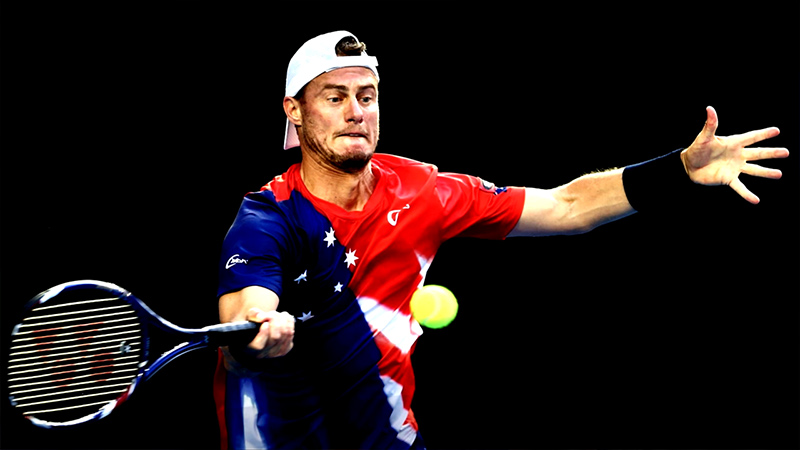
Lleyton Hewitt is an Australian tennis legend known for his fierce competitiveness, historic stint as the ATP World No. 1, and pioneering the modern counter-punching game.
Nicknamed “Rusty,” he redefined the sport in the early 2000s through unrelenting baseline hustle and a trademark “never-say-die” attitude.
Hewitt secured two Grand Slam singles titles—the 2001 US Open and 2002 Wimbledon—while becoming the youngest male singles World No. 1 in history at age 20.
Beyond individual glory, he is celebrated for his deep patriotism, leading Australia to two Davis Cup titles and later serving as the national team’s longtime captain and mentor.
What Are Lleyton Hewitt’s Biggest Career Achievements?
The professional journey of Lleyton Hewitt, spanning from 1998 to 2016, is defined by elite consistency and an ability to triumph over the most powerful players of his era.
Throughout his career, he amassed 33 total titles, including 30 in singles and 3 in doubles. His success was not limited to a single surface; he proved his versatility by winning on hard courts, grass, clay, and carpet.
Below is a comprehensive breakdown of the statistical milestones that cement his place among the all-time greats.
| Category | Statistical Milestone |
|---|---|
| Grand Slam Singles Titles | 2 (2001 US Open, 2002 Wimbledon) |
| Grand Slam Doubles Titles | 1 (2000 US Open) |
| Weeks at World No. 1 | 80 Weeks Total |
| Career Singles Record | 616 Wins – 262 Losses |
| Career Prize Money | Over $20.8 Million |
| Year-End Championships | 2 (2001 & 2002 Tennis Masters Cup) |
| Davis Cup Titles | 2 (1999 & 2003) |
Why Was Hewitt Known as the Youngest World No. 1?
Lleyton Hewitt made history on November 19, 2001, when he ascended to the top of the ATP rankings. This achievement was not merely about reaching the summit; it was about the unprecedented speed with which he climbed it.
At just 20 years and 268 days old, he shattered existing perceptions of how long it took for a player to mature into a world leader. This record remained untouched for over two decades, standing as a testament to his precocious talent and mental fortitude.
Breaking the age barrier in professional tennis
When Hewitt reached the No. 1 spot, he bypassed legends who had taken years longer to find that level of consistency.
His rise signaled a shift in the sport, proving that a relentless defensive baseline game could overcome the raw power of older, more experienced serve-and-volley specialists.
By the time he was 21, he had already finished as the year-end No. 1 twice consecutively, in both 2001 and 2002.
Maintaining dominance over eighty weeks
Holding the No. 1 ranking is one feat; defending it is another. Hewitt spent a total of 80 weeks at the top, including a staggering 75 consecutive weeks.
During this period, he was the primary rival to the emerging Roger Federer and the final hurdle for the aging icons of the 1990s.
His ability to stay at the pinnacle of such a demanding sport for nearly two full years highlighted his exceptional physical endurance and tactical discipline.
What Made the Hewitt Playing Style So Revolutionary?
Standing at 5’10”, Hewitt lacked the massive serve or the towering physical frame of many of his contemporaries, such as Pete Sampras or Marat Safin.
To compensate, he engineered a methodology of play that relied on superior movement and psychological warfare.
He was the quintessential “counter-puncher,” a player who thrived by absorbing the power of his opponents and redirecting it with surgical precision. This shift in strategy helped usher in the modern era of baseline dominance seen in today’s game.
The master of counter-punching baseline defense
Hewitt popularized a style that prioritized court coverage and an impeccable return of serve. He viewed every ball as reachable, utilizing world-class footwork to extend rallies until his opponents eventually succumbed to exhaustion or frustration.
This aggressive baseline defense forced power-hitters to play “one more ball,” a tactic that neutralized the advantages of bigger servers.
The greatest defensive lob in tennis history
One of the most specific weapons in Hewitt’s arsenal was his defensive lob. When pulled out of position or forced to the corners, he possessed the unique ability to loft a ball deep into the opponent’s baseline with incredible height and accuracy.
This shot often turned a losing defensive position into an offensive opportunity, catching aggressive net-players off guard and forcing them to retreat.
Bridging the gap between tennis generations
Hewitt’s longevity allowed him to serve as a generational bridge in the sport. He began his career battling the likes of Andre Agassi and Pete Sampras, famously dismantling Sampras in straight sets to win the 2001 US Open.
He then transitioned into a rivalry with the “Big Three”—Federer, Nadal, and Djokovic—competing against them well into the latter half of his career. His game style influenced the defensive capabilities that players like Djokovic would eventually perfect.
How Did Lleyton Hewitt Impact Australian Davis Cup History?
Lleyton Hewitt’s legacy is perhaps most deeply felt in his commitment to team competition. For Hewitt, representing Australia was the highest honor, and he often prioritized the Davis Cup over individual tour events.
His patriotic fervor translated into unmatched success on the international stage, where he led his country to multiple world titles and established records that may never be broken.
- Two-Time World Champion: Hewitt spearheaded the Australian team to Davis Cup victories in 1999 and 2003, showcasing his ability to perform under the immense pressure of national expectation.
- Most Ties Played: He holds the Australian record for the most ties played, having participated in 43 different team encounters over 17 years.
- Most Total Wins: With 59 total wins across singles and doubles, he is the most successful Australian Davis Cup player in the modern era.
- Singles Dominance: His 44 singles wins in Davis Cup play remain a national record, underscoring his reliability in high-stakes matches.
- Transition to Captaincy: Following his retirement from professional play in 2016, he seamlessly transitioned into the role of Davis Cup Captain, a position he has held for nearly a decade.
What Is the Meaning Behind the Iconic “Come On!” Cry?
To many fans, Lleyton Hewitt is defined as much by his vocal intensity as his tennis skills. He brought an emotional volume to the court that was rare for the time, often polarizing opponents while deeply inspiring his supporters.
His signature look—the backwards baseball cap and the fist pump—became synonymous with the fighting spirit of Australian sport.
Raw on-court intensity and psychological edge
The passionate shout of “Come on!”—frequently directed toward his own chest or his player box—was a tool Hewitt used to maintain his focus and intimidate his rivals.
It signaled that he was emotionally invested in every single point, regardless of the score. This unrelenting intensity often wore down opponents mentally, as they realized Hewitt would never go away quietly.
The trademark backwards cap and cultural icon
The image of Hewitt with his cap turned backward became one of the most recognizable sights in 21st-century tennis. It represented a youthful, rebellious energy that appealed to a new generation of fans.
This persona, combined with his status as a Member of the Order of Australia (AM), helped him transcend the sport to become a broader cultural icon in his home country.
What Is Lleyton Hewitt Doing Now After Retirement?
Although he retired from professional singles play in 2016, Hewitt has remained one of the most influential figures in the tennis world. He has shifted his focus toward leadership and the preservation of the sport’s history.
His post-retirement career is marked by his continued guidance of the next generation of Australian players and his own induction into the pantheon of tennis legends.
Captaining the national team and mentoring talent
As the Captain of the Australian Davis Cup team, Hewitt has played a vital role in mentoring young stars like Alex de Minaur. His leadership style is an extension of his playing days: disciplined, strategically sound, and fiercely patriotic.
He continues to travel the world with the team, ensuring that the “never-say-die” culture he championed remains a core part of Australian tennis.
Hall of Fame inductions and prestigious honors
Hewitt’s career has been officially immortalized through the most prestigious institutions in the sport. He was inducted into the International Tennis Hall of Fame in 2022 and the Australian Tennis Hall of Fame in 2024.
These honors were accompanied by the placement of a bronze bust in Garden Square at Melbourne Park, ensuring his physical presence remains at the home of the Australian Open for future generations to admire.
Frequently Asked Questions About Lleyton Hewitt
Who did Hewitt beat to win his Grand Slam titles?
In the 2001 US Open final, Hewitt defeated Pete Sampras with a dominant score of 7-6, 6-1, 6-1. In the 2002 Wimbledon final, he defeated David Nalbandian 6-1, 6-3, 6-2.
What is Lleyton Hewitt’s nickname?
Lleyton Hewitt is famously nicknamed “Rusty”.
Is Lleyton Hewitt in the Hall of Fame?
Yes, he was inducted into the International Tennis Hall of Fame in 2022 and the Australian Tennis Hall of Fame in 2024.
How many Davis Cup titles did Hewitt win?
Hewitt won two Davis Cup titles for Australia, in 1999 and 2003.
Who broke Hewitt’s record as the youngest World No. 1?
His record as the youngest male singles No. 1 held for over 20 years until it was broken by Carlos Alcaraz in 2022.
Conclusion: The Relentless Spirit of a Champion
Lleyton Hewitt’s impact on tennis extends far beyond his 33 career titles or his 80 weeks at the top of the rankings. He proved that a player could dominate the world stage through grit, tactical intelligence, and sheer willpower rather than just physical stature.
From his historic rise as the youngest World No. 1 to his current role as a mentor and captain, Hewitt remains the gold standard for competitive excellence in Australian sport.
His legacy is etched in the “Come on!” cries heard on courts around the world and in the baseline defensive strategies that now define the modern professional game.