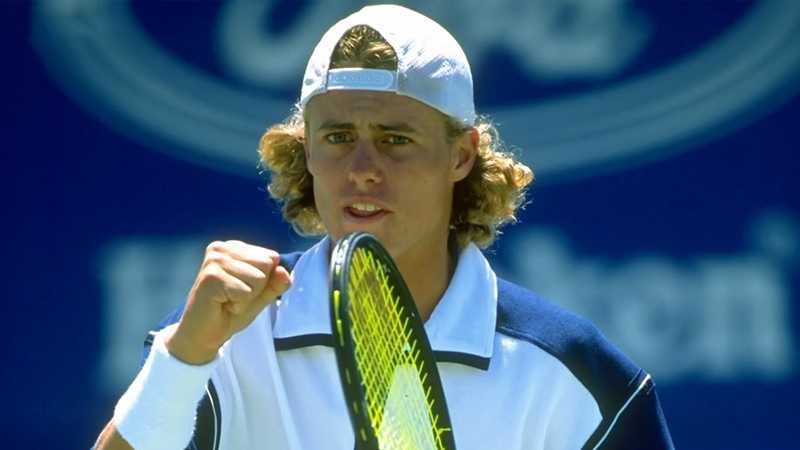
Lleyton Hewitt dominated professional tennis through a revolutionary baseline counter-punching style, exceptional tennis IQ, and unmatched competitive grit.
As the youngest World No. 1 in history at age 20, he successfully bridged the gap between the Pete Sampras era and the Big Three dominance.
His greatness stemmed from his elite return of serve, which effectively dismantled the traditional serve-and-volley game, and his legendary “never-say-die” attitude.
Despite severe injuries later in his career, Hewitt’s ability to maximize his talent without a single overpowering weapon remains a blueprint for modern defensive baseline specialists.
The Strategic Brilliance of the Modern Baseline Prototype
Lleyton Hewitt was not just a player; he was a tactical shift in the evolution of professional tennis.
Before his rise, the tour was heavily influenced by powerful servers and net-rushers, but Hewitt proved that relentless consistency and superior movement could neutralize raw power.
He operated like a “brick wall” from the back of the court, forcing opponents to play extra balls they were neither physically nor mentally prepared to handle.
Ending the Era of Serve-and-Volley Dominance
Hewitt is often credited with ushering in the modern era by weaponizing the return of serve and the passing shot. His performance in the 2001 US Open final remains one of the greatest tactical displays in history.
Pete Sampras had entered that match having held 87 consecutive service games, yet Hewitt broke the legendary American six times in a dominant straight-sets victory.
By consistently putting the ball at the feet of approaching net players, he effectively forced a generation of athletes to reconsider the viability of serve-and-volley tactics.
Elite Anticipation and Underrated Tennis IQ
While fans often focused on his speed, his true advantage was an “uncanny” ability to read his opponent’s intentions.
Professional analysts and peers noted that Hewitt could decipher an opponent’s shot based on their racquet face and shoulder positioning, allowing him to react faster than any other player of his time.
Andre Agassi once remarked that Hewitt was the finest shot selector he had ever witnessed, a testament to a high tennis IQ that allowed him to remain competitive even against taller, stronger opponents.
The Precision Lob as an Offensive Weapon
In an era where many players used the lob as a desperate defensive measure, Hewitt transformed the topspin and slice lob into a calculated offensive tool.
He utilized his iconic two-handed backhand to guide the ball precisely over the heads of net-rushers, frequently turning defensive positions into immediate winners.
This specific technical mastery made him a nightmare for traditionalists who relied on closing the net to finish points.
Analyzing the Statistics of a World Number One
To understand Hewitt’s dominance, one must look at the data that supported his 80-week reign at the top of the rankings.
He achieved a consistency that few in the history of the game have matched, especially considering the physical demands of his playstyle.
| Metric | Achievement Details |
|---|---|
| Career Singles Titles | 30 ATP Titles |
| Singles Win-Loss Record | 616–262 (70.1% Win Rate) |
| Weeks at World No. 1 | 80 Weeks (10th longest for a 2-Slam winner) |
| Youngest World No. 1 | 20 years, 8 months (Historical Record in 2001) |
| ATP Finals Success | Back-to-back Champion (2001, 2002) |
| Davis Cup Record | 59–21 (Most successful Australian in history) |
Global Consistency Across All Surfaces
One of the most impressive aspects of Hewitt’s resume is his versatility. He is one of only eight players in history to have secured at least 100 match wins on all three major surfaces: grass, clay, and hard courts.
This statistic highlights a level of all-court proficiency that is rare for baseline counter-punchers, who often struggle on faster grass or slower clay.
The Efficiency of the Transition King
Hewitt managed to maximize his career results by capitalizing on the “in-between” years of tennis history.
From 2001 to 2002, he was the most consistent athlete on tour, taking full advantage of the period when Sampras and Agassi were nearing the end of their careers and the next generation had not yet matured.
His ability to win 100 matches across diverse conditions proves that his success was not merely a product of a “weak era,” but rather a result of elite multi-surface adaptability.
Why Mental Grit and Physical Speed Defined His Legacy
Lleyton Hewitt’s physical attributes and mental fortitude were the twin pillars of his success. He was widely regarded as the fastest player on the professional tour until the emergence of Rafael Nadal.
This speed, combined with a “pitbull” mentality, allowed him to compete in matches that others would have conceded.
The Never-Say-Die Pitbull Mentality
The hallmark of a Hewitt match was the fiery “Come on!” celebration, a vocal display of his intense competitive spirit. He possessed a dogged grinding ability that wore down opponents both physically and psychologically.
Players knew that to beat Hewitt, they would have to hit three or four “winners” just to earn a single point, as he refused to give up on any ball.
This tenacity elevated the standard of professional toughness, eventually becoming the baseline expectation for the modern game.
The High Physical Cost of Perfection
The very style that made Hewitt great also led to the premature decline of his physical prime. His relentless court coverage and reliance on foot speed placed immense strain on his body.
By the mid-2000s, Hewitt was dealing with severe injuries that would have sidelined most athletes, including multiple hip surgeries and a fused toe that required a titanium implant.
Despite these limitations, he continued to compete at a high level, demonstrating a level of professional dedication that earned him widespread respect across the industry.
Examining the Legendary Rivalries of the Early 2000s
Hewitt’s career is defined by his encounters with the greatest legends of the sport. He famously held winning records or dead-even splits with many of the icons who followed or preceded him.
Owning a Young Roger Federer
Before Roger Federer became a dominant force, he struggled immensely to solve the puzzle of Lleyton Hewitt. Hewitt actually won seven of their first nine professional meetings, utilizing his consistency to exploit the Swiss maestro’s early lack of patience.
Federer later credited Hewitt with helping him refine his own game, as the Australian’s defensive excellence forced Federer to develop the tactical discipline required to become a champion.
The Battles with Sampras and Roddick
Hewitt holds a prestigious 5–4 winning record against Pete Sampras, a feat that few can claim. His ability to break the Sampras serve was unprecedented, effectively neutralizing the greatest weapon of the 1990s.
Similarly, his rivalry with Andy Roddick was a classic clash of styles, ending in a perfect 7–7 deadlock. While Roddick possessed the thunderous power, Hewitt’s precision passing shots and return game allowed him to counter that power with surgical efficiency.
Frequently Asked Questions About Lleyton Hewitt
How many Grand Slams did Lleyton Hewitt win?
Hewitt won two Grand Slam singles titles: the 2001 US Open and the 2002 Wimbledon Championships. He also won the 2000 US Open men’s doubles title.
Why did Lleyton Hewitt’s reign as Number 1 end?
His dominance was curtailed by two factors: the rise of Roger Federer, who began a 15-match winning streak against Hewitt in 2004, and a series of debilitating injuries to his hips and feet.
Was Lleyton Hewitt a good doubles player?
Yes, he was highly accomplished in doubles early in his career, reaching a career-high ranking of No. 18 and winning a Grand Slam doubles title before his singles breakthrough.
What made Hewitt’s return of serve so effective?
Hewitt attacked every serve with aggressive positioning and exceptional racquet head control, making him one of the greatest returners in history prior to the arrival of Djokovic and Murray.
The Enduring Influence of an Australian Icon
Lleyton Hewitt’s legacy is found in the DNA of today’s top-tier players. He set the standard for the modern counter-puncher, proving that athletic defensive play could be an offensive weapon.
By maximizing his physical potential and utilizing superior tactical intelligence, he achieved a level of success that remains a benchmark for any athlete who lacks an overwhelming power game.
His 30 career titles and his status as the most successful Australian Davis Cup player in history cement his place in the Hall of Fame.
While the “Big Three” eventually eclipsed his statistical records, Hewitt remains the pioneer who showed the world how to dismantle giants with nothing more than speed, a return, and an iron will.
His career serves as a reminder that in professional sports, psychological toughness and tactical adaptability are just as valuable as raw physical power.