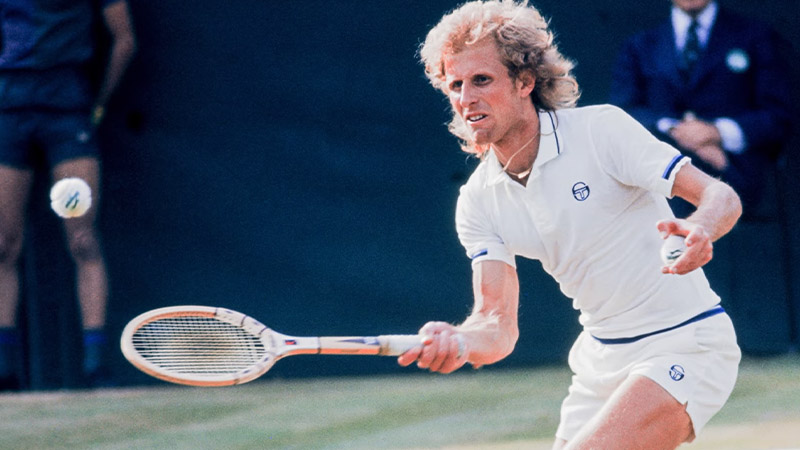
Vitas Gerulaitis was a citizen and national of the United States, representing the American flag throughout his legendary professional tennis career.
Born on July 26, 1954, in Brooklyn, New York, he held U.S. citizenship by birthright and was a vital member of the United States Davis Cup team.
However, his identity was deeply rooted in his Baltic ancestry, as his parents were Lithuanian refugees who fled Soviet occupation during World War II.
This dual identity earned him the iconic nickname “The Lithuanian Lion,” symbolizing a bridge between his American reality and his proud cultural heritage.
What Nationality Was Vitas Gerulaitis?
To understand the nationality of Vitas Gerulaitis, one must look at both his legal status and his international representation on the professional circuit. He was an American professional tennis player who lived the entirety of his life as a United States citizen.
His presence in the sport was defined by his speed, charisma, and the stars and stripes he wore on his jersey during team competitions.
While many fans were curious about his heritage due to his name and nickname, his legal and competitive allegiance was always clear.
Born and Raised in New York
Gerulaitis was a quintessential New Yorker, born in Brooklyn and raised in the borough of Queens. Because he was born on American soil, he was a proud American citizen from the moment of his birth on July 26, 1954.
This upbringing in the heart of New York’s diverse landscape shaped his outgoing personality and his rise through the local tennis ranks, eventually leading him to the global stage.
Representing the United States Internationally
Throughout his highly successful career, Gerulaitis exclusively competed under the United States flag. He did not just play as an individual; he was a patriot on the court, helping lead the United States to prestigious Davis Cup victories in 1978 and 1979.
His commitment to the American team solidified his status as a national sporting hero, even as he maintained a deep, private connection to his ancestral land.
The Lithuanian Heritage of the Tennis Legend
While his passport was American, the heart of Vitas Gerulaitis’s identity was profoundly Lithuanian. His life story is a classic example of the immigrant experience in America, where cultural roots are preserved with intense dedication.
His parents, Vitas Sr. and Elena Gerulaitis, were native Lithuanians who were forced to flee their homeland during the turmoil of World War II.
They spent time in displaced persons camps in Germany before finally immigrating to New York in 1949 to start a new life.
A Household of Baltic Traditions
Growing up in New York did not mean Gerulaitis lost touch with his roots; in fact, the opposite was true. Lithuanian was his native tongue, and it was the primary language spoken inside his childhood home.
Remarkably, he did not learn English until he began attending school, as his early years were spent entirely within the cultural embrace of his family and the local diaspora.
The Impact of Soviet Occupation on Identity
The geopolitical situation of the era played a significant role in Gerulaitis’s nationality and how he chose to represent himself.
During his lifetime, Lithuania was under Soviet occupation, meaning there was no independent Lithuanian team for him to represent on the international stage.
This reality made his American citizenship the only viable path for his professional career, even though he remained active in Lithuanian community groups and attended Lithuanian camps as a child.
Why Was He Called the Lithuanian Lion?
The nickname “The Lithuanian Lion” became one of the most recognizable monikers in sports history. It was more than just a catchy phrase for commentators; it was a testament to how Gerulaitis carried his heritage into the public eye.
This title reflected a blend of his physical appearance, his aggressive style of play, and his refusal to let his family’s history fade into the background.
Symbolism of the Lion
The “Lion” portion of his nickname was a direct reference to his fierce and fast-paced style on the tennis court. Combined with his iconic, flowing blonde hair, he possessed a regal yet predatory presence during matches.
By prepending “Lithuanian” to the title, the sporting world acknowledged that his strength and tenacity were viewed as products of his Baltic lineage.
Maintaining Ties with the Diaspora
Despite his fame and the high-flying lifestyle of a professional athlete, Gerulaitis remained deeply engaged with the Lithuanian diaspora in New York.
He was named after the 15th-century Lithuanian King Vytautas the Great, a name he shared with his father, which served as a constant reminder of his royal cultural standing within his community.
His involvement in community groups helped ensure that his success was shared by Lithuanians worldwide.
Key Achievements of an American Champion
Gerulaitis’s career statistics reflect his dominance as an American athlete during one of the most competitive eras in tennis history. He was a frequent sight in the late stages of Grand Slams, often facing off against other legends of the game.
His nationality was never in question when he stood on the podium to receive his trophies under the American flag.
Grand Slam Glory on the World Stage
His greatest individual achievement came in 1977 when he captured the Australian Open singles title. This victory cemented his place among the elite players of the world.
Additionally, he found significant success in doubles play, most notably winning the Wimbledon doubles title in 1975. These wins were recorded as victories for the United States, further highlighting his professional nationality.
Leadership in the Davis Cup
The Davis Cup is the premier international team event in men’s tennis, and Gerulaitis was a cornerstone of the American squad. His contributions were pivotal in securing world titles for the United States in both 1978 and 1979.
In these moments, he was the face of American tennis, proving that his loyalty to his country of birth was absolute, even as he remained a hero to the Lithuanian people.
The Legacy of a Multi-Cultural Sports Icon
The passing of Vitas Gerulaitis on September 17, 1994, at the age of 40, was a significant loss for both the American and Lithuanian communities.
He left behind a legacy that transcends mere nationality, serving as an inspiration for athletes who navigate dual identities. He showed that one could be a “proud American citizen” while remaining a “proud Lithuanian” in heart and spirit.
A Bridge Between Two Worlds
Gerulaitis effectively served as a cultural ambassador. To the American public, he was the charismatic, hard-working champion from Queens.
To the Lithuanian community, he was a symbol of hope and resilience, a son of refugees who conquered the world while keeping their language and traditions alive. This dual role is a major part of why he is still remembered so fondly today.
Remembering the Silent Racket
His sudden death marked the end of an era, but the story of the “Lithuanian Lion” continues to be told.
His life serves as a reminder of the historical complexities of the 20th century, where war and occupation forced many to find new homes and new nationalities, all while carrying the torch of their original culture into the future.
Frequently Asked Questions About Vitas Gerulaitis
Was Vitas Gerulaitis a U.S. Citizen?
Yes, he was a United States citizen by birth, born in Brooklyn, New York.
What was his first language?
Lithuanian was his native tongue and the language spoken in his home; he learned English at school.
Did he ever represent Lithuania?
No, he exclusively represented the United States, as Lithuania was occupied by the Soviet Union during his career.
What was his most famous nickname?
He was widely known as “The Lithuanian Lion”.
When did his family move to the U.S.?
His parents immigrated to the United States in 1949 after fleeing Lithuania during WWII.
Conclusion: An American Legend with a Lithuanian Heart
In conclusion, Vitas Gerulaitis was a national of the United States who became a global icon through his prowess on the tennis court. While his legal nationality was American, his cultural identity was inextricably linked to his Lithuanian heritage.
He successfully navigated these two worlds, becoming a champion for his country and a hero for his people. His story remains a powerful narrative of how heritage can define a player’s spirit as much as their passport defines their home.