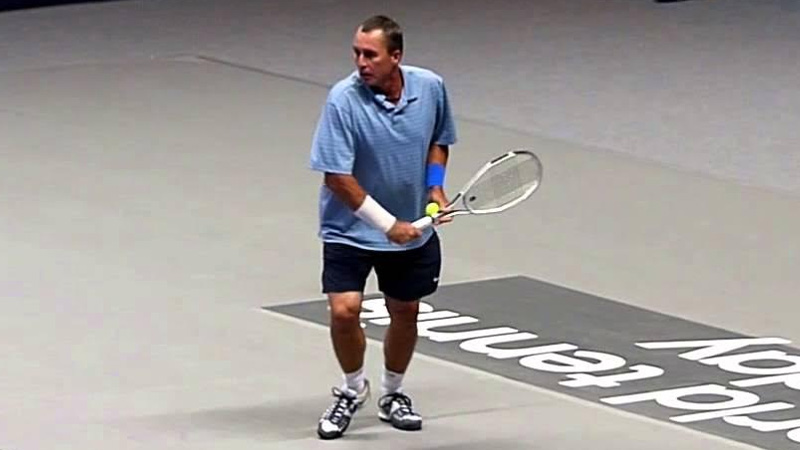
Ivan Lendl never won Wimbledon primarily because his methodical, heavy-topspin baseline game clashed with the low-bouncing, lightning-fast grass of the 1980s.
Despite reaching two finals and seven semifinals, he was repeatedly thwarted by era-defining specialists like Boris Becker and Stefan Edberg.
While he transformed his technique under coach Tony Roche to become a competent serve-and-volleyer, his net play remained mechanical and lacked natural instinct.
Ultimately, a combination of elite competition, technical vulnerabilities on his second serve, and the immense psychological pressure of his career-long obsession kept the crown out of reach.
Why Was Lendl’s Game Fundamentally Unsuited for the Lawn?
To understand why a man who spent 270 weeks at World No. 1 failed to capture the most prestigious title in tennis, one must look at the architectural clash between his playing style and the surface.
Lendl built his legendary dominance on clay and hard courts by utilizing extreme physical training and rhythmic, heavy-topspin groundstrokes from the back of the court.
The disruption of rhythmic baseline play
The grass courts of the 1980s were notorious for producing fast, low, and often irregular bounces that disrupted highly calculated, rhythmic strokes. Lendl’s game required a predictable bounce to time his powerful passing shots and heavy topspin.
On the slick lawns of the All England Club, the ball often skidded or stayed low, forcing him out of his comfort zone and preventing him from grinding down opponents through attrition as he did in Paris or New York.
This unpredictability made him feel insecure in his movement, as he never fully trusted his footing or his ability to slide on the slippery surface.
The “Grass is for Cows” philosophy
Early in his career, Lendl’s frustration with the surface was palpable, leading to his famous 1982 decision to skip the tournament entirely to vacation and play golf.
He famously quipped that grass was “only for cows,” a sentiment that reflected his initial disdain for a surface that neutralized his greatest weapons.
This psychological barrier meant that during his early prime, he was not fully committed to the tactical adaptations required to win on the lawn, potentially wasting years where his physical peak was at its highest.
How Did Technical Vulnerabilities Impact His Performance?
Recognizing that he could not win Wimbledon by staying at the baseline, Lendl embarked on one of the most professional and intense technical overhauls in the history of the sport.
He hired Australian legend Tony Roche to transform him into a serve-and-volley player, a style that was essentially foreign to his natural instincts.
Mechanical net play vs. natural instinct
While Lendl’s discipline allowed him to become a very competent volleyer, analysts and rivals noted that his net game remained rigid and mechanical. He lacked the fluid, split-second reflexes and “soft hands” of natural net rushers like John McEnroe or Stefan Edberg.
His movement toward the net was systemic rather than instinctive, meaning that in high-pressure moments, his volleys were more prone to breaking down under the stress of rapid-fire exchanges.
He attempted to emulate the aggression of Becker or McEnroe, but he could never replicate their inherent comfort in the “no man’s land” of the court.
The vulnerability of the second serve
A critical technical flaw that elite opponents exploited was Lendl’s second serve. While his first serve was an immense weapon, his second serve lacked the heavy spin or biting slice necessary to keep aggressive returners at bay on grass.
Specialists like Boris Becker and Pat Cash could easily “chip and charge” his second serve, putting Lendl on the defensive immediately after he started the point.
By exposing himself to these attacks while trying to rush the net, he often found himself strangled by returns at his feet, a position where his mechanical volleying was most vulnerable.
Facing a “Pond Full of Piranhas”: The Rivalry Barrier
Even when Lendl mastered the conditions and his own technical adaptations, he faced the misfortune of playing in a golden era of grass-court specialists.
His consistency at Wimbledon was staggering—reaching at least the semifinals in seven out of eight consecutive attempts between 1983 and 1990—but he was repeatedly stopped by all-time greats at their absolute peak.
- John McEnroe (1983): Lendl reached his first semifinal but was dismissed by McEnroe in straight sets, a masterclass in grass-court artistry that Lendl could not yet counter.
- Jimmy Connors (1984): In another semifinal, Lendl fell in four sets to Connors, a player whose flat-hitting game and exceptional return were perfectly suited for the lawn.
- Boris Becker (1986, 1988, 1989): Becker was Lendl’s most frequent tormentor at SW19, defeating him in the 1986 final and two subsequent semifinals.
- Stefan Edberg (1988, 1990): The sublime Swede took Lendl out in two semifinals, including a dominant straight-sets victory in 1990 when Lendl was at his peak preparation.
- Pat Cash (1987): In what was arguably Lendl’s best chance at a title, he ran into a “red hot” Pat Cash who played the tournament of his life to win the final in straight sets.
The 1987 Final: A Heartbreaking Opportunity
The 1987 championship match remains the “bitter pill” of Lendl’s career. Coming off a dominant year and having defeated Stefan Edberg in a brilliant four-set semifinal, Lendl entered the final as a strong contender to finally break the “grass ceiling”.
However, Pat Cash played at a level that some analysts describe as the finest grass-court tennis Lendl ever faced. Cash was “on fire,” serving and volleying with such precision that Lendl struggled to find any rhythm.
The tragedy of the 1987 final lay in the third set. After losing the first two sets 6-7 and 4-6, Lendl finally carved out a significant lead of 4-1 and then 5-2.
He was points away from extending the match and potentially shifting the momentum, as Cash began to show signs of nerves.
Instead, Lendl’s game tightened, and Cash stormed back to win five consecutive games, securing the title and leaving Lendl as the runner-up for the second year in a row.
Did Psychological Obsession and Over-Preparation Backfire?
By the late 1980s, Wimbledon had shifted from a tournament Lendl disliked to a literal obsession. His commitment was unparalleled; in both 1990 and 1991, he made the staggering sacrifice of skipping the French Open—a Grand Slam he was favored to win—to spend months practicing exclusively on grass.
Peaking too early at Queen’s Club
In 1990, his hyper-focus appeared to pay dividends when he won the warmup tournament at the Queen’s Club, destroying John McEnroe and Boris Becker in the process.
Veteran commentators noted that Lendl’s performance at Queen’s was the “finest grass-court tennis” they had ever seen, making him the clear favorite heading into Wimbledon.
However, the mental toll of maintaining that peak for another two weeks was too great. By the time he reached the semifinals against Edberg, he appeared “mentally drained,” tight, and inhibited by the immense self-imposed pressure to fulfill his destiny.
The weight of the systematic mindset
Lendl’s greatest strength—his ability to analyze and systemize the game—became a hindrance on the unpredictable lawns. His systemic mindset struggled to adapt when weather conditions shifted or when the court wear changed the bounce mid-match.
For instance, in the 1989 semifinal against Becker, Lendl had a 2-1 set lead and a break in the fourth set when a rain delay halted his momentum.
When play resumed, the slightly changed conditions favored Becker’s more explosive game, and Lendl, unable to adjust his rigid tactics, watched his best chance of beating Becker slip away in five sets.
A Statistical Overview of Lendl’s Grass-Court Excellence
Despite never winning the trophy, Lendl’s statistics prove he was one of the greatest grass-court players of the Open Era. His career winning percentage on the surface is higher than that of many players who actually won the title.
| Achievement Category | Statistics / Details |
|---|---|
| Career Grass Record | 81–25 (.764 Winning Percentage) |
| Wimbledon Match Record | 48–14 (.774 Winning Percentage) |
| Wimbledon Consistency | 7 Semifinals or better in 8 years (1983–1990) |
| Finals Appearances | 2 (1986, 1987) |
| Quarterfinals Record | 7–0 (Never lost a Wimbledon Quarterfinal) |
| Top 10 Seedings | Seeded in the top 3 for 8 consecutive years (1981–1991) |
Conclusion: The Legacy of an Uncrowned Master
Ivan Lendl’s failure to win Wimbledon does not diminish his greatness but rather highlights the era-specific challenges of the 1980s.
He was a pioneer who introduced ultra-fitness and professionalization to the tour, yet he was ultimately a victim of his own era’s surface conditions and a “pond full of piranhas” who were natural born grass specialists.
While he never achieved the career Grand Slam, his transition from a baseline grinder to a two-time Wimbledon finalist remains one of the most impressive tactical evolutions in sports history.
Lendl himself later expressed peace with the result, knowing he had left “no stone unturned” and gave the absolute maximum effort to claim the crown.
Common Questions About Lendl’s Wimbledon Pursuit
Why did Ivan Lendl skip the French Open to play Wimbledon?
In 1990 and 1991, Lendl was so obsessed with winning Wimbledon that he skipped the French Open, where he was a multi-time champion, to spend three months practicing on grass.
He believed this was the only way to overcome his lack of natural instinct on the surface.
Who was the player who beat Lendl in his final Wimbledon match?
In 1993, a 33-year-old Lendl played his final match at the All England Club, losing in the second round to Arnaud Boetsch. This tournament also marked the first of seven titles for Pete Sampras, signaling a complete changing of the guard.
Would Lendl have won Wimbledon in the modern era?
Many analysts believe that if Lendl had played on the modern, more consistent grass of today, his powerful baseline game would have earned him multiple titles.
The current conditions neutralize the “bad bounces” and unpredictable skidding that plagued his rhythmic style in the 1980s.