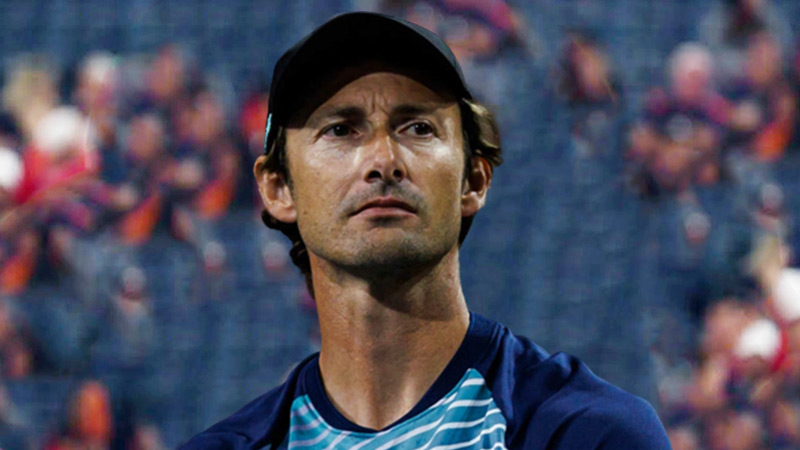
Juan Carlos Ferrero was an elite, world-class champion who reached the absolute peak of tennis as the World No. 1 in September 2003.
Known as “El Mosquito” for his blistering speed and slender frame, he revolutionized the sport by proving Spanish players could dominate hard courts as effectively as clay.
With 16 ATP titles, a French Open crown, and three Davis Cup trophies, Ferrero served as the definitive bridging force for modern Spanish tennis.
His career win rate of 64.6% and 176 consecutive weeks in the Top 10 solidify his status as a legendary baseline powerhouse.
What Made Juan Carlos Ferrero a World-Class Player?
To understand the sheer quality of Ferrero’s game, one must look beyond the trophy cabinet and analyze the technical and physical innovations he brought to the ATP Tour.
He was not a traditional defensive specialist; rather, he was a proactive aggressor who forced opponents out of their comfort zones with relentless pace and precision.
The Revolutionary “El Mosquito” Speed
The nickname “El Mosquito” was more than just a catchy label; it was a description of a physical phenomenon on the court. Ferrero possessed rapid footwork and lateral movement that allowed him to track down balls that seemed out of reach for his peers.
This blistering speed was his primary defensive tool, but it also served as an offensive engine.
By reaching the ball earlier than expected, he could transition instantly from a defensive stretch into a neutral or attacking position, never allowing his opponent to settle into a rhythm.
Mastering the Inside-Out Forehand
While his movement provided the foundation, his inside-out forehand was the weapon that dismantled the world’s best players. Ferrero had the unique ability to run around his backhand with such efficiency that he could dictate almost every point from the baseline.
During the early 2000s, his forehand was arguably the most devastating and aggressive shot in the game. He hit the ball with a penetrating, flat trajectory that allowed the ball to skid through the court, particularly on faster surfaces where traditional topspin would sit up for the opponent.
Flattening the Baseline Game
One of the most significant aspects of Ferrero’s excellence was how he diverged from the traditional Spanish school of tennis. Previous generations of Spanish specialists often stayed deep behind the baseline, hitting heavy topspin and waiting for errors.
Ferrero changed this paradigm by stepping up and standing close to the baseline, taking the ball early to rob his opponents of time.
This aggressive positioning allowed him to excel on hard courts just as effectively as on clay, effectively rewriting the blueprint for what a Spanish champion could look like.
Reviewing the Peak Career Statistics of Juan Carlos Ferrero
The following table provides a comprehensive overview of the data-driven milestones that defined his tenure at the top of the professional game. These figures illustrate his remarkable consistency during his prime years.
| Statistic | Record / Achievement |
|---|---|
| Career Win-Loss Record | 479–262 (64.6% Win Rate) |
| Highest ATP Ranking | World No. 1 (September 8, 2003) |
| Consecutive Weeks in Top 10 | 176 weeks |
| Grand Slam Titles | 1 (2003 Roland Garros) |
| Total ATP Singles Titles | 16 Titles |
| ATP Masters 1000 Titles | 4 (Rome, Monte-Carlo x2, Madrid) |
| Grand Slam Match Record | 99–45 (68.8% Win Rate) |
| Career Prize Money | $13,998,165 |
How Did Juan Carlos Ferrero Perform Across Different Surfaces?
A common misconception is that Ferrero was merely a clay-court specialist, but his statistical breakdown reveals a highly adaptable player who could compete for titles on any court.
His peak from 2001 to 2003 saw him reach the final stages of major tournaments across the globe, proving his all-court pedigree.
Clay Court Dominance and Technical Mastery
Clay was undoubtedly the surface where Ferrero’s genius was most evident, finishing his career with a 254–95 record and a 72.8% win rate.
He captured 13 of his 16 career titles on the red dirt, including his defining victory at the 2003 French Open where he defeated Martin Verkerk in straight sets.
His ability to slide into shots and maintain a high winning percentage over long rallies made him a nightmare for opponents, eventually reaching back-to-back finals in Paris in 2002 and 2003.
Hard Court Success and Global Versatility
Ferrero was a pioneer in demonstrating that Spanish baseline mechanics could translate to hard courts. He maintained a solid 57.1% win rate on hard surfaces, bolstered by a significant title win at the Madrid Masters and a run to the 2003 US Open final.
Perhaps his most impressive hard-court feat was defeating Andre Agassi in the 2003 US Open semifinals to secure the world number one ranking, a result that shattered the stereotype of the “clay-court specialist”.
Grass and Carpet Adaptation
While he never won a title on grass, Ferrero’s 61.2% win rate on the surface proves he was far more capable on the green turf than many of his contemporaries.
He reached the quarterfinals of Wimbledon on two separate occasions, demonstrating that his flat hitting and quick reflexes could handle the low bounce and speed of the grass.
Even on the now-extinct carpet surface, he held a winning record of 17–14, further highlighting his ability to adjust his tactical approach to suit the environment.
Why Did Juan Carlos Ferrero’s Time at the Top End So Quickly?
Despite reaching the absolute pinnacle of the sport, Ferrero’s reign was hindered by a series of unfortunate events that prevented him from maintaining his position at the very top.
This decline was not a result of a loss in skill, but rather a combination of health issues and shifting eras.
The 2004 Physical Setbacks
Right as he was in his athletic prime in early 2004, Ferrero was struck by a “perfect storm” of physical ailments. It began with a severe case of chickenpox, which sapped his strength and endurance. This was followed in rapid succession by debilitating injuries to his wrist, ribs, and thighs.
These consecutive setbacks prevented him from training at the required intensity, causing his ranking to plummet out of the Top 30 within a single year. He never fully recaptured the explosive physical edge that defined his 2003 season.
The Rise of the Big Three
Timing played a cruel role in the legacy of Juan Carlos Ferrero. He reached the top just as the “Big Three” era was beginning to take shape.
As Ferrero struggled with his health in 2004, Roger Federer began his period of total dominance, and a young countryman named Rafael Nadal was quickly rising to take the mantle of Spain’s premier player.
Ferrero found himself caught between the legends of the late 90s and the unprecedented dominance of the Federer-Nadal-Djokovic triumvirate, making it difficult to reclaim his spot as the tour’s primary protagonist.
What Drove the Man Behind the Player?
The emotional resilience Ferrero displayed on the court was deeply rooted in his personal history. Understanding his internal motivations provides a clearer picture of why he was able to reach the top of the world despite the immense pressures of professional tennis.
Overcoming Personal Tragedy
At the age of 16, Ferrero faced a life-altering tragedy when his mother, Rosario, passed away from cancer. The loss was so profound that he nearly walked away from the sport of tennis entirely.
It was only through the encouragement of his father and his coach, who reminded him that his mother would have wanted him to continue, that he stayed on the path to professionalism.
This early experience with grief forged a mental toughness that became a hallmark of his competitive spirit.
The Symbolic Tribute to Rosario
Throughout his entire professional career, Ferrero carried the memory of his mother onto the court with him. After every single match victory, he would point a finger toward the sky, a quiet and consistent dedication to her.
This ritual served as a reminder that his success was built on the foundation of the support he received during his youth and provided him with a sense of purpose that transcended mere rankings and prize money.
What Is the Lasting Legacy of Juan Carlos Ferrero Today?
Ferrero’s impact on the sport did not conclude when he retired from the professional tour. Instead, his influence has evolved, shaping the future of tennis through his work as a mentor and strategist.
Transforming Spanish Tennis Culture
Ferrero is celebrated for changing the sports culture in Spain forever. Before his arrival, the perception was that Spanish players were limited to success on red clay.
By winning the Madrid Masters on a hard court and reaching the US Open final, he shattered those limitations for future generations.
Furthermore, his heroics in the 2000 Davis Cup, where he won the decisive final match to give Spain its first-ever title, sparked a golden era for Spanish tennis that persists to this day.
The Mastermind Behind Carlos Alcaraz
In the modern era, Ferrero is widely recognized as one of the world’s greatest active coaches. At his JC Ferrero Equelite Academy, he took a 15-year-old prospect named Carlos Alcaraz and meticulously developed him into a multi-time Grand Slam champion and World No. 1.
Alcaraz’s aggressive, all-court style is a direct reflection of Ferrero’s own tennis philosophy, proving that the technical innovations “El Mosquito” brought to the tour in 2003 remain the gold standard for success in the 2020s.
Frequently Asked Questions about Juan Carlos Ferrero
How many Grand Slams did Juan Carlos Ferrero win?
Juan Carlos Ferrero won one Grand Slam singles title, the 2003 French Open, where he defeated Martin Verkerk 6–1, 6–3, 6–2 in the final. He also reached the finals of the 2002 French Open and the 2003 US Open.
Did Juan Carlos Ferrero ever beat Roger Federer?
Yes, Ferrero defeated Roger Federer three times during his career. Notably, Ferrero won three of their first seven meetings before Federer began his period of historic dominance over the tour.
What was Juan Carlos Ferrero’s career-high ranking?
Ferrero reached the absolute peak of the sport as the World No. 1 on September 8, 2003. He held the top spot for a total of eight weeks during that season.
How did he perform against his rival Andre Agassi?
Ferrero had a competitive head-to-head record of 2–3 against Andre Agassi. His most significant victory over the American came in the 2003 US Open semifinals, a win that allowed him to clinch the World No. 1 ranking.
Conclusion: A Champion Who Redefined the Game
Juan Carlos Ferrero was far more than just a successful player; he was a visionary who bridged the gap between the clay-court specialists of the past and the explosive, all-court athletes of the present.
His combination of technical mastery, emotional resilience, and blistering speed allowed him to conquer the tennis world and earn his place among the legends of the sport.
Today, as he guides the next generation of champions, his legacy continues to fly as high as it did during his peak as “El Mosquito”.