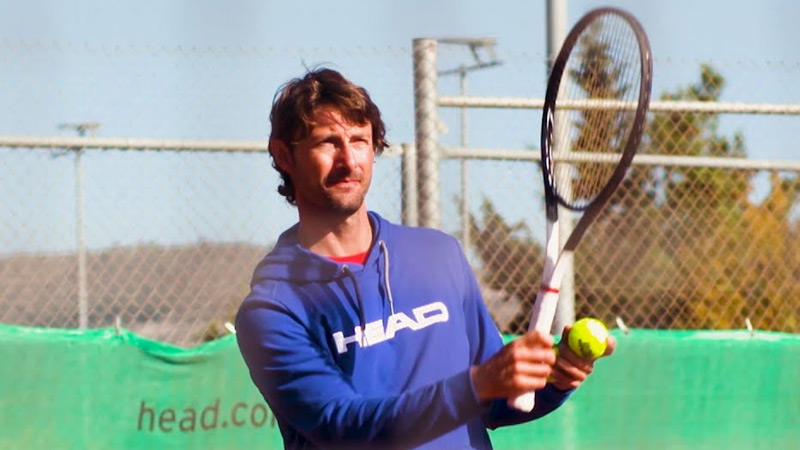
Juan Carlos Ferrero, the former World No. 1 and French Open champion, has transitioned into a mental performance coach for professional golfer Ángel Ayora as of early 2026.
This shift follows a shocking December 2025 split from his long-time protégé, Carlos Alcaraz, whom he guided to six Grand Slam titles.
While physical setbacks shortened his playing peak after his 2003 dominance, Ferrero reinvented himself as an elite strategist at his Equelite Academy.
Today, he applies his championship mindset to the greens of pro golf while remaining open to future high-level tennis opportunities.
The Playing Peak of “El Mosquito” (1998–2012)
Before becoming a master strategist on the sidelines, Ferrero was a dominant force on the ATP tour, particularly in the early 2000s, where his exceptional speed and slender frame earned him a legendary nickname.
Reaching World No. 1 in 2003
The pinnacle of Ferrero’s playing career arrived in 2003, a year that saw him cement his place in tennis history. He captured his maiden Grand Slam title at the French Open, defeating Martin Verkerk in a clinical final.
His momentum carried over to the hard courts of New York, where he reached the US Open final, falling only to Andy Roddick. These results culminated on September 8, 2003, when he officially ascended to the World No. 1 ranking in men’s singles.
During this era, he was widely regarded as one of the best up-and-coming talents, winning multiple Masters titles and proving his versatility across surfaces.
The Injury Battles that Halted His Momentum
Following the 2004 Australian Open semifinals, many fans noted that Ferrero seemed to “fall off the map” regarding title consistency. His decline was largely attributed to a relentless cycle of physical setbacks that derailed his rhythm.
A severe bout of chicken pox was followed by debilitating wrist injuries and recurring groin strains. Some analysts also pointed to the physical toll his high-intensity style of play took on his body.
Despite these challenges, he remained a dangerous opponent, famously defeating Rafael Nadal in Rome in 2008—the only time Nadal has ever lost in the first round of a clay-court tournament.
He also surprised critics with two Wimbledon quarterfinal runs in 2007 and 2009, showing a surprising aptitude for grass late in his career.
Why Did Ferrero and Carlos Alcaraz Split in 2025?
The seven-year partnership between Ferrero and Alcaraz was one of the most successful in modern history, transforming a talented teenager into the youngest World No. 1 in history.
However, the tennis world was stunned in December 2025 when the duo announced an abrupt separation just before the start of the 2026 season.
Contract Negotiations and Philosophical Differences
The root cause of the sudden breakup was a breakdown in annual contract negotiations. While the duo had achieved immense success, reports indicated growing friction between Ferrero and the broader “Alcaraz clan,” including Carlos’s father.
These disagreements primarily centered on career management strategies, specifically tournament travel schedules and training locations.
As Alcaraz’s career reached new heights, the differing philosophies regarding scheduling became an insurmountable barrier to continuing their professional relationship.
The Emotional Impact of the Separation
The termination of the partnership was not merely a business decision; it carried significant emotional weight for Ferrero. He publicly admitted that the dismissal left him “hurting,” as he had fully intended to continue coaching Alcaraz into the 2026 season.
Having taken Alcaraz under his wing in 2018 at his academy in Villena, Ferrero had invested seven years into molding the athlete.
The sudden nature of the split, occurring just as the new season approached, caught the former World No. 1 by surprise and marked a bittersweet end to a defining chapter of his coaching career.
Where Is Juan Carlos Ferrero Now in 2026?
Following his exit from the Alcaraz camp, Ferrero did not remain idle. He quickly leveraged his extensive experience in high-performance sports to explore a completely new discipline while maintaining his deep roots in the tennis world.
Pivoting to Mental Coaching in Professional Golf
In January 2026, Ferrero announced a strategic pivot to professional golf, signing on as a mental performance coach for the rising Spanish star Ángel Ayora.
This role focuses on overseeing the golfer’s mental preparation and resilience, qualities that Ferrero mastered during his own time at the top of the rankings.
By applying the “Mosquito” mentality to the nuances of professional golf, Ferrero is proving that elite competitive principles are transferable across sports.
Continuing the Legacy at Equelite Academy
Beyond his work in golf, Ferrero remains deeply committed to his primary venture, the JC Ferrero Equelite Tennis Academy in Villena, Spain. Since his retirement from the professional tour in 2012, he has heavily invested his time and resources into this elite facility.
The academy continues to serve as a hub for the next generation of players, where Ferrero actively trains athletes using the same disciplined philosophy that produced Alcaraz.
Will Juan Carlos Ferrero Return to Tennis Coaching?
While he is currently enjoying a break from the grueling travel schedule of the ATP tour, Ferrero has made it clear that his journey in tennis is far from over. He has expressed a keen interest in returning to the tour if the right opportunity presents itself.
| Potential Future Scenarios | Details and Context |
|---|---|
| Coaching Elite Talents | Ferrero has explicitly mentioned interest in working with other top players, such as Jannik Sinner, to help them reach the next level. |
| Reunion with Alcaraz | Although the 2025 split was difficult, Ferrero has not closed the door on a future reunion with Carlos Alcaraz. |
| Academy Expansion | He continues to prioritize the development of his training facility to remain a top-tier global tennis destination. |
Professional Insights: Understanding the Ferrero Legacy
Juan Carlos Ferrero’s career is a case study in resilience and adaptation. His ability to transition from a clay-court specialist to an all-surface No. 1, and later from a retired player to a world-class coach, demonstrates a rare tactical intelligence.
From “El Mosquito” to “The Architect”
As a player, Ferrero’s game was built on blistering speed and consistency. As a coach, he translated that physical intensity into a rigorous mental framework for his students.
The success of Carlos Alcaraz is the primary testament to this methodology, as Ferrero molded a raw talent into a six-time Grand Slam champion in just seven years.
This shift from athlete to architect has redefined his legacy, making him one of the few figures to reach the summit of the sport in two distinct roles.
Mental Performance Across Disciplines
The transition to golf mental coaching in 2026 highlights Ferrero’s focus on the psychological aspects of winning.
In professional sports, the margin for error is razor-thin, and Ferrero’s experience handling the pressure of Grand Slam finals and Davis Cup victories provides him with unique authority.
Working with Ángel Ayora allows him to refine these mental strategies in an environment where patience and focus are paramount, further expanding his influence in the sports world.
Enhanced FAQ: Common Questions About Ferrero
Why did Juan Carlos Ferrero retire so early?
Ferrero retired in 2012 at the age of 32 after a 14-year career. While not exceptionally early, his consistency at the top was impacted by a long history of injuries, including shoulder, wrist, and groin issues that began as early as 2004.
Is Juan Carlos Ferrero still working with Carlos Alcaraz?
No, they officially parted ways in December 2025 due to disagreements over contract terms and career philosophies.
Which golfer is Juan Carlos Ferrero coaching?
As of January 2026, he is the mental performance coach for Ángel Ayora, a rising Spanish professional golfer.
Does Ferrero still own a tennis academy?
Yes, he manages the JC Ferrero Equelite Tennis Academy in Villena, Spain, which remains one of the premier training facilities in Europe.
Conclusion: A Master of the Strategic Pivot
Juan Carlos Ferrero’s trajectory from the “El Mosquito” of the early 2000s to a leading mental performance coach in 2026 is a testament to his enduring impact on Spanish sports.
Whether he is navigating the complexities of the ATP tour or the precision of professional golf, his focus remains on elite performance and the development of the next generation.
While the split with Alcaraz marked the end of an era, Ferrero’s current ventures suggest that his influence on the world of competitive athletics is only entering its next significant phase.