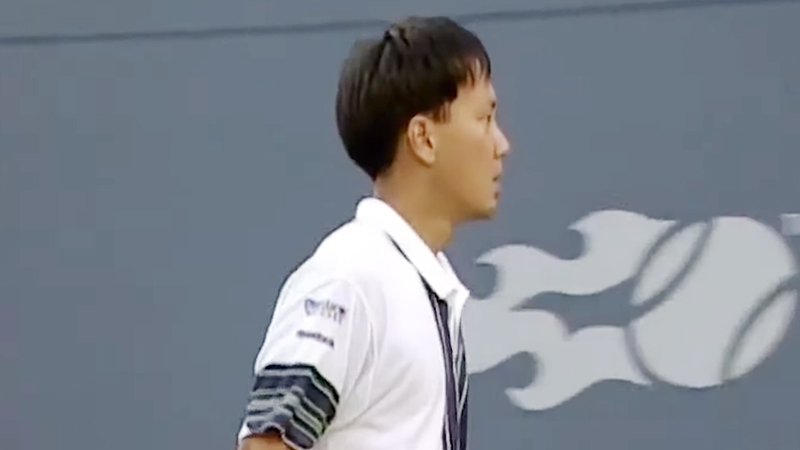
Yes, Michael Chang won one Major title during his career, triumphing at the 1989 French Open. At just 17 years and 110 days old, he made history as the youngest male player to ever win a Grand Slam singles title, a record that remains unbroken today.
While this was his only victory, Chang was a perennial contender, reaching three additional Major finals—the 1995 French Open, 1996 Australian Open, and 1996 US Open.
His career is defined by relentless grit, tactical intelligence, and a remarkable 142–58 singles record across all four Major tournaments.
Did Michael Chang Ever Win a Major?
Michael Chang’s historic victory at Roland Garros in 1989 remains one of the most legendary runs in the history of professional tennis.
His path to the title was not merely a display of athletic skill but a masterclass in psychological resilience and strategic innovation that captured the world’s attention.
The Lendl Miracle: Psychological Warfare on Clay
The defining moment of Chang’s 1989 run occurred in the Round of 16 against the world No. 1 and defending champion, Ivan Lendl.
After falling behind by two sets, Chang began to suffer from severe, dehydrating leg cramps that threatened to force his retirement from the match.
In a desperate attempt to conserve energy and disrupt Lendl’s rhythm, Chang famously utilized an underhand serve and stood exceptionally close to the service line to return Lendl’s serves.
These unconventional tactics broke Lendl’s concentration, allowing Chang to complete an improbable comeback with a final score of 4–6, 4–6, 6–3, 6–3, 6–3.
Defeating Stefan Edberg to Secure the Title
Following his victory over Lendl, Chang reached the final to face world No. 3 Stefan Edberg. The championship match was a grueling five-set marathon that lasted 3 hours and 41 minutes.
Despite the physical toll of the preceding rounds, Chang demonstrated elite stamina and mental fortitude to outlast Edberg with a score of 6–1, 3–6, 4–6, 6–4, 6–2.
This win ended a 34-year drought for American men at the French Open, as he became the first American to win the event since Tony Trabert in 1955.
Analyzing Michael Chang’s Grand Slam Success and Statistics
While the 1989 French Open was the pinnacle of his career, a statistical analysis of Chang’s performance reveals a player of extraordinary consistency.
Over a 16-year professional career spanning from 1987 to 2003, he competed in 60 Grand Slam main draws and maintained a high winning percentage across various playing surfaces.
| Major Tournament | Win-Loss Record | Win % | Best Result |
|---|---|---|---|
| Australian Open | 43–13 | 76.8% | Runner-up (1996) |
| French Open | 38–15 | 71.7% | Champion (1989) |
| US Open | 43–16 | 72.9% | Runner-up (1996) |
| Wimbledon | 18–14 | 56.3% | Quarter-finalist (1994) |
| Total | 142–58 | 71.0% | 1 Title |
Chang found his greatest success on hard and clay courts, where his defensive baseline game and speed were most effective. His win percentage exceeded 70% at three of the four Majors, highlighting his status as a top-tier competitor throughout the 1990s.
Why Michael Chang Remained a World No. 2 Behind Legends
Despite his high level of play and 34 career singles titles, Michael Chang never reached the world No. 1 ranking.
His career-high ranking of World No. 2 was achieved on September 9, 1996, during a period of intense competition in men’s tennis. Several factors contributed to him remaining just shy of the top spot.
Competing Against the Era of Sampras and Agassi
Chang spent much of his prime competing in what is often described as a “golden era” of tennis. He frequently faced off against legendary players including Pete Sampras, Andre Agassi, Boris Becker, and Jim Courier.
These rivals often stood in his way during the final stages of Major tournaments. For instance, in 1996 alone, he reached the finals of both the Australian Open and the US Open, only to be defeated by Boris Becker and Pete Sampras, respectively.
Surface Limitations and the Wimbledon Struggle
While Chang was dominant on clay and hard courts, grass proved to be his most challenging surface. His win percentage at Wimbledon was significantly lower (56.3%) compared to his other Major performances.
He only reached the quarter-finals at Wimbledon once, in 1994, and frequently exited in the early rounds. In a points-based ranking system, this lack of high-end results on grass made it difficult to overtake rivals who were more proficient across all four surfaces.
The Youngest Grand Slam Winner: A Record Unbroken
The legacy of Michael Chang extends beyond his trophy count. His 1989 victory set a benchmark for youth in the sport that has remained untouched for decades. His triumph at 17 years and 110 days old surpassed the previous record held by Boris Becker.
To put this in perspective, even the most dominant players of the modern era have failed to win a Major at such a young age.
Impact on the American Tennis Boom
Chang’s success served as a catalyst for a surge in American men’s tennis. By winning a Major at such a young age, he inspired his contemporaries, such as Sampras, Agassi, and Courier, to strive for their own Grand Slam breakthroughs.
This collective of players would go on to dominate the sport for over a decade, but it was Chang who first proved that the new generation of Americans could compete with the world’s best on any surface.
Cultural Significance and Political Context
The 1989 French Open took place against the backdrop of significant global events, specifically the Tiananmen Square protests in China.
As a Chinese-American, Chang felt a deep connection to these events and frequently stated that his performance was motivated by a desire to provide a sense of hope and joy to Chinese people worldwide during a difficult period.
This added layer of purpose contributed to the legendary status of his run at Roland Garros.
Detailed Major Performance Tracker by Year
To understand the longevity of Michael Chang’s career, it is helpful to look at his year-by-year progression in Grand Slam tournaments. He was a consistent fixture in the second week of Majors for over a decade.
- 1989: French Open Winner; Wimbledon 4R; US Open 4R.
- 1990-1991: Reached the French Open Quarter-finals in consecutive years.
- 1992: US Open Semi-finalist.
- 1993: Quarter-finalist at both the French Open and US Open.
- 1994: Achieved his best Wimbledon result (Quarter-finals).
- 1995: Australian Open Semi-finalist; French Open Runner-up; US Open Quarter-finalist.
- 1996: Australian Open Runner-up; US Open Runner-up.
- 1997: Semi-finalist at both the Australian Open and US Open.
Even as he entered the later stages of his career, Chang remained competitive, finally retiring in 2003 after a 16-year journey that saw him accumulate 142 Major match wins.
Frequently Asked Questions About Michael Chang
How many Majors did Michael Chang win?
Michael Chang won one Major title, the 1989 French Open. Although he reached three other Grand Slam finals—the 1995 French Open, 1996 Australian Open, and 1996 US Open—he finished as the runner-up in those instances.
Who is the youngest man to win a Grand Slam?
Michael Chang holds the record as the youngest male player to win a Grand Slam singles title. He achieved this feat at the 1989 French Open at the age of 17 years and 110 days.
What was Michael Chang’s highest world ranking?
His career-high ranking was World No. 2, which he reached on September 9, 1996. He was never able to secure the No. 1 spot, largely due to the dominance of rivals like Pete Sampras and Andre Agassi.
Is Michael Chang in the Hall of Fame?
Yes, Michael Chang was inducted into the International Tennis Hall of Fame in 2008. This honor recognizes his Major victory, his 34 career titles, and his overall impact on the sport.
Final Thoughts on a Hall of Fame Career
Michael Chang’s career is a testament to the power of perseverance and tactical intelligence. While the question “Did Michael Chang ever win a Major?” is answered by his singular, historic triumph in 1989, his impact on tennis is far broader.
He retired with 34 singles titles and a reputation as one of the most difficult players to beat on the tour.
His 1989 French Open victory remains a cornerstone of tennis history, not just for the record he set as a teenager, but for the dramatic and courageous way in which he secured the title.
Today, he is remembered as a pioneer who helped usher in a new era of global and American tennis excellence.