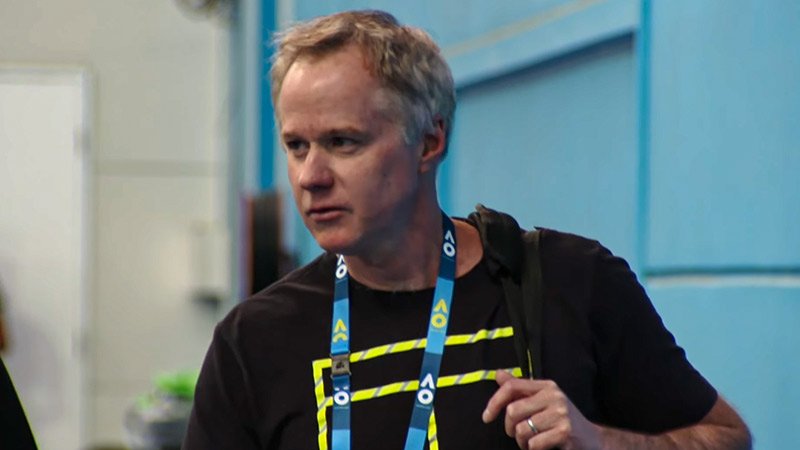
Yes, Patrick McEnroe has won a major tournament. His definitive Grand Slam victory occurred at the 1989 French Open, where he captured the Men’s Doubles title alongside partner Jim Grabb.
While he never secured a singles major title, reaching a career-best semifinal at the 1991 Australian Open, his doubles prowess was world-class.
Patrick’s career, spanning 1988 to 1998, saw him reach three Major finals and achieve a peak doubles ranking of World No. 3. This victory at Roland Garros ensures his individual legacy alongside his famous brother, John, in the annals of tennis history.
Did Patrick McEnroe Ever Win a Grand Slam?
The question of whether Patrick McEnroe secured a major title is often met with confusion due to the immense success of his older brother.
However, Patrick carved out his own elite path, specifically in the doubles discipline where he was a constant threat on the global stage. His professional journey culminated in a historic performance in Paris that cemented his status as a Grand Slam champion.
The 1989 French Open Championship Run
Patrick’s greatest professional achievement came on the red clay of Stade Roland Garros in 1989. Entering the tournament as an unseeded duo, Patrick and Jim Grabb navigated a difficult draw to reach the final.
They faced the charismatic Iranian player Mansour Bahrami and Frenchman Éric Winogradsky in a high-stakes championship match.
The American pair displayed remarkable chemistry and mental toughness, securing the title with a hard-fought four-set victory: 6–4, 2–6, 6–4, 7–6(7–5).
Match Day Drama and the Shadow of John
The 1989 final was marked by a unique set of circumstances that highlighted the unusual dynamic of the McEnroe family’s tennis dominance.
Tournament officials were forced to move the Men’s Doubles final away from the main Philippe Chatrier Center Court to the smaller Court No. 1. This decision was made because the singles final between Ivan Lendl and John McEnroe was running exceptionally long.
Consequently, Patrick had to compete for his first major title while the echoes of his brother’s intense battle resonated from the adjacent stadium.
This victory was not just a statistical win; it was a moment where Patrick stepped out from the familial shadow to etch his own name on a Grand Slam trophy.
How Many Majors Has Patrick McEnroe Won?
To provide a clear understanding of Patrick’s standing in the tennis world, it is essential to look at the numbers. His career was defined by longevity and high-level consistency, particularly when compared to other elite athletes of the 1990s.
The following data highlights the distinction between the two McEnroe brothers and Patrick’s specific accomplishments.
| Category | Patrick McEnroe (Career) | John McEnroe (Career) |
|---|---|---|
| Total Major Titles | 1 (1989 French Open Doubles) | 17 (7 Singles, 9 Doubles, 1 Mixed) |
| Major Singles Titles | 0 | 7 |
| Major Doubles Titles | 1 | 9 |
| Major Mixed Doubles Titles | 0 (1 Final appearance) | 1 |
| Career High Ranking (Singles) | No. 28 (1995) | No. 1 |
| Career High Ranking (Doubles) | No. 3 (1993) | No. 1 |
| Total Professional Titles | 1 Singles, 16 Doubles | 77 Singles, 78 Doubles |
Analyzing Patrick McEnroe’s Singles and Doubles Record
While the 1989 French Open is the centerpiece of his resume, Patrick was far from a “one-hit wonder.” He maintained a high standard of play across all surfaces, though his efficiency in doubles significantly outpaced his singles results.
Analyzing his win-loss percentages reveals a player who understood the nuances of team-based tennis at a masterclass level.
Dominance in the Doubles Discipline
Statistically, Patrick was an elite force on the doubles court, finishing his career with a 79–35 win-loss record in major doubles events. This reflects a winning percentage of 69.3%, a figure that places him among the upper echelon of specialists during his era.
His tactical intelligence and serve-and-volley skills allowed him to reach multiple quarterfinals and finals, including the 1991 Australian Open final with Scott Davis.
His success was further validated in 1993 when he reached a career-high individual doubles ranking of World No. 3.
Notable Singles Achievements and Deep Major Runs
Though a singles major title eluded him, Patrick was a formidable opponent who often peaked during the biggest tournaments.
His best performance in a singles major came at the 1991 Australian Open, where he reached the semifinals before falling to the legendary Boris Becker. He also enjoyed deep runs later in his career, most notably at the 1995 US Open.
Playing in front of his home-state New York crowd, an older Patrick reached the quarterfinals, demonstrating that his competitive fire remained intact even as he transitioned toward the end of his playing days.
What Were Patrick McEnroe’s Best Major Results?
Understanding the breadth of Patrick’s career requires looking at his performance across all four Grand Slam venues. He was a versatile player who could adapt his game to the slow clay of Paris, the fast grass of London, and the hard courts of Melbourne and New York.
- Australian Open: Finalist in Men’s Doubles (1991) and Semifinalist in Singles (1991).
- French Open: 🏆 Champion in Men’s Doubles (1989) and reached the 3rd Round in Singles (1991).
- Wimbledon: Twice a Quarterfinalist in Men’s Doubles (1992, 1993).
- US Open: Finalist in Mixed Doubles (1988) and Quarterfinalist in Singles (1995).
Professional Milestones Beyond the Grand Slams
Patrick’s achievements extended to the prestigious year-end championships, which often carry as much weight as majors among professional peers.
Winning these events requires defeating the top-ranked players in the world in a concentrated format, leaving little room for error or luck.
The 1989 Year-End Masters Championship
Directly following his triumph in Paris, Patrick capstoned his 1989 season by winning the prestigious year-end Masters Doubles title alongside Jim Grabb.
This victory was crucial in proving that their French Open win was a result of sustained excellence rather than a singular bracket anomaly.
By defeating the top eight teams on the planet, Patrick solidified his position as one of the premier doubles players of the decade.
Ranking Consistency and Longevity
Over an 11-year professional career from 1988 to 1998, Patrick remained a constant fixture in the later rounds of ATP events. He secured a total of 16 professional doubles titles and one singles title at the 1995 Sydney international tournament.
His ability to maintain a top-30 singles ranking while simultaneously being a top-5 doubles threat speaks to his physical conditioning and deep understanding of the sport’s various strategic layers.
Frequently Asked Questions About Patrick McEnroe’s Career
How many singles majors did Patrick McEnroe win?
Patrick McEnroe never won a singles major title. His best singles result in a Grand Slam was reaching the semifinals of the 1991 Australian Open.
Who was Patrick McEnroe’s partner when he won the French Open?
He won the 1989 French Open Men’s Doubles title with fellow American Jim Grabb. They entered the tournament unseeded and defeated Mansour Bahrami and Éric Winogradsky in the final.
What was Patrick McEnroe’s highest world ranking?
In doubles, Patrick reached a career-high of World No. 3 in April 1993. In singles, his highest ranking was World No. 28, achieved in 1995.
Did Patrick McEnroe win any Mixed Doubles majors?
No, although he reached the final of the 1988 US Open Mixed Doubles tournament with Elizabeth Smylie, he finished as the runner-up.
Conclusion: A Respected Figure in Tennis History
Patrick McEnroe’s career serves as a testament to the fact that success in professional sports is not solely defined by the number of trophies on a mantle.
While he operated in an era dominated by icons and under the immense weight of the McEnroe surname, he built a resume that any professional would envy.
By securing a Grand Slam title at Roland Garros and reaching the pinnacle of the world rankings, he earned his place as a legitimate star in his own right.
His transition from an elite player to a respected captain and broadcaster further cements his enduring influence on the game of tennis.