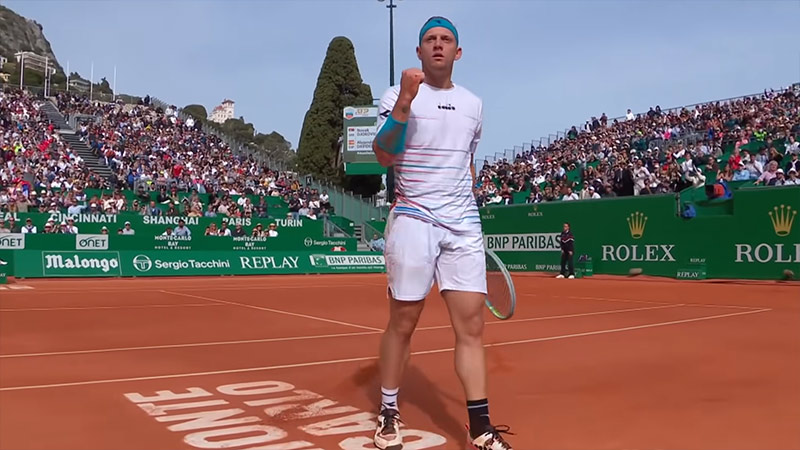
Alejandro Davidovich Fokina wears odd socks as a strict superstition that defines his professional career. The Spanish tennis star wears one black and one white sock during every match and practice session, a habit he has maintained since age 15 or 16.
What began as a teenage desire to stand out from his peers became a mandatory ritual after he won a match while wearing mismatched colors.
Today, he considers the look essential to his identity, jokingly claiming he cannot play without them and that a matching pair would signal an impostor.
Why Does Alejandro Davidovich Fokina Wear Mismatched Socks?
To understand the specific ritual of this Spanish powerhouse, one must look back at his developmental years on the junior circuit, where the seeds of this habit were first planted.
It was not originally born of a deep-seated belief in luck, but rather a simple expression of personality.
A Teenage Quest for Individuality
As a teenager, Davidovich Fokina was looking for a way to distinguish himself in a sport that often demands uniformity in its younger ranks. At age 15 or 16, he decided to step onto the court wearing socks of different colors simply because he wanted to be unique.
He had a desire to wear something that was “different from everybody else,” marking the beginning of a visual signature that would eventually become famous across the ATP Tour.
This initial choice was purely aesthetic, a small act of rebellion against the standard white-on-white athletic attire often seen in tennis academies.
The First Victory that Sparked a Career Ritual
The transition from a stylistic choice to a mandatory superstition happened in an instant. After wearing the mismatched pair during a match and securing a victory, Davidovich Fokina associated the gear with his success.
This is a common psychological phenomenon in high-stakes sports where an athlete attributes a positive outcome to a specific, repeatable action or item.
From that day forward, the “one black, one white” look was no longer optional; it became a requirement for his mental preparation.
He has explicitly stated in interviews with the ATP that he feels completely unable to play or even train if he is not wearing his mismatched set.
The Psychological Weight of the Mismatched Gear
For Davidovich Fokina, the socks are more than just fabric; they are a mental anchor. Professional tennis is as much a battle of psychology as it is of physical skill, and for Alejandro, the absence of his ritual can lead to significant internal friction.
The Imposter Theory: Dealing with Matching Socks
One of the most famous anecdotes regarding this superstition involves Davidovich Fokina’s “brother.” He has joked on multiple occasions that his identity is so closely tied to the mismatched socks that if fans ever see him wearing two socks of the same color, it isn’t actually him on the court.
“It’s not me. It’s my brother!” he has famously stated, emphasizing that he does not feel like himself when the ritual is broken. This humor masks a real psychological dependency; the socks act as a “trigger” that tells his brain he is ready for professional competition.
Mental Comfort and High-Performance Court Presence
Rituals provide athletes with a sense of control in an unpredictable environment. For a player like Davidovich Fokina, who is known for his expressive and often erratic playing style, the consistency of his socks provides a stabilizing force.
When he looks down and sees the black sock on one foot and the white on the other, it reinforces his sense of self and his history of winning.
The distress he feels when this routine is interrupted—whether by medical necessity or tournament rules—can be visible to spectators, as the mental “flow” of his game is momentarily disrupted.
Navigating the Rigid Dress Codes of Professional Tennis
While most ATP tournaments allow for creative freedom in attire, certain historic events have posed a direct challenge to Davidovich Fokina’s unyielding superstition. The conflict between personal ritual and institutional tradition creates a unique hurdle for the Spaniard.
| Tournament Type | Sock Rule Policy | Davidovich Fokina’s Approach |
|---|---|---|
| Standard ATP Events | Generally flexible colors | Standard: One black sock, one white sock. |
| Training Sessions | No restrictions | Mandatory mismatched set. |
| Wimbledon | Strict All-White clothing policy | Creative workarounds using tape or wraps. |
| Warm-up Events (e.g., Queen’s) | Flexible but formal | Maintains ritual while discussing exemptions. |
The Ingenious Wimbledon Tape Solution
Wimbledon is world-renowned for its “all-white” dress code, which explicitly bans dark colors like Davidovich Fokina’s signature black sock. During his match against Hubert Hurkacz, he faced a dilemma: follow the rules and risk his mental game, or find a loophole.
He chose the latter. He wore two white socks but used heavy athletic tape to wrap over one of them, strategically darkening the appearance of the sock to mimic his usual mismatched aesthetic.
This creative solution allowed him to respect the tournament’s traditions while satisfying his own psychological need for visual asymmetry.
The Quest for Official Exemptions
Davidovich Fokina is well aware of how unusual his request is, yet he continues to champion his cause. During warm-up tournaments such as the Queen’s Club Championships, he has engaged in lighthearted discussions about asking Grand Slam officials for special dispensation.
He has joked about trying to convince officials to let him bypass the dress code specifically for his socks, illustrating just how much he values this particular routine.
While he has not yet received a formal exception, his dedication to finding “workarounds” shows that he prioritizes his superstition over the ease of following the standard rules.
Technical Nuances of the Left-Foot Requirement
The superstition is not just about having two different colors; it is about the specific arrangement of those colors. There is a precise method to Davidovich Fokina’s ritual that must be followed for him to feel “match-ready.”
Why the Black Sock Stays on the Left
Davidovich Fokina has a specific preference for which foot wears which color. He normally designates his left foot for the black sock. This level of specificity is common among elite athletes who use “left-right” routines to ground themselves.
By assigning a permanent color to a specific foot, he removes one more variable from his pre-match preparation. This consistency ensures that every time he looks down during a serve or a return, his environment remains exactly as it has been since he was 16 years old.
Physical Wraps vs. Mental Focus
The ritual is sometimes challenged by the physical demands of professional tennis. If a trainer needs to wrap an ankle or apply medical tape over a sock for support, it can obscure the colors or force the use of specific medical gear.
This has been known to cause visible distress to Davidovich Fokina, as it physically interferes with the visual cues of his superstition.
The battle to maintain his routine even while dealing with injury highlights the deep-seated nature of this habit; the mental comfort of the mismatched socks is often as important as the physical stability provided by the tape.
The Evolution of Superstitions in Elite Tennis
Davidovich Fokina is part of a long lineage of tennis players who rely on eccentric routines to manage the pressure of the professional circuit. His socks are his version of the meticulous line-stepping or bottle-placing seen in other champions.
How Professional Rituals Protect the Mind
In the world of elite sports, routines serve as a shield against performance anxiety. For Davidovich Fokina, the act of putting on his mismatched socks is likely the final step in a mental “warm-up” that signals his transition from a person to a competitor.
When an athlete has a ritual that has lasted nearly a decade, it carries the weight of every victory they have achieved in that time frame.
Breaking that chain feels like inviting bad luck, which is why Davidovich Fokina is willing to go to such lengths—like taping his feet at Wimbledon—to keep the chain intact.
The Fan Perspective on Visual Signatures
Beyond the player’s psychology, these rituals create a powerful brand identity. Fans and commentators frequently discuss “the man with the odd socks,” which makes him instantly recognizable on a crowded tour. This fulfills his original teenage goal of being “different from everybody else”.
By leaning into his quirk, Davidovich Fokina has fostered a sense of authenticity that resonates with fans who appreciate seeing the human, slightly superstitious side of world-class athletes.
Frequently Asked Questions About Fokina’s Odd Socks
When did Alejandro Davidovich Fokina start wearing odd socks?
He began the habit when he was 15 or 16 years old. Initially, it was just a way to stand out, but it quickly became a superstition after he won a match while wearing them.
What specific colors does he wear?
He typically wears one black sock and one white sock. Usually, the black sock is worn on his left foot.
Why can’t he wear them at Wimbledon?
Wimbledon has a strict “all-white” clothing policy that forbids dark colors like black socks. To get around this, he has used white athletic tape to darken one of his white socks, maintaining the mismatched look without technically breaking the color rule.
Does he wear matching socks during practice?
No, he has stated that he cannot train or play without the mismatched socks. The ritual extends to his daily practice sessions, not just official tournament matches.
What happens if he wears two matching socks?
He jokingly says that if he wears matching socks, it isn’t him, but his brother. He feels that his true identity on the court is tied to the mismatched look.
Maintaining the Momentum
Whether you see it as a quirk or a critical psychological tool, Alejandro Davidovich Fokina’s mismatched socks are here to stay.
They represent the individuality of a player who refused to blend in and found a way to turn a teenage fashion choice into a source of professional strength.
As he continues his journey on the ATP Tour, his black and white socks will remain a constant reminder that in the world of high-performance sports, your mind is just as important as your racquet.
Stay tuned to his upcoming matches to see how he continues to navigate the traditions of the sport while staying true to his unique identity.