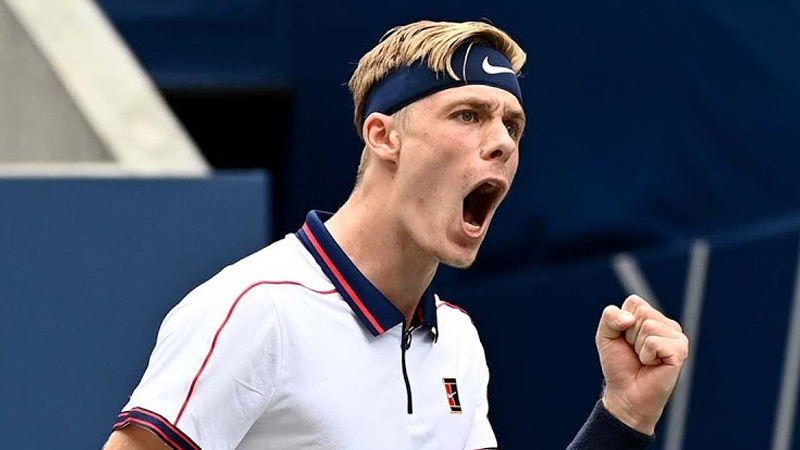
Denis Shapovalov is not at the 2026 Monte-Carlo Masters because he was eliminated in the first round on April 6, 2026.
While he traveled to Monaco to compete, the Canadian star suffered a tough three-set defeat (6-4, 4-6, 6-3) against Belgian qualifier Alexander Blockx.
If you notice his absence from the current schedule or draw, it is due to this early exit rather than an injury or withdrawal.
This loss continues a difficult trend for Shapovalov, who now holds a winless 0–4 career record at this specific Masters 1000 event on the slow red clay.
Why is Denis Shapovalov Not at Monte Carlo? 2026 Match Review
The absence of Denis Shapovalov from the later stages of the Monte-Carlo Masters often leads fans to wonder if he is dealing with an injury or a scheduling conflict. However, for the 2026 season, the explanation is purely performance-based.
The Opening Round Battle Against Alexander Blockx
Shapovalov’s campaign in Monaco ended abruptly during the first round of the main singles draw. He faced Alexander Blockx, a rising 20-year-old qualifier from Belgium who managed to capitalize on the Canadian’s inconsistency.
The match was a grueling three-set affair that lasted several hours, ultimately ending in a 6-4, 4-6, 6-3 victory for the underdog.
Critical Turning Points and Missed Opportunities
The most significant moment of the match occurred in the final set. Shapovalov had a golden opportunity to get back on level terms when he earned a love-40 lead on Blockx’s serve in the final game.
Failing to convert any of those three consecutive break points proved fatal, as Blockx recovered to hold serve and secure the match.
This lack of clinical execution at high-pressure moments has been a recurring theme in Shapovalov’s recent performances on this surface.
Statistical Analysis of the 2026 First-Round Exit
The numbers behind the match provide a clear picture of why the Canadian left-hander struggled to maintain control against his Belgian opponent.
| Match Metric | Denis Shapovalov | Alexander Blockx |
|---|---|---|
| Final Score | 1 Set (4-6) | 2 Sets (6-4, 6-3) |
| Aces | 2 | 2 |
| Double Faults | 5 | 2 |
| Break Points Converted | 2 of 7 | 3 of 4 |
| Service Consistency | Struggled with errors | High pressure on return |
This statistical matchup highlights structural issues, particularly the five double faults committed by Shapovalov, which gifted Blockx crucial points throughout the match.
His inability to protect his serve and his low conversion rate on break point opportunities (only 28%) were the primary drivers of the defeat.
A Deep Dive into the Denis Shapovalov Monte Carlo Record
While many elite players find their rhythm in Monaco, the Monte-Carlo Country Club has historically been a “bogey” tournament for the talented Canadian.
The 0–4 Career Win-Loss Record
Shapovalov has never won a main draw match in Monte Carlo. Across four different appearances, he has exited in the opening round every single time he has entered the competition.
This winless streak is particularly notable because it spans nearly a decade of his professional career.
Year-by-Year Results in Monaco
- 2018: His debut ended in a straight-set loss to Stefanos Tsitsipas (6-3, 6-4).
- 2019: Entering as the 15th seed, he was upset by Germany’s Jan-Lennard Struff in three sets (5-7, 6-3, 6-1).
- 2025: After a period of absence, he returned only to be eliminated by American Marcos Giron (6-3, 7-6).
- 2026: His most recent defeat came at the hands of Alexander Blockx (6-4, 4-6, 6-3).
It is important to note that Shapovalov chose to skip or withdraw from this event during the 2021, 2022, 2023, and 2024 seasons, often citing schedule optimization as the reason for his absence.
The Technical Challenge: High-Risk Tennis vs. Heavy Clay
To understand why a player of Shapovalov’s caliber struggles in Monaco, one must look at the intersection of his playing style and the specific environmental conditions of the venue.
The Penalty of Slow and Heavy Conditions
The red clay at the Monte-Carlo Country Club is known for being uniquely slow and heavy compared to other clay courts on the ATP tour. These conditions dampen the power of aggressive baseline shots, which is the cornerstone of Shapovalov’s game.
On faster surfaces, his explosive left-handed forehand can end points quickly, but in Monaco, the ball sits up, allowing opponents more time to track down his shots.
Elevated Unforced Error Counts
Because the surface rewards patience and defensive consistency, it heavily penalizes high-risk, aggressive shotmaking. Shapovalov’s natural instinct is to go for winners, but on this heavy clay, those risks often result in elevated unforced error counts.
The 2026 match against Blockx was a prime example of this, as the Canadian struggled with consistency throughout the three sets.
The Physicality of the Rallies
Longer rallies are inevitable in Monaco. For a player who prefers short, punchy points, the physical and mental demand of sustaining 15-to-20-ball exchanges often leads to a breakdown in technique.
This explains why he has struggled to close out sets even when leading, as seen in his historical metrics where he has lost eight sets while winning only two at this venue.
Comparative Analysis: Shapovalov’s Clay Court Successes
It would be a mistake to assume that Denis Shapovalov is a poor clay-court player overall. His struggles in Monte Carlo are an outlier when compared to his performance at other major tournaments on the dirt.
Success at the Madrid and Rome Masters
Shapovalov has proven he can compete with the world’s best on clay when the conditions are more favorable to his speed and power.
- Madrid Masters: He reached the Semifinals in 2018, benefiting from the high altitude and faster clay in Spain.
- Rome Masters: He has reached the Quarterfinals twice (2020 and 2022), showing that he can handle the traditional European clay when he is in top form.
Professional Career Performance Metrics
Beyond the Masters level, Shapovalov reached the final of the Geneva Open in 2021. On the ATP tour level, he maintains a career win rate of 46.8% on clay.
This data suggests that while Monte Carlo represents a significant hurdle, his overall capability on the surface is much higher than his 0–4 record in Monaco would suggest.
Schedule Optimization and the 2023 Monte Carlo Withdrawal
If you are looking for information on a time when Shapovalov was truly “not at” the tournament in terms of physical presence, you are likely thinking of the 2023 season.
The Strategy Behind Skipping Events
In 2023, Shapovalov famously withdrew from the Monte-Carlo Masters before the tournament began. This was not due to a last-minute injury but was a calculated move for schedule optimization.
Given that clay is historically his least preferred surface, his team decided to focus on training and preparing for events where he had a higher probability of success.
Balancing the ATP Calendar
For elite players, the transition from hard courts to clay is one of the most taxing periods of the year. Shapovalov’s history of skipping Monte Carlo highlights a strategic approach to preserving his body and focusing his energy on the French Open and the grass-court season, where his game naturally flourishes.
However, in 2026, he made the decision to play, making his absence from the later rounds a result of his match loss rather than a strategic withdrawal.
The Impact on Canadian Tennis Standings in 2026
Shapovalov’s early exit in 2026 was part of a larger, disappointing day for Canadian tennis fans following the tournament.
A Tough Day for the Maple Leaf
On the same day that Shapovalov fell to Blockx, fellow Canadian Gabriel Diallo was also eliminated from the tournament. Diallo lost in straight sets to Brazil’s Joao Fonseca, meaning that two of Canada’s primary hopes for a deep run were extinguished within 24 hours.
Looking Ahead to the Rest of the Season
This rough start to the 2026 clay season has put pressure on the Canadian contingent to find their form ahead of the Madrid and Rome Masters.
While the loss in Monaco is a setback, the historical data shows that Shapovalov often finds his rhythm as the season progresses and the courts become slightly faster and more responsive to his aggressive style.
FAQ: Common Questions on Shapovalov’s Clay Season
Did Denis Shapovalov withdraw from Monte Carlo 2026?
No, he did not withdraw. He competed in the main draw but was eliminated in the first round by Alexander Blockx.
How many times has Shapovalov won a match in Monte Carlo?
To date, he has never won a main draw match at the Monte-Carlo Masters, holding a career record of 0–4.
Why does he play better in Madrid than in Monaco?
The conditions in Madrid are faster and the altitude allows his shots to travel through the air more quickly, which suits his aggressive, high-risk playing style better than the heavy, slow clay of Monaco.
Who defeated Denis Shapovalov in his most recent Monte Carlo appearance?
He was defeated by Belgian qualifier Alexander Blockx in a three-set match (6-4, 4-6, 6-3).
Is Shapovalov injured?
There are no current reports of injury explaining his 2026 exit; the documentation indicates his absence from the latter stages of the tournament is strictly due to his first-round loss.
Summary of Next Steps for the Canadian Star
As the tennis world moves past the early results in Monaco, the focus for Denis Shapovalov will undoubtedly shift toward technical adjustments.
To improve his consistency on heavy clay, he may need to temper his high-risk approach and focus on better point construction.
While his 0–4 record in Monte Carlo is a blemish on his otherwise impressive resume, his past successes in Rome and Madrid provide a blueprint for a successful clay-court campaign.
Fans can expect to see him back in action as he looks to reclaim his standing in the ATP rankings during the remainder of the European swing.