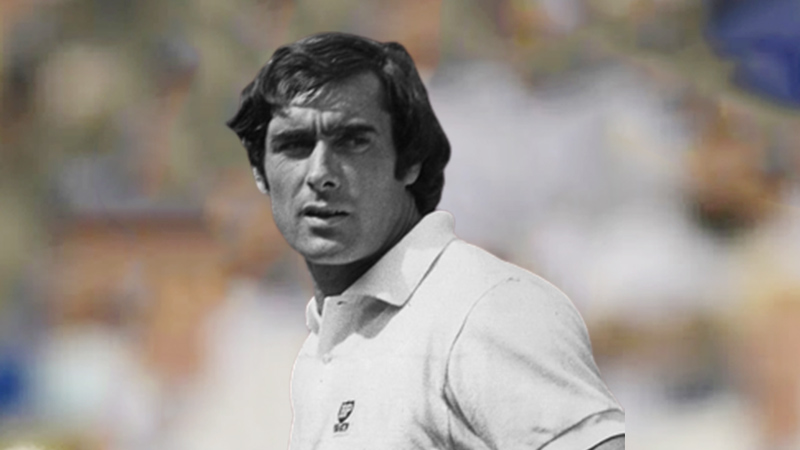
Roger Taylor is famous in tennis as a dominant British No. 1 who defined the early 1970s through grit and sportsmanship.
Celebrated for reaching three Wimbledon semifinals and winning two US Open doubles titles, his legacy centers on defeating world No. 1 Rod Laver in 1970 and refusing to join the 1973 Wimbledon boycott, earning him the title “The Man Who Saved Wimbledon.”
Beyond stats, Taylor was a cultural icon—a member of the “Handsome Eight” who nearly became James Bond. From Sheffield’s public courts to the Davis Cup captaincy, Taylor’s multifaceted career remains a cornerstone of British tennis history.
Professional Career Achievements and Grand Slam Stats
The trajectory of Roger Taylor’s career is a testament to self-reliance and technical mastery. Rising from the industrial landscape of Sheffield, Taylor was a self-taught athlete who honed his skills by hitting tennis balls against a wall.
This unconventional beginning paved the way for him to reach the absolute peak of the sport during a transformative era.
His statistical profile highlights a player of remarkable consistency across both singles and doubles disciplines, maintaining a high level of performance on various surfaces.
| Achievement Category | Key Statistical Milestones |
|---|---|
| Grand Slam Singles Semifinals | Wimbledon (1967, 1970, 1973); Australian Open (1970) |
| Grand Slam Singles Quarterfinals | French Open (1973) |
| Major Doubles Titles | US Open Men’s Doubles Champion (1971, 1972) |
| Career High Ranking | World No. 11 (Official ATP) / World No. 7 (Unofficial) |
| Total Singles Titles | 31 career titles between 1958 and 1982 |
| National Standing | Long-standing British No. 1 throughout the early 1970s |
How Roger Taylor Saved Wimbledon and Defied the Boycott
The 1973 season was a watershed moment for professional tennis, marked by a massive organizational strike that threatened the survival of the world’s most prestigious tournament.
When the newly formed Association of Tennis Professionals (ATP) initiated a boycott of Wimbledon, 81 of the world’s top players withdrew from the competition.
As the reigning British No. 1, Taylor faced immense pressure to follow the collective action of his peers. However, his decision to remain in the draw is widely credited with preserving the tournament’s integrity during a period of extreme instability.
Choosing Loyalty Over the ATP Strike
Taylor’s refusal to participate in the boycott was rooted in a deep sense of responsibility toward the British public and the heritage of the All England Club.
By playing while his contemporaries sat out, he ensured that the 1973 tournament retained its star power and competitive relevance.
This act of defiance against the strike led to his lifelong moniker, “The Man Who Saved Wimbledon,” which he eventually adopted as the title for his official autobiography.
His participation proved that the tournament was larger than any single political dispute within the professional ranks.
The Ethical Victory Against Björn Borg
During the same 1973 tournament, Taylor’s commitment to fair play was tested on the court during a tense quarterfinal match against a 17-year-old Björn Borg.
When the umpire awarded Taylor a match point based on a disputed line call, Borg reacted with frustration. In a display of legendary sportsmanship, Taylor voluntarily offered to replay the point to ensure the outcome was beyond reproach.
Despite replaying the point and extending the match, Taylor still secured the victory, cementing his reputation as a paragon of athletic integrity who valued a fair contest over an easy win.
The Giant Killer: Ending Rod Laver’s 1970 Streak
Perhaps the most famous individual victory of Taylor’s career occurred during the 1970 Wimbledon quarterfinals.
At the time, Rod Laver was the undisputed titan of the sport, the reigning world No. 1 and defending champion who was riding a historic 31-match winning streak at the All England Club.
Taylor’s performance in this match is still cited by historians as one of the most significant upsets in the history of the game, as he dismantled Laver’s dominance in front of a stunned home crowd.
A Tactical Masterclass at the All England Club
Taylor’s victory over Laver was not merely a matter of luck but a demonstration of his tactical evolution and mental toughness. By snapping Laver’s streak, Taylor proved that the era of untouchable legends was transitioning into a more competitive landscape.
This “giant-killer” performance elevated Taylor’s global profile, demonstrating that a British player could not only compete with the best in the world but could dictate the terms of the match against the greatest living exponent of the sport.
The Shift in Global Tennis Power
Following his victory over Laver, Taylor’s trajectory continued upward, eventually leading him to a career-high ranking.
While official computer rankings later placed him at No. 11, many contemporary analysts and unofficial listings regarded him as the No. 7 player in the world.
His ability to consistently reach the later stages of Grand Slams—including his 1970 Australian Open semifinal run—solidified his place as a perennial threat in the draw and a key figure in the narrative of 1970s tennis.
The Professional Revolution and “The Handsome Eight”
In 1968, Taylor was instrumental in the commercial modernization of the sport. He was selected as the sole British representative to join Lamar Hunt’s “Handsome Eight,” a pioneering group of contracted touring professionals who laid the groundwork for the modern Open Era.
This group helped transition tennis from its amateur roots into a high-revenue professional industry.
- Pioneering Professionalism: The Handsome Eight were the first group of players to sign lucrative professional contracts that challenged the amateur status quo.
- Global Ambassadors: These eight players toured the world, bringing high-level tennis to new markets and proving that the sport had massive commercial potential.
- Standard Setting: Their involvement forced traditional tournaments to open their doors to professionals, leading directly to the creation of the modern ATP circuit.
- Cultural Impact: The “Handsome” branding helped market players as celebrities, bridging the gap between sports and mainstream entertainment.
Why was Roger Taylor almost James Bond?
Taylor’s fame was never confined strictly to the tennis court; his physical presence and rugged aesthetic gave him a level of mainstream celebrity that was rare for athletes of his generation.
With his jet-black hair and broad shoulders, he possessed a “Hollywood appeal” that caught the attention of the film industry during the peak of his playing days.
This crossover appeal often saw him featured in media outlets that had little to do with sport, focusing instead on his status as a British cultural icon.
The 007 Screen Test and Audition
In 1967, while practicing at the Queen’s Club, Taylor was spotted by Bond filmmakers who were seeking a replacement for Sean Connery. Impressed by his dashing looks and athletic poise, they invited him to audition for the role of James Bond.
Taylor reportedly spent an entire week practicing the legendary “The name’s Bond… James Bond” line in preparation for the role.
However, the opportunity ended when he declined a required swimwear screen test after his wife expressed objections to the nature of the scene.
The Locker Room Enforcer Persona
Contrasting with his polished movie-star looks was a fierce, working-class grit that defined his on-court personality. Unlike many of his contemporaries who came from privileged backgrounds, Taylor’s upbringing in Sheffield gave him a harder edge.
This manifested in 1969 during a famous locker-room incident where Taylor used a powerful left hook to floor Australian pro Bob Hewitt following a heated dispute.
This duality—the gentleman sportsman on the court and the gritty enforcer in the locker room—made him a unique and compelling figure in the public eye.
Leadership Roles and Post-Retirement Excellence
After concluding his active playing career in 1982, Taylor transitioned into leadership roles that allowed him to shape the future of British tennis.
His experience as a top-tier professional made him an ideal candidate for captaincy positions, where he could mentor younger players and guide national teams through major international competitions.
| Leadership Position | Key Impact and Achievements |
|---|---|
| Davis Cup Captain | Led the Great Britain men’s team from 2000 to 2004 |
| Wightman Cup Captain | Guided the British ladies’ team to their last-ever victory in 1978 |
| Royal Recognition | Awarded an MBE in 1977 for extensive services to tennis |
| Ambassadorial Role | Continues to represent British tennis as a symbol of sportsmanship and history |
Common Questions About Roger Taylor’s Tennis Legacy
Why is he called “The Man Who Saved Wimbledon”?
He earned this title by refusing to participate in the 1973 ATP boycott, ensuring the tournament remained a viable event despite the absence of 81 other top pros.
Did Roger Taylor ever win a Grand Slam title?
Yes, he won the US Open men’s doubles title twice, in 1971 (with John Newcombe) and 1972 (with Cliff Drysdale).
Who did Roger Taylor beat in his most famous upset?
He famously defeated Rod Laver in the 1970 Wimbledon quarterfinals, ending Laver’s 31-match winning streak.
Was he really considered for the role of James Bond?
Yes, he was invited to audition in 1967 and practiced for a week before turning down a screen test due to personal reasons.
What was his highest world ranking?
His official ATP high was World No. 11 in 1973, though he reached an unofficial rank of World No. 7 earlier in his career.
The Lasting Influence of a British Icon
Roger Taylor remains a foundational figure in the history of the sport, representing a bridge between the amateur past and the professional present. His legacy is defined by more than just trophies; it is built on the choices he made when the integrity of the game was at stake.
By choosing to play in 1973 and replaying points out of respect for his opponents, he established a standard of conduct that modern players still strive to emulate.
For fans and historians of the game, Taylor’s story is a reminder that excellence is often forged in the absence of traditional advantages.
From the brick walls of Sheffield to the hallowed grass of Wimbledon, his journey is a blueprint for aspiring athletes everywhere. His contributions as a player, captain, and cultural ambassador ensure that his name will always be synonymous with the best traditions of British sport.
To explore more about the history of legendary athletes who shaped the modern era, consider reviewing archival footage of the 1973 season or visiting the museum at the All England Club.