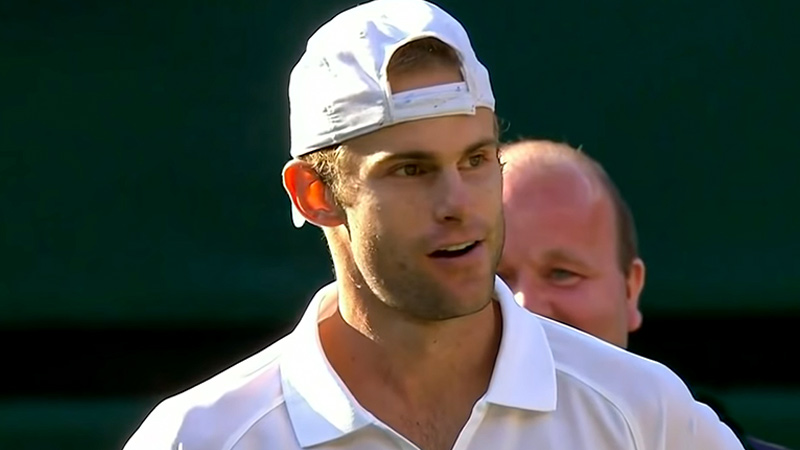
Andy Roddick was an elite, world-class tennis champion, achieving a career singles record of 612–213 and capturing 32 ATP titles. His career peak arrived in 2003 when he won the US Open and became World No. 1, a ranking he held for 13 weeks.
Roddick’s legacy is defined by sustained excellence, remaining in the year-end Top 10 for nine consecutive seasons between 2002 and 2010.
As the last American man to win a Grand Slam and reach No. 1, his dominance featured a record-breaking 155 mph serve and an unplayable serve-plus-one game.
Was Andy Roddick Good? Analytical Assessment of Elite Performance
Andy Roddick was significantly better than the average professional, maintaining a status as a dominant force on fast courts for over a decade.
His statistical profile includes winning 90% of his career service games and firing 9,074 aces, which allowed him to overwhelm opponents with power.
Beyond raw power, Roddick was characterized by a fierce competitive grit and a tireless work ethic that enabled him to succeed in grueling five-hour matches.
The Mechanics of the “Rocket” Serve
Roddick’s first serve often exceeded 135–150 mph, providing him with a high volume of free points and easy putaways. His second serve was arguably the best in the game during his career, featuring a massive kick and heavy spin that made it difficult to attack.
His serve placement was as exceptional as his speed, creating a one-two punch with his aggressive forehand. To this day, his 155 mph (249 km/h) serve remains one of the fastest ever recorded in professional tennis.
Offensive Prowess and Early Dominance
In the early 2000s, Roddick utilized a heavy, hyper-aggressive topspin forehand to blow opponents off the baseline. During his 2003 US Open run, he unloaded on every opportunity, jumping around backhand returns to rip unreturnable forehand winners.
His game was built on constant forward pressure, utilizing tactical variations and heavy spins to keep opponents defensive. This aggressive style allowed him to remain a heavy favorite against players ranked below him for nearly his entire career.
Sustained Consistency and Longevity
Roddick was not a “one-hit wonder,” as evidenced by his 40 consecutive Grand Slam seedings and 10 years of winning at least one title per season.
He was a cornerstone of the United States Davis Cup team, famously leading the squad to a championship victory over Russia in 2007.
His ability to remain in the Top 10 for nine straight years highlights a level of sustained excellence that few players in history have matched. His peers viewed him as a player who could take the racquet out of an opponent’s hand when motivated and “on”.
Was Andy Roddick Ever #1? Historical Context of His Reign
Andy Roddick reached the World No. 1 ranking on November 3, 2003, following his dominant straight-sets victory over Juan Carlos Ferrero in the US Open final.
He held the top spot for 13 consecutive weeks and finished the 2003 season as the year-end World No. 1. He remains the last American man to hold this prestigious ranking, a drought that has persisted for over two decades.
Achieving the Pinnacle in the Transitional Era
Roddick’s ascent occurred during a transitional period in tennis history, post-90s depth and pre-Federer/Nadal dominance. He was able to “make hay” during this window, securing 32 singles titles and five Masters 1000 events.
His No. 1 ranking was a testament to his ability to outperform other Grand Slam winners of that era, such as Marat Safin and Lleyton Hewitt. While his time at No. 1 was relatively brief at 13 weeks, it cemented his status as a legendary figure in American sports.
The Impact of the Big Three Rivalry
Roddick’s stay at the top was curtailed by the emergence of Roger Federer, who became a primary obstacle for Roddick’s career. Roddick reached five Grand Slam finals but faced Federer in four of them, losing all four.
Between 2004 and 2009, Federer directly denied Roddick multiple Grand Slam titles in either semifinals or finals.
Many analysts suggest that Roddick could have easily won five or more career Slams had his prime not overlapped perfectly with the peaks of Federer, Nadal, and Djokovic.
Technical Evolution and Tactical Shifts
Over the course of his career, Roddick’s playing style underwent a significant transformation that analysts still debate today.
Originally a power-based offensive baseline player, he eventually transitioned into a more defensive, passive counter-puncher under various coaches.
While this shift enhanced his consistency and prolonged his career, it stripped away the raw, offensive forehand power that defined his youth.
The Defensive Shift and Style of Play
Mid-career, Roddick began relying heavily on fitness and defensive grinding, often playing well behind the baseline. This tactical change was likely a response to the slowing of court surfaces and the rise of defensive masters like Rafael Nadal and Novak Djokovic.
By the end of his career, some observers referred to him as a “pusher” who relied more on slices and consistency than on blasting winners. Despite this, his high-level court coverage and fighting spirit ensured he remained a constant threat on the tour.
Structural Weaknesses and Technical Limitations
Roddick possessed a structurally rigid backhand that was vulnerable to being exploited during deep baseline rallies by historic counter-punchers.
His approach shots and volleys were often criticized as inconsistent, sometimes lacking the placement needed to pull opponents off the court.
Furthermore, his court tactics were occasionally questioned, such as a relative inability to take the ball early, which gave opponents more time to react. Despite these minor limitations, he remained competitive at the highest level for a decade.
Career Performance and Statistical Breakdown
The following table highlights Roddick’s primary statistical achievements and his performance in major championship matches.
| Category | Career Statistic / Result | Historical Context |
|---|---|---|
| Win-Loss Record | 612–213 (74.2%) | Elite Tier Consistency |
| ATP Titles | 32 Singles Titles | Including 5 Masters 1000s |
| Max Serve Speed | 155 mph (249 km/h) | Former World Record |
| Grand Slam Titles | 1 (2003 US Open) | Last American Male Winner |
| Grand Slam Finals | 5 Appearances | Lost 4 to Roger Federer |
| Top 10 Consistency | 9 Consecutive Years | 2002–2010 Year-End Top 10 |
| Service Game Win % | 90% | One of the highest in history |
| Career Aces | 9,074 | All-time statistical leader tier |
External Factors: Technology and Court Conditions
Roddick’s career was uniquely impacted by external changes in the sport, specifically regarding equipment and surface speeds.
The rise of polyester (poly) and co-poly strings helped opponents increase spin and margin for error on returns, making Roddick’s massive serve easier to handle.
Simultaneously, tennis courts globally began to slow down, which diminished the effectiveness of his power game and favored baseline grinders.
The Evolution of Return Tactics
As string technology improved, players’ return games became significantly better, reducing the slim margins Roddick relied on.
Racket technology and improved physical conditioning across the tour meant that more players could hang in long rallies without tiring.
Roddick’s “big game” eventually felt less overwhelming as the general journeyman quality on the tour increased. This technological shift contributed to his decision to retool his game for more consistency rather than pure aggression.
The 2009 Wimbledon Final: A Statistical Anomaly
The 2009 Wimbledon final remains a defining moment of Roddick’s career and a testament to his elite level. In a match lasting 4 hours and 16 minutes, Roddick held serve 37 consecutive times against Roger Federer.
He was broken only once in the entire match—the final game of the fifth set, which ended 16-14. This performance demonstrated that Roddick could play flawlessly for hours on the game’s biggest stage, even if the result was a heartbreaking loss.
Conclusion
Andy Roddick’s legacy is that of a Hall of Fame athlete who maximized his physical gifts to become one of the most consistent players of his generation.
While his career is often viewed through the lens of his rivalry with Roger Federer, his statistics—612 wins, 32 titles, and nine years in the Top 10—secure his place as an all-time great.
He was inducted into the International Tennis Hall of Fame in 2017, cementing his status as the standard-bearer for American tennis during its most competitive era.
Roddick was not merely a big server; he was a fierce competitor who remained a fixture at the pinnacle of the sport for a decade.
FAQs
How many Grand Slam finals did Andy Roddick reach?
Andy Roddick reached five Grand Slam singles finals during his career. He won the 2003 US Open in straight sets against Juan Carlos Ferrero.
His other four final appearances were at Wimbledon (2004, 2005, 2009) and the US Open (2006), all of which he lost to Roger Federer.
When did Andy Roddick retire from professional tennis?
Andy Roddick officially announced his retirement during his last US Open in 2012. One of his final significant victories was a match against Roger Federer in Miami earlier that same year, where he showcased a return to his aggressive offensive style.
What was Andy Roddick’s fastest serve?
Roddick set a then-world record with a serve clocked at 155 mph (249 km/h). His serve was a primary weapon throughout his career, contributing to his 9,074 career aces and a career service game win rate of 90%.