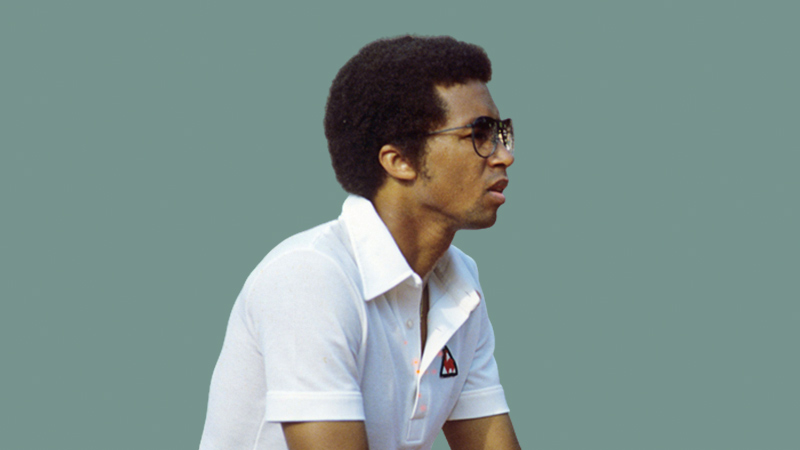
In the chronicles of professional sports, few moments resonate with the same intellectual and social gravity as the afternoon of July 5, 1975, on the hallowed grass of Centre Court.
For those seeking a definitive answer to the question—yes, Arthur Ashe won the Wimbledon men’s singles title—the victory represents far more than an entry in a record book.
It was a triumph of tactical ingenuity over raw power and a watershed moment for representation in a sport that had long been a bastion of exclusivity.
Fifty years later, this upset remains a cornerstone of sporting history, not merely for the result, but for the profound strategic shift that made it possible.
The Historical Landscape: An Unbeatable Opponent
To understand the magnitude of Ashe’s victory, one must look at the landscape of professional tennis in 1975. The defending champion, Jimmy Connors, was the undisputed titan of the era.
At just 22 years old, Connors was a left-handed powerhouse who had dominated the 1974 season, winning three of the four Grand Slams. He arrived at the 1975 final having not dropped a single set during the entire tournament.
The contrast between the two finalists was stark:
| Feature | Arthur Ashe | Jimmy Connors |
|---|---|---|
| Age | 31 (Veteran) | 22 (Defending Champion) |
| Style | “Professorial,” fluid, hard-hitting | Brash, aggressive, counter-punching |
| Rank/Status | Heavy Underdog | Perceived as “Invincible” |
| Major Titles | 2 (Entering the match) | 8 (Career total) |
| Psychological Factor | Stoic and calm | High-energy and confrontational |
Adding to the tension was a legal battle outside the court. Just weeks prior, Connors had filed a defamation lawsuit against Ashe over a letter Ashe had written to the Association of Tennis Professionals (ATP) criticizing Connors’ refusal to play for the US Davis Cup team. The match was as much a clash of character as it was of skill.
The “Playboy Club” Strategy: A Tactical Masterclass
The evening before the final, Arthur Ashe met with his inner circle—including Donald Dell, Charlie Pasarell, and Freddy McNair—at the Playboy Club in London.
They recognized a fundamental truth: if Ashe played his usual “free-flowing, hard-hitting style,” he would lose.
Connors, though smaller in stature, excelled at using his opponent’s pace against them; he was a master at absorbing power and redirecting it with lethal accuracy.
The group devised a counter-intuitive plan that required Ashe to abandon his instincts. This “soft-ball” strategy focused on depriving Connors of the power he craved.
Key Elements of the 1975 Tactical Shift:
- The “Junk” Ball: Ashe intentionally hit slow, low-pace balls that forced Connors to generate his own power.
- The Wide Slice Serve: Instead of his trademark flat, high-velocity serve, Ashe used a wide slice to pull Connors out of position.
- Strategic Variety: Ashe utilized an array of lobs, drop shots, and dinked volleys to disrupt Connors’ rhythm.
- Deep Returns: By staying back and slicing the ball, Ashe forced Connors into uncomfortable areas of the court.
The Match Breakdown: 6-1, 6-1, 5-7, 6-4
When the match began, the Centre Court crowd was “bemused” by Ashe’s approach. The man known for a blistering serve-and-volley game was suddenly “pushing” the ball over the net and dinking shots like a club player.
The Opening Dominance
The strategy worked with surgical precision. Connors was “flummoxed,” expecting power but receiving only “soft” balls that gave him nothing to work with.
Ashe raced through the first two sets with identical 6-1 scores, leaving the “invincible” champion looking utterly lost.
The Third Set Pivot
Connors, a fierce competitor, began to find his footing in the third set. He increased his aggression and managed to take the set 7-5.
At this juncture, most players would have panicked and reverted to their natural, hard-hitting game. However, Ashe remained “stoic” and disciplined, refusing to abandon the plan that had brought him this far.
Closing the History Books
In the fourth set, Ashe regained control. His calm demeanor—a hallmark of his “gentleman” personality—never wavered under the heat of battle.
He closed out the set 6-4, securing a victory that silenced the doubters and cemented his place as the first and, to this date, the only Black man to win the Wimbledon singles title.
The Significance of the Victory
This match was a turning point for the sport and for Ashe’s own legacy. While his 1968 US Open win was a major milestone, winning at Wimbledon—often considered the “pinnacle” of the sport—was the realization of a lifelong ambition.
A Legacy of Representation
For future generations of players, particularly players of color, Ashe proved that excellence was not tied to a specific background. His victory on the “hallowed grounds” of Wimbledon served as a beacon of possibility.
Current professionals, such as Chris Eubanks, look back at this moment as a poetic achievement that paved the way for modern diversity in the sport.
Humanitarian and Global Impact
Ashe’s life was defined by the phrase “Citizen of the World,” which he often wore on a favorite T-shirt. His win at Wimbledon gave him an even larger platform to pursue the causes he was passionate about:
- Anti-Apartheid Activism: He leveraged his status to challenge the South African government’s policies.
- Public Health Advocacy: After contracting HIV through a blood transfusion, he became a leading voice for AIDS awareness and research.
- Educational Opportunities: He was a tireless advocate for youth tennis and education, believing that the sport could be a vehicle for social mobility.
Analysis of Ashe’s Playing Style and Temperament
Observers who knew him best, such as teammate Stan Smith and journalist Richard Evans, often comment on the psychological strength required to pull off such an upset.
Ashe was not just a physical player; he was a strategic thinker who understood the “big picture” of both a match and his life.
The Dual Legacy of Arthur Ashe
| On-Court Impact | Off-Court Legacy |
|---|---|
| First Black man to win Wimbledon | Global humanitarian for civil rights |
| Mastered the “soft-ball” tactical shift | Arrested for protesting for refugees and against apartheid |
| Winner of 3 Grand Slam singles titles | Founding member of the ATP |
| Known for composure and dignity | A leading advocate for AIDS awareness |
Conclusion: The Enduring Impact of a Champion
Arthur Ashe’s victory in 1975 was not just a win for a player; it was a win for strategy, dignity, and progress. It remains one of the most “brilliant tactical” moments in the history of any sport.
By defeating an opponent who seemed invincible through the power of the mind, Ashe proved that the ultimate strength lies in one’s ability to adapt and remain composed under pressure.
Today, as players compete in the largest tennis stadium in the world—named in his honor—the memory of that July afternoon at Wimbledon serves as a reminder that a true champion is measured not just by the trophies they hold, but by the barriers they break and the lives they inspire.