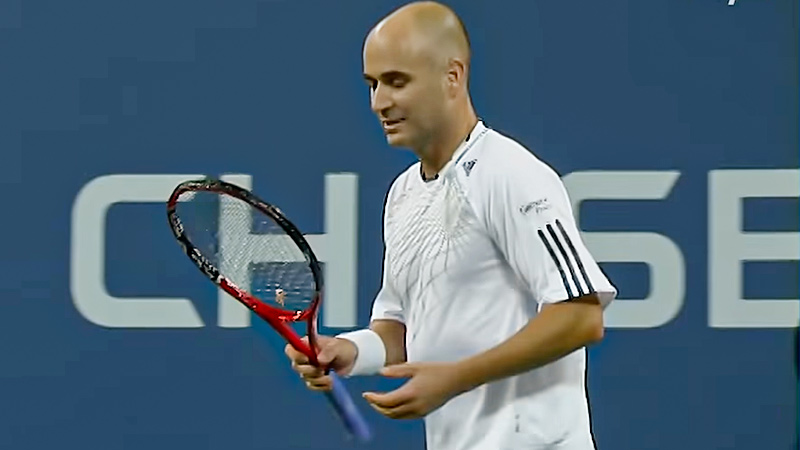
In the history of professional athletics, few figures have transformed as profound or as successfully as Andre Agassi.
To evaluate how good he truly was, one must look beyond the flashy early-career persona and analyze a technical foundation that changed the mechanics of modern tennis.
Agassi was not merely a champion; he was a pioneer of the baseline-centric game that dominates the tour today.
As one of only five men in history to achieve a Career Grand Slam, and one of the even rarer few to secure a Career Golden Slam, Agassi’s resume places him in the highest echelon of the sport.
His journey from a teenage prodigy to a seasoned, thirty-something World No. 1 is a study in technical mastery, physical adaptation, and mental resilience.
The Technical Foundation: A New Way to Play
What made Agassi “good” was a radical departure from the traditional tennis logic of his era.
While his contemporaries often relied on massive serves and net-rushing tactics, Agassi revolutionized the sport from the back of the court.
The Greatest Return in History
Agassi is widely regarded by analysts and peers as one of the premier service returners the game has ever seen. His ability to neutralize the most powerful serves was not just a matter of fast reflexes; it was a matter of technical geometry.
- Early Reading: He possessed an uncanny ability to read a server’s toss and shoulder rotation, allowing him to begin his move before the ball even crossed the net.
- Neutralizing Power: Even against players like Pete Sampras or Boris Becker, Agassi could take a 120mph delivery and put it back at the server’s feet, immediately shifting the point from a defensive struggle to an offensive opportunity.
Taking the Ball on the Rise
Perhaps his most influential contribution to the sport was his “early ball-striking”. Most players wait for the ball to reach the apex of its bounce or begin to descend before striking. Agassi, however, stood close to the baseline—sometimes even inside it—and struck the ball as it was still rising.
- Time Robbery: By hitting the ball earlier, he forced his opponents to react faster. This style effectively “stole” time from the person on the other side of the net, making Agassi appear much faster and more aggressive than a traditional counter-puncher.
- Flat, Deep Accuracy: His shots were characterized by a flat trajectory and extreme depth, which kept opponents pinned behind their own baseline, unable to find an opening to attack.
Statistical Dominance: The Trophy Cabinet
To quantify Agassi’s greatness, we must look at the sheer volume and variety of his achievements. His success was not limited to one surface or one era; it spanned two decades of global competition.
| Achievement Type | Total / Detail | Historical Significance |
|---|---|---|
| Grand Slam Singles Titles | 8 | Only 5 men have won all four in the Open Era. |
| Career Golden Slam | All 4 Majors + Olympic Gold | Includes his 1996 Atlanta Olympic Gold Medal. |
| Total ATP Titles | 60 | Ranks among the top winners in the history of the tour. |
| Masters Series Titles | 17 | Demonstrates consistency at the highest level outside of Slams. |
| Weeks at World No. 1 | Multiple Stints | Reached the top in both the 90s and the 2000s. |
| Davis Cup Titles | Multiple | Led the United States to several international victories. |
The Evolution of a Competitor: Longevity and Resilience
Agassi’s career was defined by its second act. Many players of his generation burned out by their late 20s. Agassi, conversely, found a new level of excellence in his 30s.
- The Mid-90s Slump: During the middle of his career, Agassi experienced significant fluctuations in his ranking and motivation. His ranking famously plummeted to No. 141 in the world in 1997.
- The Historic Revitalization: Instead of retiring, he committed to a rigorous conditioning program and returned to the Challenger circuit to rebuild his game. This led to a historic climb back to World No. 1, proving his mental fortitude was as strong as his physical talent.
- Adapting to the New Guard: Even as power-hitters like Marat Safin and a young Roger Federer entered the scene, Agassi remained a top-tier global competitor by refining his fitness and playing high-percentage tennis.
A Comprehensive Look at His Grand Slam Titles
Agassi’s eight major titles were spread across every surface, showcasing a level of versatility that many of his rivals lacked.
- Australian Open (4 Titles): This was his most successful major. His fitness and baseline consistency were perfectly suited for the hard courts of Melbourne.
- US Open (2 Titles): Winning in New York cemented his status as a national icon and a master of the hard-court game.
- Wimbledon (1 Title): In 1992, Agassi shocked the world by winning on grass—a surface that supposedly favored serve-and-volleyers—by simply out-hitting everyone from the baseline.
- French Open (1 Title): His 1999 victory in Paris completed his Career Grand Slam, a feat that had eluded many of the greatest players before him.
Strategic Analysis: Overcoming Limitations
Agassi’s greatness is perhaps best measured by how he succeeded despite not having a “perfect” game. He was a specialist who maximized his strengths to hide his deficiencies.
- Service Limitations: Unlike his primary rival, Pete Sampras, Agassi did not have a dominant, unreturnable first serve. He had to work harder for every service game, relying on placement and follow-up groundstrokes rather than free points.
- The Baseline Preference: He rarely ventured to the net, preferring to dictate play from the back. While this could have been a weakness, his “early ball-striking” made it difficult for opponents to lure him into uncomfortable positions or pass him.
- Overcoming the Odds: By focusing on being the best returner in history, he effectively turned his opponents’ greatest weapons—their serves—against them, leveling the playing field against taller, more powerful players.
Final Verdict: The Legacy of Andre Agassi
How good was Andre Agassi? He was good enough to redefine the physical and strategic boundaries of his sport.
He proved that a player could dominate the world’s most powerful servers without having a massive serve of their own. He proved that a career could be resurrected from the depths of the rankings through sheer willpower and conditioning.
Most importantly, Agassi’s legacy is found in the way the game is played today. Every time a modern professional stands on the baseline and rips a return winner or takes a ball on the rise to dictate play, they are utilizing the blueprint that Andre Agassi perfected over two decades of excellence.
He remains not just a champion, but one of the most influential figures in the history of global athletics.