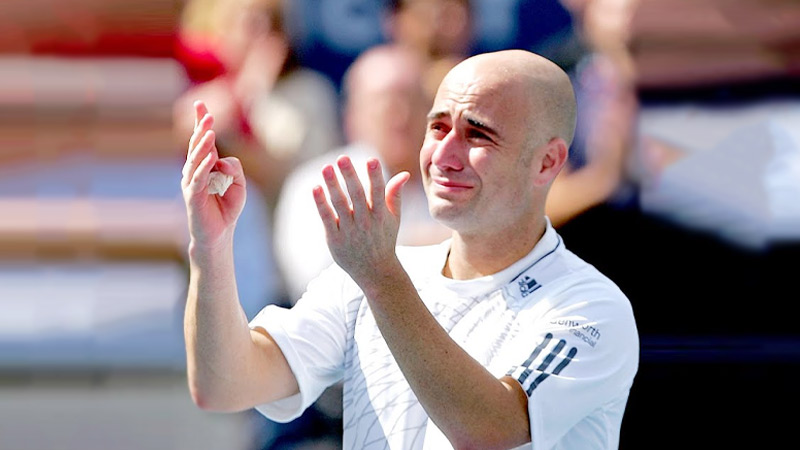
The twilight of an iconic sports career is rarely a quiet fade into the background. For Andre Agassi, stepping away from professional tennis on September 3, 2006, at the US Open, was a masterclass in grace under fire.
After two decades of redefining a sport through sheer kinetic electricity, cultural disruption, and unmatched baseline dominance, Agassi’s body simply demanded a permanent ceasefire.
Understanding why Andre Agassi retired requires looking past the final scoreboard defeat to Benjamin Becker and examining the staggering physical toll exacted by a 21-year elite career.
It is a narrative of anatomical breakdown, relentless willpower, and the ultimate realization that time remains undefeated against even the greatest champions.
The Anatomical Breakdown: What Happened to Agassi’s Body?
By the time Agassi arrived at Flushing Meadows for his final tournament in late August 2006, his spine was functionally compromised. Decades of sliding on hard courts, explosive rotational torque on groundstrokes, and aggressive deceleration had battered his spinal architecture. Medical evaluations revealed a trifecta of severe degenerative structural conditions:
Spondylolisthesis: A spinal condition where one vertebra slips forward over the one below it. For Agassi, this instability created chronic structural weakness in his lower back, compromising his ability to maintain an athletic posture without acute agony.
Bulging Discs and Sciatica: The discs acting as shock absorbers between his vertebrae protruded outward, heavily impinging on the sciatic nerve. This triggered searing, debilitating radiation down his legs—a persistent electric shock with every step, twist, and sprint.
Bone Spurs: Bone overgrowths developed along his vertebrae as an inflammatory response to chronic joint stress, further compressing surrounding neural pathways and intensifying his pain.
This catalog of injuries meant that standard athletic preparation was no longer viable. Agassi was not merely managing normal tennis wear-and-tear; he was managing a structural crisis that threatened his long-term mobility away from the sport.
The Daily Reality: Cortisone Shots and Clockwork Recovery
Elite athletic endurance is built on the twin pillars of training and recovery. In his final professional seasons, Agassi’s routine shifted from performance optimization to basic damage control.
To step onto the court for competitive matches, he required regular, pain-numbing cortisone injections directly into his lumbar spine to temporarily suppress the nerve inflammation.
These interventions acted as temporary electrical tape on a crumbling foundation. Once the medication wore off, the reality of his physical decay returned instantly.
At 36 years old, Agassi famously noted that his body required significantly more recovery time than he possessed. A single intense match demanded days of passive medical treatment just to return to a baseline state of functional movement.
The mathematics of professional sport are unforgiving: when recovery outpaces preparation time, retirement becomes an inevitability rather than a choice.
The Final Curtain: The 2006 US Open Farewell
Agassi’s retirement was announced well in advance, turning the 2006 US Open into a global pilgrimage for sports fans.
Playing through agonizing pain, he carved out a gritty path to the third round, setting up a clash against German qualifier Benjamin Becker under the lights of Arthur Ashe Stadium.
The match ended in a four-set defeat, 7–5, 6–7, 6–4, 7–5. Yet, the final score dissolved into irrelevance the moment the last ball landed.
What followed was an immortal moment in sports history: a four-minute standing ovation from 20,000 roaring fans. Agassi, tears streaming down his face, delivered a farewell speech that resonated far beyond tennis:
Legacy and Post-Tennis Impact
Agassi walked away with an extraordinary resume: 8 Grand Slam singles titles, an Olympic Gold Medal, 101 weeks at World No. 1, and the rare distinction of completing the Career Grand Slam across three different surface types.
Yet, his retirement marked a seamless transition rather than an identity crisis. Freed from the daily pharmaceutical management of his back pain, Agassi redirected his legendary intensity toward philanthropy and education.
Through the Andre Agassi Foundation for Education and the creation of the Andre Agassi College Preparatory Academy in Las Vegas, he channeled his platform into transforming underserved communities.
His departure from tennis serves as a definitive case study in elite longevity. Agassi did not leave the game because his competitive spirit faded; he left because his physical vessel reached its absolute terminal threshold.
In doing so, he demonstrated that knowing when to walk away—with transparency, dignity, and grace—is just as defining as the championships won along the way.
Frequently Asked Questions
What exact back injuries forced Andre Agassi to retire?
Agassi retired primarily due to a combination of spondylolisthesis (a shifting vertebra), bulging discs causing severe sciatica, and localized bone spurs that pressed directly against his spinal nerves.
How old was Andre Agassi when he retired from tennis?
He was 36 years old and concluded a professional career that spanned 21 consecutive years after turning pro in 1986.
Who was Andre Agassi’s final professional opponent?
His final career match was against German player Benjamin Becker in the third round of the 2006 US Open.
Did Andre Agassi win all four Grand Slams?
Yes, Agassi achieved the rare Career Grand Slam by winning the Australian Open, French Open, Wimbledon, and the US Open at least once during his career