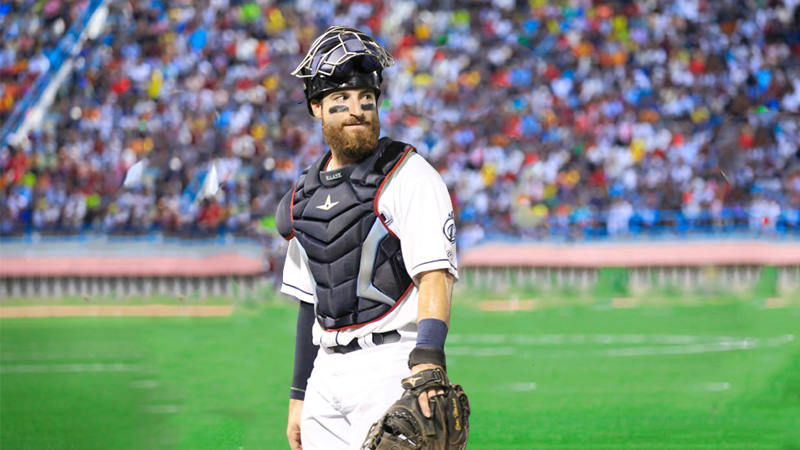
Eric Haase is a 33-year-old veteran Major League Baseball backstop who offers valuable depth as a third-string option.
Overall, Haase is a prototypical power-over-contact catcher who brings genuine home run capabilities at the bottom of a lineup but suffers from major contact limitations.
Over a nine-season major league career, he has generated a .224 batting average, 52 home runs, and 3.0 Wins Above Replacement.
While his raw power and throwing arm remain legitimate strengths, poor pitch-framing metrics and a high strikeout rate prevent him from securing a permanent starting role on a contending roster.
Power-Over-Contact Skill Profile
Evaluating veteran backstops requires examining their overall offensive profile, as raw power output often offsets lower contact rates when major league clubs need late-inning bench options or injury insurance during a long season.
Three-True-Outcome Hitting Approach
Haase represents a classic example of a three-true-outcome player whose plate appearances heavily result in home runs, walks, or strikeouts. This extreme offensive profile creates noticeable volatility in his performance.
While he provides occasional home run power from the lower third of a lineup, his low overall contact rate prevents consistent rally creation during multi-inning scoring threats.
Organizational Depth and Roster Value
Professional organizations value experienced backstops who can step into major league games without disrupting pitching operations.
Haase’s realistic value rests as a third-string option or temporary backup during emergency injury stretches.
His power gives teams an explosive bench option, though his limited hit tool keeps him from holding down a permanent everyday starting role.
Offensive and Defensive Strengths Breakdown
Analyzing Haase’s skill set reveals several high-value traits that make him an appealing veteran asset, particularly his raw power output, strong throwing arm, and reliable game management.
Legitimate Raw Power and Home Run Production
Haase features genuine pop that sets him apart from standard defensive backups. His career peak took place in 2021 with the Detroit Tigers, when he launched 22 home runs.
Even during a brief 2026 stint with the San Francisco Giants, he recorded 4 home runs, including an impressive grand slam, in just 74 at-bats.
Throwing Arm Strength and Outfield Versatility
Defensively, Haase possesses a powerful arm behind the plate that deters base runners. Furthermore, he provides versatility by offering the ability to play left field in a pinch.
This secondary position capability gives managers tactical roster flexibility when constructing late-game bench substitutions.
Clubhouse Leadership and Pitching Staff Management
Pitchers consistently respect Haase’s presence and game-calling abilities. He is regarded across baseball as a reliable veteran leader who smoothly navigates high-pressure pitching situations.
His steady demeanor helps calm staff members and maintains effective pitch execution during critical game innings.
Critical Weaknesses and Performance Flaws
To gain a complete picture of Haase’s major league value, one must evaluate his notable technical weaknesses, including persistent swing-and-miss tendencies, low on-base metrics, and defensive framing struggles.
High Strikeout Rates Against Velocity and Breaking Balls
Haase experiences severe difficulties against major league breaking balls and high velocity, resulting in a career .224 batting average. He routinely strikes out in nearly one-third of his plate appearances.
During his 2026 stint with San Francisco, he struck out 28 times in 74 at-bats, illustrating his high swing-and-miss frequency.
Low Walk Totals and Sub-Par On-Base Percentages
Because Haase rarely draws bases on balls, his ability to get on base remains limited. His career .276 On-Base Percentage (OBP) makes him a liability for maintaining continuous offensive rallies.
Without consistent walks, his offensive output depends almost entirely on extra-base hit production.
Pitch-Framing Deficiencies and Passed Ball Hazards
While Haase displays strong throwing arm power, advanced defensive metrics grade him poorly in receiving and pitch-framing quality.
In 191 innings behind the plate for San Francisco in 2026, he surrendered 10 wild pitches and 2 passed balls, reflecting noticeable defensive rough edges during game action.
Statistical Comparison and Performance Trends
Examining Haase’s statistical production across nine major league seasons alongside his recent organizational stops reveals his evolving offensive and defensive baseline.
| Performance Metric | Nine-Season Career Baseline | 2025 Milwaukee Brewers Stint | 2026 San Francisco Giants Stint |
|---|---|---|---|
| Batting Average (BA) | .224 | .229 | .162 |
| On-Base Percentage (OBP) | .276 | .289 | .235 |
| Slugging Percentage (SLG) | .394 | .357 | .365 |
| Home Runs (HR) | 52 Total | 2 | 4 |
| Wins Above Replacement (WAR) | 3.0 | 0.0 | -0.1 |
Roster Dynamics and Atlanta Braves Acquisition
Tracking Haase’s career timeline shows how veteran catchers navigate assignment changes, minor league stints, and late-season signings when contending teams seek depth before playoff rosters lock.
San Francisco Release and Chicago White Sox Triple-A Stint
After seeing his playing time shrink in San Francisco due to rookie catchers like Daniel Susac, Haase was designated for assignment and released in July 2026.
He quickly joined the Chicago White Sox organization, delivering a standout .375 batting average across seven Triple-A games before opting out of his deal.
Atlanta Braves Late-Season Postseason Depth Addition
In September 2026, the Atlanta Braves signed Haase to a minor-league contract just prior to the September 1st roster cutoff. This strategic signing secures Haase as an eligible third-string backstop behind Sean Murphy and Drake Baldwin.
His presence gives Atlanta an experienced veteran capable of handling emergency duty during playoff play.
Frequently Asked Questions About Eric Haase
What is Eric Haase’s current professional status?
Haase is under a minor-league contract with the Atlanta Braves, serving as third-string catcher depth behind Sean Murphy and Drake Baldwin.
What was Eric Haase’s most successful career season?
Haase enjoyed his peak season in 2021 with the Detroit Tigers, hitting 22 home runs and establishing himself as a fan favorite.
Can Eric Haase play defensive positions other than catcher?
Yes, Haase possesses the athleticism and arm strength to play left field in emergency situations.
Why did the San Francisco Giants release Eric Haase in 2026?
San Francisco designated Haase for assignment after he batted .162 with 28 strikeouts in 74 at-bats, giving playing time to rookie catchers like Daniel Susac.
Final Verdict and Scouting Outlook
Determining how good Eric Haase is depends on the roster context in which he is evaluated.
As an everyday starter or primary backup for a championship contender, his severe swing-and-miss tendencies, low .276 career OBP, and pitch-framing deficiencies present clear obstacles.
However, as a third-string organizational depth piece, Haase offers substantial value. His legitimate home run power, strong throwing arm, and respected clubhouse game-calling make him a dependable option when emergency injuries strike.
Organizations like the Atlanta Braves benefit greatly from having an experienced catcher of Haase’s caliber ready in the minor leagues.