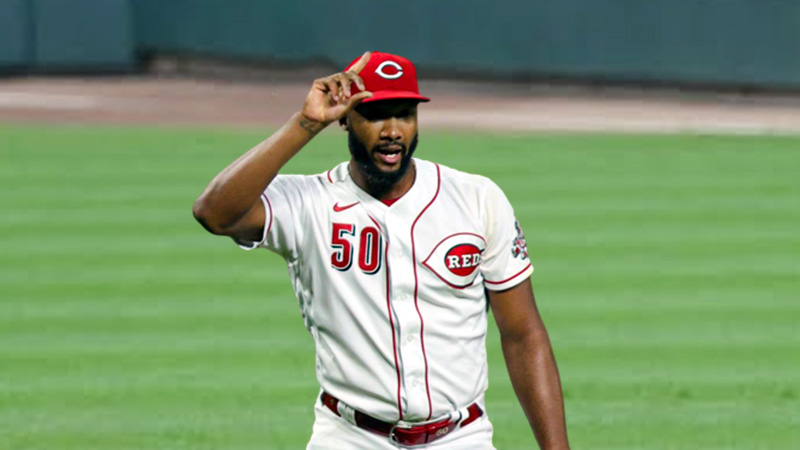
Amir Garrett established a reputation as one of baseball’s most emotionally expressive relief pitchers. Throughout his Major League Baseball career, his high-intensity style of play led to multiple disciplinary actions from league authorities.
When examining why Amir Garrett was suspended, the record indicates two primary categories of policy violations: inciting on-field altercations with opposing teams and engaging in improper interactions with spectators.
Across three distinct incidents spanning from 2019 to 2022, Garrett received a total of eighteen games in initial suspensions, which were subsequently reduced to fifteen games following official league appeal proceedings.
This comprehensive analysis examines the specific circumstances surrounding each disciplinary event, the underlying policy triggers, the mechanics of the league appeal process, and Garrett’s public accountability measures.
Categorizing Amir Garrett’s Major League Suspensions
Major League Baseball enforces strict behavioral guidelines to maintain game integrity, player safety, and professional conduct standards both on the diamond and in stadium spectator areas. Disciplinary interventions against Garrett stemmed from two distinct types of conduct:
- Inciting On-Field Altercations: Actions during competitive gameplay that led directly to benches-clearing incidents or physical confrontations with opposing dugouts.
- Fan-Related Conduct Violations: Actions involving direct physical contact or inappropriate boundary crossing with spectators positioned behind team dugouts.
Understanding these two categories provides clear context into how the league evaluates emotional escalation during competition versus off-field professional responsibilities.
Incident Timeline & Detailed Case Studies
1. Charging the Pittsburgh Pirates Dugout (September 2019)
- Club Affiliation: Cincinnati Reds
- Primary Offense: Charging an opposing dugout and sparking a massive brawl
- Initial Penalty: 8-Game Suspension
- Final Penalty: 8-Game Suspension
Context and Event Sequence:
During a late-season contest between the Cincinnati Reds and the Pittsburgh Pirates in September 2019, lingering verbal altercations escalated into a major physical confrontation. Pitching for the Reds, Garrett engaged in verbal exchanges with members of the Pirates’ bench.
Rather than remaining near the mound or returning to his team’s dugout, Garrett sprinted directly across the field and charged single-handedly into the Pittsburgh Pirates dugout.
This aggressive charge instantly triggered a massive benches-clearing brawl as players and coaches from both teams rushed into the dugout area to intervene.
Disciplinary Ruling
Major League Baseball cited Garrett for single-handedly inciting a massive brawl through his charge into the opposing dugout.
Due to the severity of entering an opponent’s bench area and initiating physical contact, the league issued an eight-game suspension. This stands as the longest single suspension of Garrett’s career.
2. The Benches-Clearing Conflict with the Chicago Cubs (May 2021)
- Club Affiliation: Cincinnati Reds
- Primary Offense: Inciting a benches-clearing incident through aggressive celebration
- Initial Penalty: 7-Game Suspension
- Final Penalty: 5-Game Suspension (Reduced on Appeal)
Context and Event Sequence:
In May 2021, during a rivalry matchup between the Cincinnati Reds and the Chicago Cubs, Garrett entered the game in a high-leverage relief situation.
Facing Cubs batter Anthony Rizzo, Garrett recorded a critical strikeout. Immediately following the third strike, Garrett engaged in an intense celebration, screaming and pounding his chest directly toward Rizzo.
The directed nature of the celebration drew an immediate response from the Chicago Cubs dugout. Infielder Javier Báez reacted by leaping over the dugout railing to confront Garrett on the field. This action caused both benches and bullpens to clear as personnel rushed to separate the key participants.
Disciplinary Ruling & Appeal Outcome
The league determined that Garrett was responsible for inciting the benches-clearing incident through his directed post-strikeout demeanor.
MLB initially handed down a seven-game suspension. Garrett exercised his right to appeal under the collective bargaining agreement, resulting in a reduction of the penalty to five games.
3. The Drink-Tossing Incident in Kansas City (August 2022)
- Club Affiliation: Kansas City Royals
- Primary Offense: Throwing a beverage at a spectator behind the dugout
- Initial Penalty: 3-Game Suspension
- Final Penalty: 2-Game Suspension (Reduced on Appeal)
Context and Event Sequence
By August 2022, Garrett had transitioned to the Kansas City Royals. During a game involving the Chicago White Sox, a fan seated directly behind the Kansas City dugout repeatedly heckled Garrett. In response to the persistent verbal comments, Garrett tossed a drink at the heckling spectator.
Disciplinary Ruling & Public Apology
Major League Baseball maintains zero tolerance for players throwing objects or liquids at spectators in stadium seating.
The league issued an initial three-game suspension for the breach of conduct. Following an official appeal, the league reduced the disciplinary length to two games.
Unlike prior competitive altercations, this incident involved a non-player spectator. Garrett addressed the situation directly through both public statements and private outreach.
He offered formal apologies and acknowledged publicly that professional athletes must hold themselves to a higher standard of conduct regardless of fan provocation.
Disciplinary Summary Table
| Incident Date | Team | Opponent | Nature of Offense | Initial Penalty | Final Penalty | Primary Trigger |
|---|---|---|---|---|---|---|
| September 2019 | Cincinnati Reds | Pittsburgh Pirates | Charging opposing dugout | 8 Games | 8 Games | Verbal altercations |
| May 2021 | Cincinnati Reds | Chicago Cubs | Inciting benches-clearing incident | 7 Games | 5 Games | Chest-pounding at Anthony Rizzo / Javier Báez reaction |
| August 2022 | Kansas City Royals | Chicago White Sox | Throwing drink at fan | 3 Games | 2 Games | Heckling behind the dugout |
Key Analytical Insights: Governance, Appeals, and Accountability
The Mechanics of League Appeals
A central pattern in Garrett’s disciplinary history is the regular utilization of Major League Baseball’s appeal mechanism. Out of three major suspensions:
- The 2019 incident remained at eight games.
- The 2021 incident was reduced by two games (from seven to five).
- The 2022 incident was reduced by one game (from three to two).
These reductions reflect standard administrative procedures where players present context, demonstrate remorse, or negotiate settlement terms with league officials prior to formal arbitration hearings.
Player-Spectator Boundaries vs. Competitive Emotion
The contrast between Garrett’s 2019/2021 incidents and his 2022 incident illustrates how sports governing bodies distinguish between internal competitive heat and external fan interaction.
While charging a dugout or celebrating intensely involves fellow uniformed personnel, throwing a drink at a spectator crosses the physical boundary separating participants from patrons.
Garrett’s explicit recognition that players must maintain higher standards highlights the professional responsibility required when dealing with stadium crowds.
Scope of Available Documentation
To maintain complete analytical transparency, it is helpful to outline what specific data points are contained within the reference text versus areas that fall outside the recorded material:
- Included Details: Specific dates (September 2019, May 2021, August 2022), team affiliations (Cincinnati Reds, Kansas City Royals), opposing teams (Pirates, Cubs, White Sox), key participants (Anthony Rizzo, Javier Báez), exact suspension lengths, appeal outcomes, and player statements.
- Excluded Context: The reference records do not contain game box scores, specific inning counts, career statistical summaries, financial fine amounts, or subsequent contract details.
Conclusion
Amir Garrett’s Major League Baseball suspensions illustrate the delicate balance between high-energy competitive drive and professional league governance.
Whether confronting opposing dugouts, celebrating after key strikeouts, or responding to stadium hecklers, each incident led to swift league intervention and formal discipline.
By acknowledging his mistakes and utilizing the league’s appeal process, Garrett’s career provides a clear case study in sports discipline, athletic accountability, and stadium boundary enforcement.