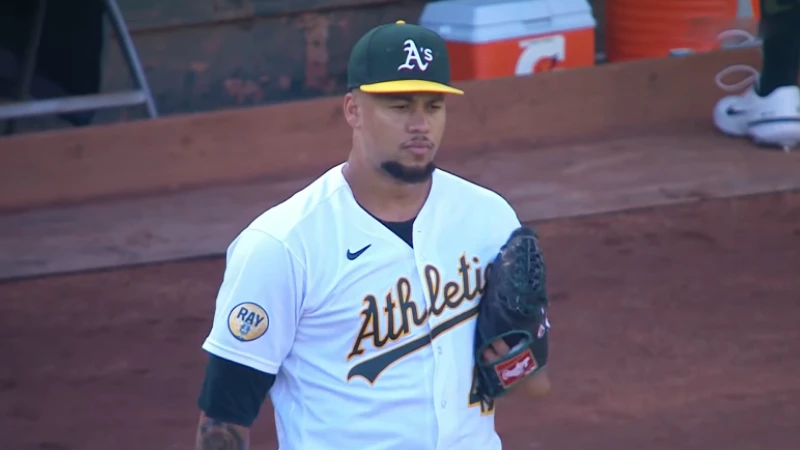
When evaluating whether Frankie Montas is currently a “good” Major League pitcher, the answer requires a clear distinction between his historical peak ceiling and his present reality.
At his absolute best, Montas demonstrated All-Star caliber pitching capabilities, relying on high-velocity arm speed and devastating secondary offerings.
However, an extensive sequence of arm troubles, declining velocity, control, and inconsistent execution has fundamentally altered his career trajectory.
At this stage of his career, Frankie Montas is not performing well on the mound and cannot be classified as a reliable or dependable Major League starter.
He is currently recovering from major Tommy John surgery, an extensive procedure undergone in September 2025 that is expected to keep him sidelined for the entire 2025–2026 stretch and season.
Furthermore, following severe struggles during his time with the New York Mets, the organization officially designated him for assignment in late 2025.
Consequently, Major League evaluators, front offices, and fantasy baseball managers view Montas not as an established, top-tier contributor, but as a high-risk injury reclamation project.
The Peak Era: What Made Frankie Montas Dominant in 2021
To understand the full scope of Frankie Montas’s career trajectory, one must examine his peak form during the 2021 Major League Baseball season with the Oakland Athletics.
During this defining campaign, Montas established himself as one of the most effective starting pitchers in the American League, delivering top-tier rotational value week after week.
Electric Pitch Arsenal and Pure Stuff
At his physical peak, Montas possessed raw, high-grade pitching mechanics and an electric repertoire that consistently overwhelmed opposing batters:
- Four-Seam Fastball / Sinker Velocity: Montas regularly touched 98 to 100 mph on his fastball, generating elite heat that allowed him to blow pitches past hitters at the top of the strike zone.
- Devastating Splitter: His primary put-away pitch was a sharp, tumbling splitter that darted down and out of the strike zone, generating high swing-and-miss rates against both right-handed and left-handed hitters.
- Wiping Slider: Complementing his high velocity and vertical depth, Montas utilized a sharp slider to sweep across the zone, keeping batters off-balance and preventing predictable hitting patterns.
Statistical Showcase of the 2021 Campaign
During his standout 2021 season with the Oakland Athletics, Montas posted career-best statistics across every major pitching category:
- Win-Loss Record: 13–9
- Earned Run Average (ERA): 3.37
- Innings Pitched (IP): 187.0
- Strikeouts (SO): 207
- Walks plus Hits per Innings Pitched (WHIP): 1.18
A 3.37 ERA paired with 207 strikeouts over 187.0 innings pitched underscored his capacity to function as a frontline rotation anchor.
His 1.18 WHIP demonstrated excellent command and efficiency, proving that when healthy, his power arsenal could dominate top-tier lineups.
Tracking the Statistical Trajectory: From All-Star Caliber to Performance Regression
The transition from frontline starter to struggling pitcher did not occur overnight. A detailed statistical analysis across four consecutive seasons (2021 to 2025) highlights a clear, steady erosion in performance metrics, workload durability, and overall run suppression.
Year-by-Year Performance Overview
| Season | Major League Team(s) | Win-Loss (W-L) | Earned Run Average (ERA) | Innings Pitched (IP) | Strikeouts (SO) | WHIP |
|---|---|---|---|---|---|---|
| 2021 | Oakland Athletics | 13–9 | 3.37 | 187.0 | 207 | 1.18 |
| 2022 | Oakland A’s / New York Yankees | 5–12 | 4.05 | 144.4 | 142 | 1.25 |
| 2024 | Cincinnati Reds / Milwaukee Brewers | 7–11 | 4.84 | 150.2 | 148 | 1.36 |
| 2025 | New York Mets | 3–2 | 6.28 | 38.2 | 32 | 1.60 |
Analyzing the Core Trends in the Numbers
- Surging Earned Run Average (ERA): Montas saw his ERA nearly double over this multi-year span, expanding from an elite 3.37 mark in 2021 to a troubling 4.05 in 2022, a 4.84 mark in 2024, and ultimately reaching a career-worst 6.28 ERA in 2025.
- Escalating WHIP and Baserunners: His WHIP steadily deteriorated from 1.18 in 2021 to 1.25 in 2022, rising further to 1.36 in 2024, and spiking to an unsustainable 1.60 WHIP in 2025. Allowing 1.60 baserunners per inning severely limited his ability to pitch deep into games and navigate high-leverage situations.
- Diminishing Strikeout Rate: While Montas racked up 207 strikeouts over 187.0 innings in 2021 (1.11 strikeouts per inning), his strikeout creation slowed down significantly. By 2024, he recorded 148 strikeouts in 150.2 innings, and in 2025, he managed just 32 strikeouts in 38.2 innings.
- Sharp Decline in Workload Volume: After logging a robust 187.0 innings in 2021, Montas was unable to reach the 160-inning mark in subsequent campaigns. His total workload dropped to 144.4 innings in 2022, 150.2 innings in 2024, and compressed down to a sparse 38.2 innings in 2025 before his arm breakdown.
The New York Mets Contract, Relocation to the Bullpen, and Physical Breakdown
Entering the free-agent market, Montas secured a lucrative multi-year agreement, signing a two-year, $34 million contract with the New York Mets.
The organization intended for Montas to stabilize their starting rotation, relying on his past high-velocity profile and track record of middle-of-the-rotation output.
Loss of Rotation Status and Bullpen Demotion
However, Montas struggled with consistency almost immediately upon joining the Mets. His inability to maintain precise lower velocity control and prevent damage early in contests led to frequent short outings and inflated run totals.
Over 38.2 innings pitched in 2025, he surrendered runs at a high rate, resulting in a 6.28 ERA and a 1.60 WHIP while securing just 32 strikeouts.
Faced with inconsistent run suppression and lower velocity control, the Mets coaching staff made the tactical decision to move Montas out of the starting rotation and into the bullpen. Yet, even in a reduced relief role, his pitching performance remained volatile.
Severe Arm Injury and Tommy John Surgery
The primary underlying factor behind Montas’s performance drop became undeniable when his arm broke down physically. In September 2025, Montas suffered a major shoulder and arm breakdown that required Tommy John surgery.
Tommy John surgery (ulnar collateral ligament reconstruction) involves an arduous recovery process. Because the surgery took place in late 2025, Montas is slated to miss the entire 2025–2026 stretch and season while completing rehabilitation.
Designated for Assignment (DFA)
Confronted with his 6.28 ERA, high 1.60 WHIP, bullpen transition, and lengthy injury absence, the New York Mets designated Frankie Montas for assignment in late 2025.
This roster move officially severed his operational trajectory with the franchise and left his future in Major League Baseball uncertain.
Analytical Breakdown: Key Factors Behind the Performance Drop
Evaluating the decline of Frankie Montas requires looking beyond surface-level statistics to examine the physical mechanics of power pitching.
1. Velocity Control Loss and Mechanical Strain
Power pitchers who rely on fastball velocities ranging from 98 to 100 mph place enormous physical strain on their elbow joint, shoulder structure, and flexor tendons. Recent years for Montas were marred by lower velocity control and physical wear.
When a pitcher loses command of their high-velocity fastball, they are forced to throw more pitches over the plate, leading to hard contact and higher WHIP numbers.
2. Secondary Pitch Flattening
Montas’s peak dominance relied heavily on the interaction between his 98–100 mph fastball and his sharp splitter/slider combination.
When arm fatigue, shoulder strain, or ligament damage set in, the sharp break on splitters and sliders often flattens out. Without elite vertical drop on his splitter, opposing hitters were able to lay off pitches out of the strike zone and punish mistake throws.
3. Organizational Shifts and Lack of Rhythm
Moving between multiple franchises—from Oakland to New York (Yankees), to Cincinnati, Milwaukee, and ultimately the New York Mets—created ongoing adjustment challenges.
Combined with persistent physical setbacks, Montas was unable to re-establish the mechanical rhythm that propelled his 2021 success.
Final Verdict
Frankie Montas’s career represents a classic tale of high-velocity peak performance derailed by physical breakdown.
At his absolute height with the Oakland Athletics in 2021, his 98–100 mph fastball and sharp splitter/slider combination made him an All-Star-caliber pitcher capable of anchoring a rotation.
However, the statistical evidence from 2022 through 2025 paints a clear picture of regression, culminating in a 6.28 ERA, a bullpen demotion, Tommy John surgery in September 2025, and a designation for assignment by the New York Mets.
Looking ahead, Montas faces a long, rigorous rehabilitation program that will keep him off the field throughout the 2025–2026 period.
If he returns to Major League Baseball, he will do so as an injury-risk reclamation project seeking to rebuild his velocity control, pitch execution, and rotational durability.