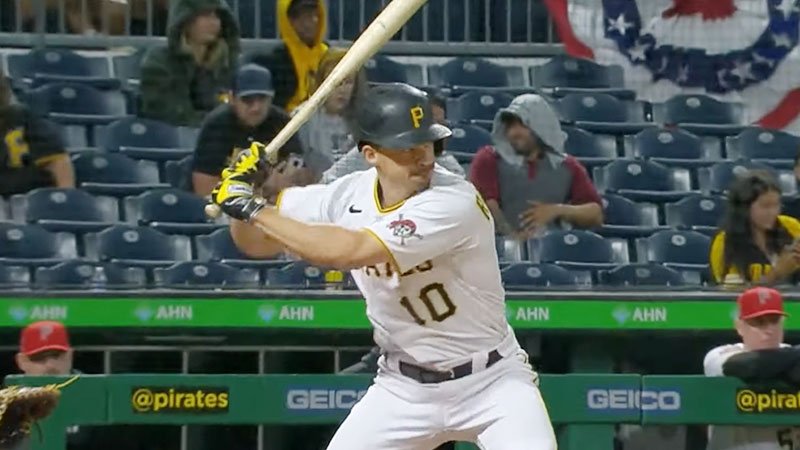
Yes, Bryan Reynolds is a switch hitter. The Pittsburgh Pirates outfielder bats from both sides of the plate and throws right-handed, which is why his player card lists him as “B/R” (bats both, throws right).
Hitting from both sides is not a late experiment for him. It has been part of his game since well before he reached the major leagues.
The question comes up often because Reynolds does not fit the old stereotype of a switch hitter. He is not a small, speedy slap hitter.
He is a 6-foot-2 corner outfielder who hits for average, drives the ball into the gaps and clears the fence from either side.
In this post, we look at who Bryan Reynolds is, how switch hitting shaped his path to the big leagues, how he performs as a left-handed and right-handed batter, and why that skill makes him one of the most valuable bats in Pittsburgh.
Who Is Bryan Reynolds?
Bryan Patrick Reynolds was born on January 27, 1995, in Baltimore, Maryland, and grew up in the Nashville suburbs of Tennessee. He starred at Brentwood High School before heading to Vanderbilt University, one of the top college baseball programs in the country.
At Vanderbilt, Reynolds made an instant impact. As a freshman in 2014, he led the Commodores with a .338 batting average and helped the team win its first College World Series title. By his junior year, he had added real power, hitting 13 home runs with a .603 slugging percentage.
The San Francisco Giants selected him in the second round of the 2016 MLB Draft, 59th overall. Less than two years later, in January 2018, the Giants traded him to the Pittsburgh Pirates as the main prospect in the deal that sent Andrew McCutchen to San Francisco.
Reynolds made his MLB debut in 2019 and quickly became a fixture in the Pirates outfield. He is now Pittsburgh’s longest-tenured position player, and in 2023 he signed an eight-year, $106.75 million contract extension to stay with the club.
How Bryan Reynolds Became a Switch Hitter
Here is the surprising part: Bryan Reynolds is a natural right-handed hitter. Batting left-handed was a skill he built on purpose, not something that came naturally.
He started learning to switch-hit at around 10 years old, practicing on the left side with his father. It took years of work before he trusted both swings in games. Reynolds did not switch-hit consistently until his junior year of high school.
That timing turned out to be important. By the time he arrived at Vanderbilt, he could handle quality pitching from either side, which gave him an edge over many young hitters.
College scouts noticed. Pre-draft reports described him as a switch hitter with good power from both sides and an advanced approach at the plate.
In the minor leagues, that label followed him everywhere. Scouting reports praised his quick hands, smooth stroke and ability to work deep counts from both sides. Many evaluators said his switch-hitting bat, combined with his ability to play all three outfield spots, gave him a high floor as a big leaguer.
Even now, Reynolds keeps tweaking both stances. He has admitted that keeping two separate swings in rhythm at the same time is one of the hardest parts of his job.
Bryan Reynolds Left-Handed vs. Right-Handed: Which Side Is Better?
Most switch hitters have one clearly stronger side. Reynolds is unusual because he has been a productive hitter from both sides for most of his career, even though his two swings look and work very differently.
Batting left-handed (vs. right-handed pitchers):
This is where Reynolds gets most of his at-bats, since the majority of MLB pitchers are right-handed. From the left side, he tends to lift the ball more, producing more line drives and fly balls. Many fantasy analysts consider the left side his best, especially for power.
Batting right-handed (vs. left-handed pitchers):
From his natural side, Reynolds often hits the ball harder but with a lower launch angle. He sprays more balls up the middle and to the opposite field, which helps him keep his batting average up even when the ball stays on the ground.
The balance showed up early. During one strong minor-league stretch, he hit .295 from the left side and .365 from the right. That kind of two-way production is exactly what teams hope for when they invest in a switch hitter.
The takeaway is simple. Left-handed Reynolds is usually the power threat, while right-handed Reynolds is the contact-and-line-drive version. Both can hurt a pitcher.
Why Switch Hitting Makes Bryan Reynolds So Valuable
Switch hitting gives Reynolds the platoon advantage in nearly every plate appearance. Breaking balls from a same-handed pitcher usually move away from a hitter, which is harder to handle. By always standing on the opposite side, Reynolds sees more pitches that move toward him and stay in his hitting zone.
That edge matters to his manager, too. Reynolds never needs to be benched against a tough left-hander, and he does not have to be platooned. He can play every day and hit near the top of the order no matter who is pitching.
It also frustrates opposing managers late in games. Bringing in a left-handed specialist to face Reynolds does nothing, because he simply turns around and hits right-handed. Since relievers must now face at least three batters, that matchup game is even harder to win.
For the Pittsburgh Pirates, this stability has been priceless. In 2026, Reynolds anchored a deeper lineup alongside young stars, and the club finished 82–80, ending an eight-year run of losing seasons.
Bryan Reynolds’ Career Highlights as a Switch Hitter
Reynolds has built one of the most consistent careers of any switch hitter in the National League, with about 150 home runs and two All-Star selections through the 2026 season.
| Season | Highlight |
|---|---|
| 2019 | Hit .314 with 16 home runs and a rookie-leading 37 doubles; finished fourth in NL Rookie of the Year voting |
| 2021 | Hit .302 with a .912 OPS, 24 home runs and 90 RBI; earned his first All-Star selection |
| 2022 | Set a career high with 27 home runs |
| 2024 | Rode a 25-game hitting streak that began June 1 to his second All-Star selection |
| 2025 | Slumped to a .245 average, his weakest full season |
| 2026 | Bounced back with a sharper eye, a 34-game on-base streak and a near career-best walk rate |
The pattern stands out. Even after rough stretches, such as the shortened 2020 season and the 2025 slump, Reynolds has always found his swing again. His ability to adjust from both sides of the plate is a big reason why.
Final Verdict: Bryan Reynolds Is a True Switch Hitter
So, is Bryan Reynolds a switch hitter? Absolutely. He bats both left-handed and right-handed, throws right-handed, and has done so throughout his college, minor-league and major-league career.
What makes his story special is that switch hitting was earned, not gifted. A natural righty, he learned the left-handed swing as a kid with his father and refined it until it became a weapon.
Today, that skill lets him play every day, hit near the top of the lineup and take away the late-inning matchups that opposing managers rely on.
For Pirates fans, Reynolds remains the steady, two-sided bat at the heart of the order. For anyone studying the art of switch hitting, he is one of the best modern examples of how hard work on both sides of the plate can pay off.