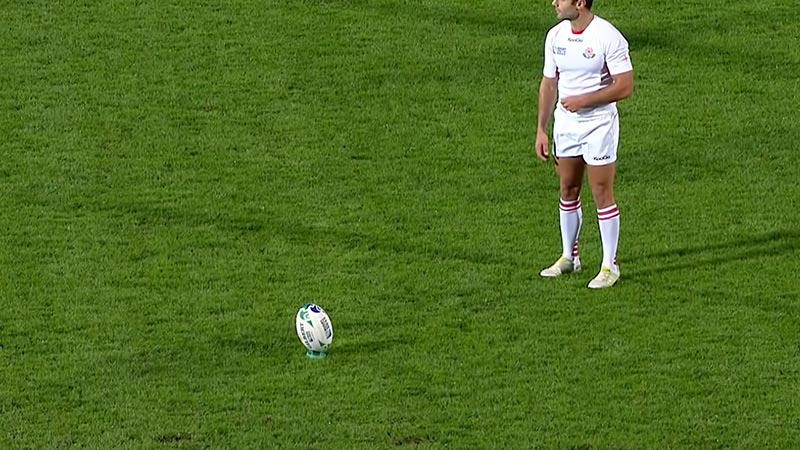
If you have ever transitioned from watching gridiron action on an autumn weekend to taking in a high-stakes international rugby match, you have likely experienced a moment of cognitive dissonance.
As a kicker prepares for a crucial shot at the goalposts, your mind immediately begins to run the calculations you have mastered over years of watching American football.
In the National Football League (NFL) or college gridiron, when a team lines up for a field goal, fans do not simply look at the line of scrimmage.
Instead, they perform a rapid mental addition: take the yard line, add ten yards for the end zone, and add another seven or eight yards for the distance of the snap.
But what happens when you apply this mental model to rugby? How many yards do you add to a rugby scoring kick to determine its true distance?
The short answer is exactly zero.
Unlike American football, rugby does not add any fixed distance buffers—such as the 17-to-18-yard calculation used in the NFL—to determine the distance of a kick.
To understand why this is the case, and how rugby measures its scoring kicks, we must look closely at the physical layout of the pitch, the rules governing goalpost placement, and the unique mechanics of rugby’s three primary scoring kicks.
The Physical Layout: Why the Gridiron and the Rugby Pitch Diverge
To understand why rugby requires zero added yards for its scoring kicks, we must first compare the structural layout of the two playing fields.
The difference in kick calculations is not arbitrary; it is a direct consequence of where the goalposts are physically anchored on the grass.
The Gridiron Blueprint
In American football, the goalposts were historically located on the goal line. However, to prioritize player safety and reduce collisions in the end zone, the posts were moved to the back of the end zone in 1974 for the NFL (and in 1927 for college football).
Because the end zone is exactly 10 yards deep, the crossbar sits 10 yards behind the goal line.
Furthermore, because a field goal is attempted from a snap, the ball must be kicked from a spot approximately 7 to 8 yards behind the line of scrimmage to allow the offensive line to block the oncoming rushers.
Consequently, the standard formula for an American football field goal is:
Line of Scrimmage + 10 yards (End Zone) + 7.5 yards (Snap Distance) = Total Kicking Distance
This is why a snap from the 20-yard line results in a 37-yard or 38-yard field goal attempt.
The Rugby Pitch Blueprint
In rugby, the playing field (referred to as the pitch) operates under an entirely different structural philosophy. Rugby goalposts sit directly on the try line (which is the equivalent of the goal line).
Because the posts are anchored directly on the line that defines the boundary between the field of play and the scoring zone, there is no physical gap between the line a team must cross to score and the plane of the goalposts.
When a player prepares to kick the ball, the distance is measured in a straight line from the spot where the ball is placed or dropped directly to the try line.
There is no end zone to account for because the in-goal area—the rugby equivalent of the end zone—sits entirely behind the goalposts rather than housing them.
Measuring a Rugby Kick: The Broadcaster’s Metric
Because the goalposts are on the try line, the distance you see on your television screen or hear from a stadium commentator is the literal, physical distance between the kicker and the goal line.
When sports analysts or television broadcasters calculate the distance of a penalty kick, a conversion, or a drop goal, they measure directly from the spot of the kick to the try line, using either meters or yards.
| Feature | American Football (Gridiron) | Rugby (Union & League) |
|---|---|---|
| Goalpost Location | Back of the End Zone | Directly on the Try Line (Goal Line) |
| End Zone / In-Goal Buffer | Adds a fixed 10 yards to every attempt | Adds 0 yards (In-goal area sits behind posts) |
| Snap / Placement Buffer | Adds 7 to 8 yards to the line of scrimmage | Adds 0 yards (Kicked directly from spot on pitch) |
| Common Measurement Unit | Yards | Meters (primarily) or Yards |
| Typical Total Distance | 20 to 60+ yards | 10 to 50+ meters/yards |
If a player is awarded a penalty kick on the opponent’s 10-meter line, the kick is exactly 10 meters away from the plane of the goalposts.
If a drop goal is struck from the 40-meter mark, the ball travels precisely 40 meters to reach the crossbar. There are no hidden calculations, no snaps to hold, and no supplementary yardage to factor in.
The Three Paths to Kicking Points in Rugby
To fully appreciate the mechanics of rugby kicking, we must examine the three distinct scenarios in which a player can kick the ball through the uprights to secure points for their team. Each of these kicks carries its own placement rules, strategic values, and mechanical challenges.
1. The Penalty Kick
A penalty kick is awarded when the opposing team commits a major infraction or foul. When a team decides to “shoot for goal” rather than running the ball or kicking it out of bounds to gain territory, the kicker is permitted to use a kicking tee to raise the ball off the ground.
- Point Value: Worth 3 points in both rugby union and rugby league.
- Placement Rule: The kick must be taken from the exact spot where the opposing team’s foul occurred.
- Mechanical Context: Because fouls can occur anywhere on the pitch, penalty kicks can be awarded at highly challenging angles. A kicker might find themselves attempting a shot from 45 meters out, right against the touchline (sideline), requiring a delicate balance of distance and lateral accuracy.
2. The Drop Goal (Field Goal)
The drop goal is rugby’s equivalent to the gridiron field goal, executed during active, open play. Unlike a penalty kick or a conversion, there is no pause in play for a drop goal; the kicker must receive a pass and strike the ball while defenders are actively rushing forward to tackle them.
- Point Value: Worth 3 points in rugby union, but only 1 point in rugby league.
- Placement Rule: Can be taken from anywhere on the pitch during active play, but the ball must hit the ground and be kicked immediately as it bounces (known as a drop-bounce).
- Mechanical Context: If a player attempts to kick the ball directly out of their hands without letting it touch the ground first (a punt), no points can be scored. The drop-bounce is highly sensitive to the turf conditions. A wet, muddy pitch or an uneven patch of grass can cause the ball to bounce unpredictably, ruining the contact.
3. The Conversion Kick
When a team successfully scores a try (the rugby equivalent of a touchdown, worth 5 points in union), they are granted the opportunity to “convert” the score by kicking the ball through the uprights for an additional 2 points.
- Point Value: Worth 2 points.
- Placement Rule: The kick is attempted in line with the exact spot where the try was grounded in the in-goal area.
- Mechanical Context: This rule introduces a massive geometric variable. If a player scores a try directly under the crossbar, the conversion is taken from an easy, centralized position directly in front of the posts. However, if a winger scores a try in the far corner of the pitch, right next to the sideline, the conversion must be taken from that extreme outer edge of the field.
The Geometric Dilemma: Distance vs. Angle in Rugby Conversions
Because conversions must be taken “in line” with where the ball was touched down, rugby kickers face a unique spatial challenge that gridiron kickers never have to contemplate.
In American football, an extra point or a field goal is always kicked from a centralized position on the field. The holder sets up between the hash marks, ensuring the kicker always has a direct, balanced view of the uprights.
In rugby, if a try is scored near the corner flag, the kicker must walk backward along an imaginary line that runs parallel to the touchline, extending from the point of touchdown. This creates a fascinating mathematical trade-off:
- Kicking from close range: If the kicker sets up the tee close to the try line (say, 5 meters out), the total distance is incredibly short. However, because they are positioned so far to the side of the pitch, the angle to the goalposts is extremely sharp, making the target space between the uprights appear incredibly narrow.
- Kicking from further back: If the kicker walks backward to the 25-meter or 30-meter mark, they increase the physical distance they must kick the ball. However, by moving further away from the try line, they widen the visual angle to the goalposts, making the target much wider and easier to target.
Finding the optimal “sweet spot” along that line is an essential skill for elite rugby kickers. They must weigh their personal maximum kicking range against their ability to curve or “draw” the ball through a tight angular window.
Why Every Yard on a Rugby Pitch is Harder to Earn
Because rugby does not add artificial buffers to its kick measurements, a “40-meter penalty kick” might sound less impressive to a gridiron fan than a “55-yard field goal.”
However, when you look at the physical realities of the two sports, rugby kicking is arguably far more demanding.
1. No Specialized Kickers
In American football, the kicker is a highly specialized athlete who only enters the field for kicking duties. They do not run, tackle, block, or endure physical contact during the rest of the game. They remain on the sideline, keeping their leg warm and their heart rate controlled.
In rugby, there are no specialized kicking positions. The player who takes the penalty kicks and conversions is a regular member of the starting lineup—usually the fly-half or fullback.
They must run miles, make tackles, absorb bruising hits, and handle the ball in open play for the entire 80-minute match. When they step up to take a crucial kick in the 78th minute, they are doing so under extreme physical fatigue and with an elevated heart rate.
2. No Defensive Line Blocking
In American football, the kicker is protected by an offensive line that blocks the defensive rushers, allowing the kicker to focus entirely on their technique.
During a rugby drop goal, there is no set offensive line to protect the kicker. The player must drop and strike the ball while defensive players are sprinting at them completely unchecked, looking to smother the kick or deliver a bone-crushing tackle. The window of opportunity to execute the drop-bounce and strike the ball is often less than a second.
3. The Shape of the Ball
A rugby ball is noticeably rounder, thicker, and heavier than an American football. It is designed primarily for passing and running rather than aerodynamic flight.
Because it lacks the pointed ends and sleek profile of a gridiron ball, it is far more susceptible to wind resistance and requires significantly more physical power to drive over long distances.
Conclusion: The Direct Precision of Rugby
When evaluating the distance of a scoring kick in rugby, remember to leave your gridiron mental math on the sideline. You do not add 10 yards for an end zone, and you do not add 7 yards for a snap.
On a rugby pitch, what you see is precisely what you get. If a player is standing 35 meters from the try line, they are facing a 35-meter challenge. The posts are right there on the line, waiting, demanding absolute physical precision, mental focus, and technical mastery.