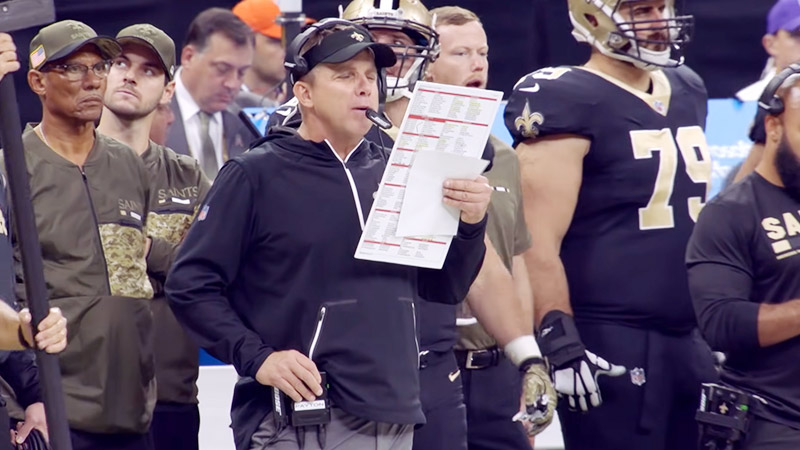
In the modern landscape of professional football, every micro-moment is an asset. As millions of fans watch from their living rooms, they witness a recurring ritual that has become as standard as the coin toss: a head coach, deeply entrenched in a high-pressure situation, cupping their hand or a laminated play sheet over their mouth while speaking into a headset.
While it might look like a simple quirk of the game, this “sideline shield” is actually a sophisticated defensive maneuver. It represents a fascinating intersection of elite strategy, cutting-edge broadcast technology, and the relentless pursuit of a competitive edge.
To understand why these coaches go to such lengths to hide their speech, we must look at the various layers of modern sports intelligence and the technical challenges of communicating in a stadium that holds 80,000 screaming fans.
The Evolution of the Sideline Shield: Why Privacy is Paramount
The most immediate reason for this behavior is simple: security. In an era where information can be intercepted in real-time, the sideline is no longer a private workspace.
1. Countering the Rise of Professional Lip Readers
The primary driver behind the mouth-covering trend is the prevention of lip-reading by opposing teams.
While it may sound like something out of a spy novel, teams actively look for any possible advantage, and decoding a play call can ruin a surprise strategy before the ball is even snapped.
The stakes are higher than many realize. It only takes one individual with lip-reading expertise watching a dedicated camera feed to compromise a sequence.
Some organizations even employ specialized personnel or analyze high-definition footage after the fact to decode verbal instructions and build a database of a coach’s terminology.
2. The Digital Panopticon: High-Definition Surveillance
The rise of high-definition (HD) television has fundamentally changed the game. Modern broadcast cameras possess incredible zoom capabilities, allowing them to track a coach’s face with forensic detail from across the field or from high within the press box.
These cameras are often in “continuous shoot mode,” meaning they are capturing every twitch of a coach’s lips throughout the four-quarter duration.
3. Protecting the “System” Over the Play
Secrecy isn’t just about the next ten seconds of play; it is about protecting a team’s entire strategic system.
NFL playbooks are notoriously complex, and coaches want to prevent opponents from breaking down their tendencies, intentions, or long-term “tells”.
One specific tactical insight suggests that the length of a verbal instruction can give away the play type. Typically, running plays have shorter names, while complex passing plays involve lengthy instructions regarding protections and routes.
By covering their mouths, coaches ensure that a defensive coordinator cannot even guess the play type based on how long the coach’s lips are moving.
Tactical Secrecy vs. Operational Clarity
To better understand the multifaceted reasons for this behavior, we can categorize them into two main areas: tactical advantages (keeping secrets) and operational necessities (improving communication).
| Category | Primary Objective | Specific Reason |
|---|---|---|
| Tactical Secrecy | Information Protection | Preventing lip-reading by opposing analysts and specialized personnel. |
| Tactical Secrecy | Strategic Integrity | Hiding “tells” related to play length (e.g., short run calls vs. long pass calls). |
| Tactical Secrecy | Historical Precaution | Maintaining a culture of security established by incidents like “Spygate”. |
| Operational Clarity | Audio Engineering | Blocking wind and crowd noise to ensure the microphone picks up clear speech. |
| Operational Clarity | Personnel Privacy | Keeping frustrated comments or raw emotions hidden from the public. |
| Operational Clarity | Brand Protection | Avoiding “viral” moments or parody breakdowns on social media. |
The Engineering Side: Battling the Elements
While the “spy” aspect of the NFL gets the most attention, a significant portion of the reason for covering the mouth is rooted in basic physics and audio engineering.
- Crowd Noise Interference: NFL stadiums are among the loudest environments on the planet. High-quality microphones on coach headsets are designed to be sensitive, but they can easily be overwhelmed by 100-plus decibels of stadium noise. By cupping a hand or a play sheet around the mic, the coach creates a makeshift “acoustic booth,” ensuring their voice carries clearly to the quarterback or coordinators.
- Wind Protection: Sideline environments are often subject to heavy winds. The “shield” acts as a physical wind-blocker, preventing that familiar “buffeting” sound that can make speech unintelligible over a radio frequency.
- A “Pop Filter” Effect: Much like a recording studio uses a mesh screen to prevent “plosive” sounds (like the letters P and B) from distorting a recording, the play sheet helps modulate the coach’s breath and speech for the personnel on the other end of the line.
Historical Lessons and Cross-Sport Influence
The paranoia regarding lip-reading is not limited to the gridiron. The sports world learned a harsh lesson in the 1989 National League Championship Series (NLCS).
During a critical moment, pitcher Greg Maddux was caught on camera discussing his pitch strategy. His opponent, Will Clark, was able to read his lips from the dugout, anticipated the pitch, and drove in the winning runs.
This event served as a wake-up call across professional sports. If a baseball player’s lips could be read from a dugout, a coach’s lips could certainly be read in the highly televised world of the NFL.
This was further reinforced by the “Spygate” scandal, which heightened the league’s collective awareness of unauthorized filming and information gathering.
Managing the Public Image: Privacy and Viral Culture
In today’s hyper-connected world, a coach is more than a strategist; they are the face of a multi-billion dollar brand. The sideline shield serves as a layer of protection against the unforgiving nature of social media.
- Hiding Raw Emotion: The heat of a game brings out intense emotions. Coaches may use the shield to hide a curse word, a frustrated critique of an official, or a private moment of exasperation that they wouldn’t want broadcast to millions of families.
- Avoiding the Viral Spotlight: There is a cottage industry of content creators, such as “Jomboy” or the “Bad Lip Reading” channel, who specialize in decoding and satirizing what is said on the sidelines. For a professional organization, becoming a meme for a stray comment is a distraction they would rather avoid.
- Maintaining Professionalism: By keeping their mouth covered, coaches maintain a “poker face.” It prevents the opposition—and the media—from reading their level of stress or confidence during pivotal moments of the game.
The “Zero-Effort” Logic: Why the Practice Will Never Die
One of the most compelling reasons for the persistence of this habit is the low cost of implementation.
As analysts have pointed out, the chances of an opponent successfully reading a lip and getting that info to the defense in time for a single play might be slim.
However, the effort required to cover your mouth is almost zero. In a high-stakes environment where “any competitive edge they can get they will take,” there is simply no reason not to do it. It has become a “force of habit” and a standard operating procedure for anyone entering the coaching ranks.
Conclusion: The Silent Strategy of the NFL
The image of a coach with a laminated sheet pressed to their face is a perfect metaphor for the modern NFL: a blend of old-school grit and high-tech scrutiny.
What started as perhaps a simple way to keep the wind out of a microphone has evolved into a mandatory tactical shield against an army of high-definition cameras and specialized analysts.
Ultimately, the sideline shield is about control. It is about controlling the narrative, controlling the information flow, and ensuring that in a game of inches, not a single syllable is given away for free.
Whether it is to hide a “tell” about a passing play or simply to avoid becoming the next viral parody video, the silent sideline is here to stay. In professional football, what you don’t show is often just as important as what you do.