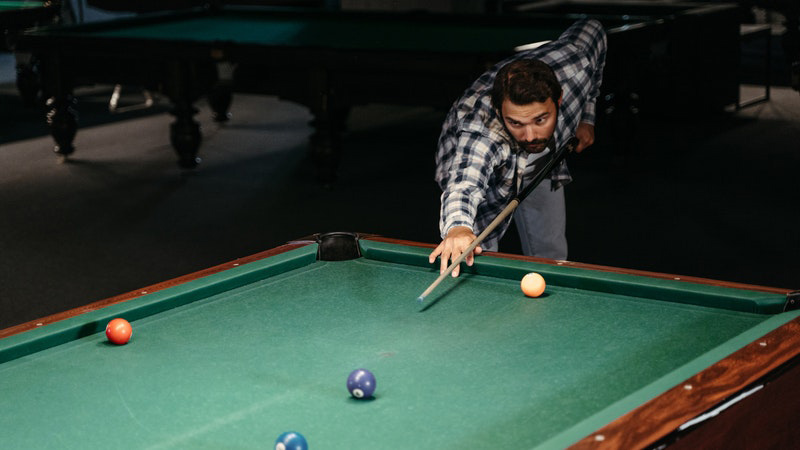
In the world of recreational billiards, few topics ignite as much heated debate as the “frozen” cue ball. You’ve likely seen it happen: a player’s cue ball comes to rest directly against the cushion.
They reach down, place the butt of their cue against the rail, and nudge the ball out an inch or two, claiming it’s a standard “relief” rule.
If you’ve questioned the legality of this move, you aren’t alone. Amateur players—often referred to in the community as “bangers”—frequently rely on a patchwork of “house rules” that would result in an immediate foul in any sanctioned tournament.
As a world-class SEO content strategist and billiards enthusiast, I’ve synthesized official regulations, professional training insights, and common community myths to provide the ultimate resource on this topic.
Whether you are settling a basement dispute or preparing for your first league night, this guide will establish the gold standard for your game.
I. The “Frozen” Dilemma: Why Amateur Myths Persist
The core of the argument usually stems from a misunderstanding of the game’s difficulty. In many casual settings, players believe that if the cue ball is “near the wall” (meaning less than the diameter of the back side of a cue), they are entitled to move it to make the shot easier.
The Origins of “Inchies” and “Barb Rules”
These non-official variations are often passed down through generations. Known colloquially as “Inchies,” “Putt-Putt rules,” or “Barb Rules” (a nod to the specific rules one might play with a step-mom or casual relative), these concessions exist to make the game more accessible for beginners or children.
The primary reasons these myths persist include:
- Protection of Equipment: Some home table owners allow players to move the ball away from the rail to prevent inexperienced players from “stabbing” or damaging the rubber cushions with their cue.
- Skill Gaps: For those who haven’t mastered the bridge required to shoot off a rail, the game can become frustrating. Moving the ball “a little bit” keeps the game moving for people who “suck at pool”.
- Mini-Golf Influence: Many recreational players subconsciously port rules from miniature golf, where “relief” from an obstacle is a standard mechanic.
The Verdict: While these rules are fine for “Calvinball” (a game where rules are made up on the fly), they have no place in a competitive or serious setting.
The Official Verdict: The “Live Ball” Principle
According to official governing bodies like the American Poolplayers Association (APA) and the Billiard Congress of America (BCA), the rules are clear: The cue ball must be played where it lies.
1. The Cue Ball is “Always Live”
In serious play, the cue ball is considered a “live” entity from the moment it is struck during a legal shot. Touching the cue ball with your hand, the side of your cue, or even your clothing while it is in play is an immediate foul.
2. The Definition of a Foul
The sources confirm that touching the cue ball with anything other than the tip of the cue constitutes a foul. Even then, contact with the tip is only legal if it occurs during a legitimate stroke. If you use your cue tip to “nudge” the ball away from the rail, you have technically committed a foul or played a shot, ending your turn.
3. “Play It Where It Lands”
Billiards is often compared to golf in this regard. Just as a golfer must play their ball out of a sand trap or deep grass, a pool player must contend with the table’s geometry. The rail is not an “obstacle” to be moved; it is a fundamental part of the field of play.
When CAN You Legally Move the Cue Ball?
To dominate search rankings and provide comprehensive value, we must clarify the specific, legal exceptions. There are only two primary scenarios where you are permitted to move the cue ball:
1. The Initial Break Shot
At the start of a game of 8-ball or 9-ball, the cue ball can be moved freely anywhere behind the headstring (the line 1/4 of the way down the table). Once the cue tip makes contact and the balls are scattered, the “live ball” principle takes effect.
2. Ball-in-Hand Scenarios
If your opponent commits a foul, you typically receive “Ball-in-Hand.” Common fouls that grant this advantage include:
- Scratching: The cue ball enters a pocket.
- Failure to Hit a Legal Ball: The cue ball fails to strike one of your designated object balls (solids or stripes).
- No Rail After Contact: After the cue ball hits an object ball, at least one ball must hit a rail or be pocketed for the shot to be legal.
- Illegal Touching: As mentioned, your opponent touching any ball with their hand or cue during their turn.
In these instances, you may place the cue ball anywhere on the table (or behind the headstring, depending on the specific league rules) to begin your next shot.
Mastering the Rail Shot: Professional Training Insights
Instead of relying on “inchie” myths, elite players embrace the challenge of the rail. Moving from an amateur to a Fortune 500-level player requires technical proficiency.
Center Ball Training
The sources recommend “Center Ball Training” to improve control. A common drill involves hitting the cue ball directly against a rail and attempting to have it return and touch the tip of your cue. This builds “straight-line” accuracy, which is essential when your bridge is hampered by the cushion.
The “Measles Ball” Advantage
Professionals often train with a “dotted cue ball” or “measles ball”. The red dots allow you to visualize the spin (English) you are putting on the ball. When the ball is frozen to the rail, seeing how it reacts to different types of spin is crucial for successful “position play.”
Technical Tips for Rail Shots:
- Elevate the Butt: When the ball is against the rail, you may need to slightly elevate the back of your cue to strike the ball cleanly without hitting the cushion first.
- Parallel Bridge: Place your hand on the rail itself to create a stable bridge, sliding the cue between your thumb and forefinger.
- Avoid the “Push Shot”: If the cue ball is frozen to the object ball, you must be careful not to commit a “push shot” (where the cue tip stays in contact with the cue ball too long). However, if the cue ball is frozen to the rail, you can hit through it normally.
Enhanced FAQ: Settling the “Basement” Arguments
Q: Can I move the ball if it’s “less than two fingers” from the rail?
A: No. This is a common “house rule” variation often referred to as “Putt-Putt rules”. In any sanctioned league (APA, BCA), this is a foul.
Q: Is it a scratch if I miss all the balls?
A: Technically, it is a foul, not necessarily a “scratch” (a scratch specifically means the cue ball went into a pocket). However, both result in the opponent getting ball-in-hand.
Q: What about the “Opposite Socket” rule for the 8-ball?
A: Some amateur circles play that the 8-ball must go in the pocket opposite where you sunk your last colored ball. This is not an official rule in the APA or BCA. Usually, you simply “call your pocket” for the 8-ball.
Q: Can I hit my ball and my opponent’s ball at the same time?
A: No. You must strike one of your own balls first. If you hit your opponent’s ball first or strike both simultaneously, it is a foul.
Conclusion: Elevate Your Game
If you want to play like a professional, you must respect the integrity of the table. The “rule” that allows you to move a ball away from the “wall” is a fabrication designed to make a difficult game easier for novices.
By adhering to the “Play It Where It Lies” principle, you not only align yourself with world-class standards but also force yourself to develop the skills necessary to win under any conditions. The next time a friend tries to claim an “inchie,” remind them: if it isn’t in the rulebook, it isn’t a rule.