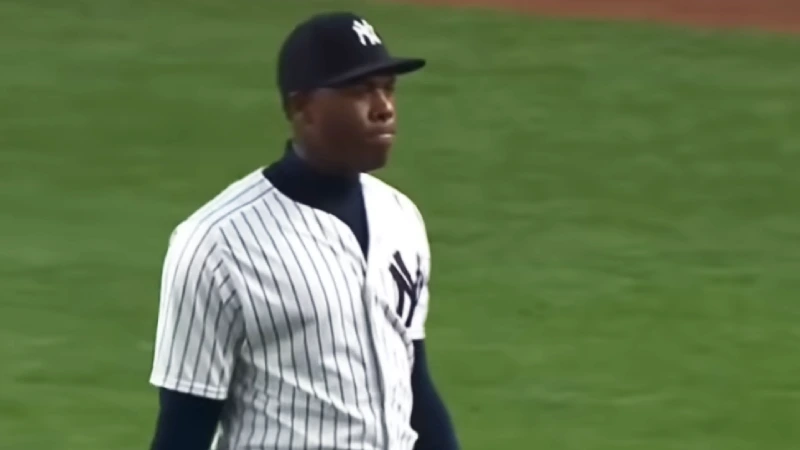
The world of Major League Baseball was forever changed in March 2016 when one of its most dominant closers, Aroldis Chapman, became the face of a new era of league accountability.
While Chapman’s career has been defined by his record-breaking fastballs, his legacy is also tied to a significant disciplinary action that occurred shortly after he joined the New York Yankees.
The suspension was not merely a sports headline; it was the first major test of a newly implemented league policy designed to address off-field conduct.
In this detailed exploration, we will break down why Aroldis Chapman was suspended, the specific details of the incident that led to the ruling, and how it shaped the MLB’s approach to player discipline.
The Core Reason: Violating the Joint Domestic Violence Policy
The primary reason for Aroldis Chapman’s suspension was a violation of Major League Baseball’s Joint Domestic Violence, Sexual Assault, and Child Abuse policy.
This policy was a collaborative effort between the league and the Players Association, aimed at providing the Commissioner with the authority to discipline players for off-field incidents, regardless of whether those incidents resulted in criminal convictions.
In March 2016, Commissioner Rob Manfred issued a 30-game suspension to Chapman. This move was historic, as Chapman was the first player to be penalized under this specific policy.
The suspension sent a clear message that the league would take a hardline stance on allegations of domestic instability and violence.
The October 2015 Incident in Davie, Florida
The events that triggered the MLB investigation took place in October 2015, before Chapman’s trade to the New York Yankees. At the time, Chapman was still a member of the Cincinnati Reds.
According to police reports from Davie, Florida, an altercation occurred between Chapman and his girlfriend, Cristina Barnea. The allegations were serious:
- Physical Altercation: It was alleged that Chapman had choked his girlfriend during the dispute.
- Firearm Discharge: Perhaps the most alarming detail of the police investigation was that Chapman allegedly fired eight shots from a handgun inside his garage during the incident.
While these details painted a troubling picture, the legal path of the case did not lead to a courtroom trial.
Why Were There No Criminal Charges?
Despite the severity of the allegations and the involvement of local law enforcement, the Broward State Attorney’s office decided in January 2016 not to file formal criminal charges against the pitcher.
The decision to drop the case was based on several factors:
- Conflicting Testimony: Statements provided to investigators were inconsistent, making it difficult to build a definitive timeline of events.
- Lack of Cooperation: A lack of cooperation from the parties involved hindered the prosecution’s ability to move forward with a case that could be proven beyond a reasonable doubt.
- Insufficient Evidence: Ultimately, the State Attorney cited a lack of sufficient evidence to secure a conviction.
However, the lack of criminal charges did not mean Chapman would escape discipline from Major League Baseball.
The Role of Commissioner Rob Manfred
One of the most significant aspects of the Joint Domestic Violence policy is that it grants the Commissioner the power to issue discipline based on his own investigation, independent of the legal system.
Commissioner Rob Manfred reviewed the facts of the October 2015 incident and determined that Chapman’s conduct warranted a significant penalty.
By suspending Chapman for 30 games, Manfred demonstrated that the “preponderance of evidence” or the general “conduct detrimental to the league” would be the standard, rather than the “beyond a reasonable doubt” standard used in criminal courts.
Chapman, acknowledging the gravity of the situation and the findings of the league, chose not to appeal the suspension. This decision allowed him to serve his time at the beginning of the 2016 season and return to the mound for the Yankees later that spring.
The New York Yankees’ Stance
When the Yankees acquired Chapman in a trade from the Reds, the investigation was already looming.
Despite the incident occurring before he donned the pinstripes, the New York Yankees organization expressed full support for the Commissioner’s decision and the underlying domestic violence policy.
The team’s management made it clear that while they valued Chapman’s talent on the field, they respected the league’s mandate to uphold higher standards of personal conduct.
This support was crucial in presenting a united front between the club and the league office during a sensitive time for the sport’s public image.
Distinguishing Between Suspensions: 2016 vs. 2020
Fans and historians need to distinguish between Chapman’s landmark 2016 suspension and other disciplinary actions he has faced.
In 2020, Chapman was involved in an on-field altercation that resulted in a different disciplinary action. Initially, he was facing a suspension for his involvement in that incident, which was eventually reduced to 2 games.
To be clear:
- The 30-game suspension (2016): Specifically for the domestic violence incident involving the discharge of a firearm and allegations of physical domestic conflict.
- The 2-game suspension (2020): Specifically for an on-field altercation during a game.
The Legacy of the Suspension
Aroldis Chapman’s 30-game ban remains a pivotal moment in MLB history. It served as the inaugural application of a policy that has since been used to discipline several other high-profile players.
For the Yankees, the suspension meant starting the 2016 season without their elite closer, but it also positioned the franchise as a supporter of the league’s new disciplinary framework.
For Chapman, the incident remains a documented chapter of his career, highlighting the intersection of professional sports and the legal/ethical expectations placed on modern athletes.
Key Takeaways:
- Duration: 30 games.
- Reason: Violation of the MLB Joint Domestic Violence policy.
- Incident Details: Alleged choking and firing 8 gunshots in a garage in Florida.
- Legal Outcome: No criminal charges due to insufficient evidence and conflicting testimony.
- Significance: First player ever penalized under the new policy.
By understanding the nuances of this suspension, we gain a clearer picture of how Major League Baseball governs itself and the standards it expects its players to uphold, both on and off the pitcher’s mound.