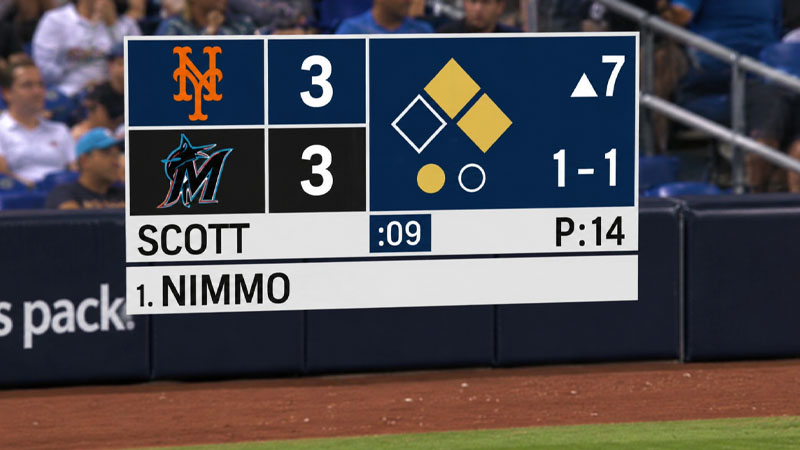
Picture this: You turn on a live baseball game, settle into your favorite chair, and look at the screen. A sleek graphic flashes in the corner—full of numbers, tiny arrows, glowing diamonds, and mysterious dashes.
If you grew up tracking every pitch, it is second nature. But if you are new to America’s pastime, that graphic (often called a “score bug”) can feel like reading code in a foreign language.
Do not worry. Once you understand the layout, the television scoreboard transforms from a confusing grid of numbers into a live-action dashboard telling the complete story of the game.
Whether you are trying to follow along with friends, understand the tension of a late-inning rally, or simply appreciate the strategic chess match unfolding on the diamond, this guide will walk you through every element of a modern broadcast scoreboard so you can watch like an expert.
Anatomy of the Score Bug: Team Order and Runs
Every broadcast network—whether it is ESPN, Fox, TBS, or a local regional sports network—designs its graphics slightly differently, but they all share the same foundational architecture.
The Visiting Team vs. The Home Team
The golden rule of baseball scoreboards is positioning:
- The Away (Visiting) Team is always listed first or on top.
- The Home Team is always listed second or on bottom.
This simple rule dictates the rhythm of the entire game. Because the home team plays in its own stadium, they take the field first to play defense. That means the visiting team always bats first at the top of every inning.
Runs (The Score)
Right next to each team’s name or abbreviation, you will see a large, prominent number. This is the total run count—how many times a player has safely crossed home plate to score for that team.
As the game progresses, these numbers update instantly. If you turn on a game and see Chicago Cubs 4, St. Louis Cardinals 2, you immediately know the Cubs are leading by two runs.
2. Tracking Time: Innings, Outs, and the Count
Unlike football or basketball, baseball is not played against a clock. There is no game clock winding down to zero. Instead, time in baseball is measured in innings.
Understanding Innings and the Arrow Indicator
A standard professional baseball game consists of nine innings. Each inning is split into two distinct halves:
- The Top Half: The visiting team bats while the home team plays defense in the field.
- The Bottom Half: The home team bats while the visiting team plays defense.
To show you where the game stands, the scoreboard features an inning number (1 through 9, or higher if the game goes into extra innings) accompanied by an arrow indicator:
- Pointing UP: You are watching the top half of the inning (visiting team batting).
- Pointing DOWN: You are watching the bottom half of the inning (home team batting).
Outs: The Lifeline of the Inning
Unlike other sports where you have unlimited chances to score within a possession, a baseball team’s turn at bat is fiercely limited. An inning half only ends when the defense records three outs.
On your TV screen, outs are typically represented by:
- Two or three small dots, circles, or lights.
- Unlit circles mean zero outs have been recorded.
- As players are called out or tagged out, the circles light up sequentially (1 out, 2 outs). The moment the third circle lights up, the teams swap places on the field.
The Count: Balls and Strikes
In the center of the scoreboard, you will almost always find a pair of numbers separated by a hyphen, such as 2-1 or 3-2. This is the batter’s count.
- The First Number: Represents Balls (pitches thrown outside the strike zone that the batter correctly chose not to swing at). A batter walks on 4 balls.
- The Second Number: Represents Strikes (pitches swung through, hit foul with fewer than two strikes, or caught inside the strike zone). A batter is out on 3 strikes.
A count of 3-2 is famously known as a full count—three balls, two strikes. The next pitch will likely decide the fate of the batter.
3. The Live Action Dashboard: Base Runners and Diamonds
One of the most satisfying parts of a modern broadcast graphic is the visual representation of the infield.
Look closely near the center of the score bug, and you will see a diamond shape turned on its side, representing the four bases: home plate, first base, second base, and third base.
- Unlit Diamonds: The bases are empty.
- Glowing or Colored Diamonds: A runner is occupying that specific base.
For example, if you see the diamond at first base and second base lit up, you instantly know there are “runners on first and second.” This instantly changes how you view the game: a single by the next batter might score one or even two runs, while the defense must be alert for a potential double play.
4. Advanced Broadcast Data: Digging Deeper Into the Stats
Once you master the basics of runs, innings, counts, and base runners, you will notice that television broadcasts love to layer in additional data points to enrich the viewing experience.
Pitch Counts
Beneath or beside the main score bug, you will often see a letter “P” followed by a number (e.g., P: 84). This tells you how many total pitches the current pitcher has thrown in the game.
Pitch counts are vital for modern managers and fans alike. As a starting pitcher approaches 100 pitches, fatigue sets in, control can waver, and managers begin looking to their bullpen for relief pitchers.
Batter Statistics
When a new player steps up to the plate, the broadcast graphic often expands to show vital context:
- Their name and jersey number.
- Their batting average for the season (e.g., .285).
- Their performance in the current game (e.g., 1 for 3 with a single).
Pitch Speed and Trajectory
Right after the ball crosses home plate, a graphic element frequently pops up displaying the velocity of the pitch in miles per hour (e.g., 97 MPH) and the pitch type (Four-Seam Fastball, Slider, Curveball, Changeup). Tracking velocity adds an extra layer of appreciation for just how fast major league athletes operate.
5. Putting It All Together: Reading a Live Scenario
Let us put your new knowledge to the test with a simulated television graphic:
Here is how you decode this in real time:
- The Matchup: The San Francisco Giants (SFG) are playing the Los Angeles Dodgers (LAD) at Dodger Stadium.
- The Score: The Dodgers are winning 5 to 2.
- The Inning: The arrow is pointing UP, and the number is 7. This means we are in the top of the 7th inning. The Giants are batting, and the Dodgers are playing defense.
- The Situation: There are 2 outs (two filled dots). The count on the current batter is 2 balls and 1 strike.
- The Runners: Looking at the base indicators, a runner is standing safely on second base (the top diamond is lit).
Armed with this quick snapshot, you know the Giants are running out of time (they only have three offensive frames left to make up a three-run deficit), but they have a runner in scoring position with a favorable hitter’s count. The tension is palpable!
Frequently Asked Questions
What happens if a game is tied after nine innings?
Baseball does not end in a tie during the regular season or postseason. If the score is tied at the end of nine complete innings, the game moves into extra innings (10th, 11th, and beyond) until one team outscores the other in a completed frame.
What does “BOT” or “TOP” mean on some digital scoreboards?
These are simply text abbreviations for the top half and bottom half of an inning, reinforcing what the up and down arrows indicate.
Why do some scoreboards show hits and errors alongside runs?
In addition to the main score, traditional box scores use an R-H-E line (Runs, Hits, Errors).
- R: Total runs scored.
- H: Total base hits safely earned by the offense.
- E: Defensive miscues or fielding errors that allowed runners to advance.
Conclusion
Reading a baseball scoreboard on TV stops feeling like a puzzle the moment you break it down into its core components: team order, inning progression, the live-action count, and base runner placement.
The next time you tune into a game, take a glance at the score bug. Track the pitch count, watch the base paths light up, and pay attention to how the strategy shifts with every ball and strike. Enjoy the game!