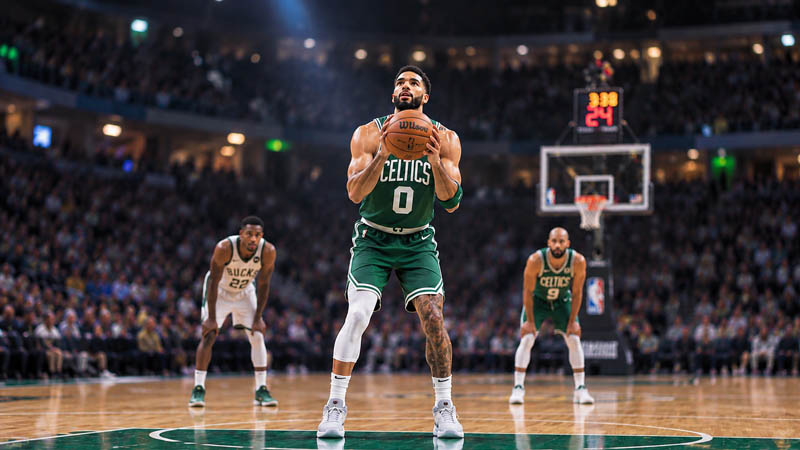
In the competitive landscape of basketball, few scenarios generate as much psychological and tactical tension as the one-and-one free throw.
This specific officiating mechanism serves as a high-stakes bridge between standard play and the “double bonus” phase, fundamentally altering how coaches manage clock stoppage and how players approach late-game execution.
Understanding the one-and-one is essential for any professional analysis of the sport’s regulatory evolution and its impact on performance metrics.
Defining the One-and-One: A Technical Overview
At its core, a “1-and-1” is a unique free-throw situation where the player at the line is not guaranteed a second attempt.
The awarding of the second shot is entirely contingent upon the success of the first. If the player successfully converts the first free throw, they are granted a second attempt to maximize the possession’s value. However, if the player misses the initial shot, the ball becomes live immediately.
This creates a high-pressure environment where players from both teams must be prepared to rebound and resume play the moment the ball hits the rim.
This rule is distinct from standard shooting fouls, where a player typically receives two or three guaranteed attempts regardless of the outcome of the first shot. The one-and-one is tied specifically to team foul totals, acting as a penalty for cumulative defensive aggression during a half or quarter.
The Threshold of the Bonus: When the Rule Applies
The transition into the one-and-one situation is governed by the frequency of team fouls. In traditional settings where this rule is utilized, the one-and-one typically comes into play after a team has committed a specific number of fouls—often the 7th, 8th, and 9th team fouls of a half.
Once a team reaches its 10th foul, the penalty structure shifts to the “double bonus,” where the offended player receives two guaranteed free throws regardless of whether the first is made.
This “middle ground” of the 7th through 9th fouls creates a strategic window. Defensive units must weigh the risk of fouling, knowing that they might give the opponent a chance for two points, while also recognizing the statistical possibility that a poor free-throw shooter might miss the first shot, resulting in a zero-point possession and a live-ball rebound opportunity for the defense.
The Strategic Argument: Positives and Performance Impact
Proponents of the one-and-one rule argue that it introduces a level of excitement and volatility that is often missing from standard free-throw sequences.
Because the stakes are higher for the individual shooter, the pressure is magnified, providing a true test of a player’s “clutch” performance capabilities.
- Higher Stakes: The “do-or-die” nature of the first shot keeps the audience engaged and the players on high alert.
- Live-Ball Opportunities: Unlike guaranteed two-shot fouls, the one-and-one allows for the ball to be back in play immediately following a miss. This rewards teams with a strong rebounding presence and can lead to quick transition opportunities.
- Deterring Foul Baiting: Because the second shot is not guaranteed, players may be less inclined to “hunt” for fouls if they are not confident in their ability to convert the first attempt under pressure.
From a tactical standpoint, the one-and-one rewards technical proficiency. A team comprised of high-percentage free-throw shooters can effectively weaponize the bonus, turning every defensive lapse by the opponent into a high-probability scoring opportunity.
The Mathematical Reality of the One-and-One
When evaluating the efficiency of the one-and-one, data-driven analysis reveals that it remains a highly efficient scoring mechanism compared to standard half-court sets.
For example, a 70% free-throw shooter in a one-and-one situation will still average approximately 1.19 points per trip to the line. In the context of professional basketball, a 1.19 points-per-possession average is considered elite offense.
As the shooter’s proficiency increases, the efficiency becomes even more pronounced. An 80% shooter—a benchmark that many modern players are approaching—averages roughly 1.44 points per trip in a one-and-one scenario.
This figure exceeds the efficiency of even the most potent offenses in the game, suggesting that while the second shot is not guaranteed, the statistical advantage still heavily favors the offensive team.
However, these figures must be balanced against the intangibles of high-pressure situations. A player who averages 70% in practice or during the early stages of a game may see their percentage dip during a critical late-game one-and-one.
The psychological weight of knowing a miss ends the possession can lead to uncharacteristic errors, making the “clutch” factor a vital component of the rule’s impact.
The Counter-Argument: Why Some Leagues Avoid the One-and-One
Despite its strategic depth, many professional organizations, including the NBA, have moved away from the one-and-one format. The primary reason cited is the flow of the game.
Historical data shows that when the NBA utilized this rule, it often led to a significant slowdown in play as teams would strategically foul in too many scenarios to exploit poor shooters.
- Abuse of Strategy: Critics argue that the rule can be abused, particularly in late-game situations. For instance, a “Hack-a-Shaq” style strategy—deliberately fouling a poor free-throw shooter—could be employed for several minutes straight. If a player misses the first shot of a one-and-one, the defense successfully regains a chance at the ball without the offense scoring a single point.
- Viewing Experience: Constant fouling and free-throw sequences can make the final five minutes of a game tedious for spectators. Professional leagues prioritize a fast-paced, high-scoring product, and the one-and-one is often seen as an impediment to that goal.
- Rewarding the Foul: Some organizations, such as FIBA, abandoned the rule because it was perceived to reward the defensive team for fouling. By creating a scenario where a foul could result in zero points and a change of possession (via a missed first shot), the rule inadvertently incentivized defensive teams to stop the clock and disrupt the rhythm of the game.
Historical Context and Global Regulation
The evolution of the one-and-one reflects a broader trend in basketball toward streamlining rules and increasing scoring efficiency.
The NBA previously utilized the one-and-one but found that removing it improved the overall game flow and reduced the incentive for tactical fouling.
Similarly, FIBA—the international governing body for basketball—had a version of this rule for years before eventually abandoning it to prevent teams from using fouls as a strategic advantage.
Currently, the one-and-one remains a staple of collegiate and high school basketball in many regions, where it is viewed as a fundamental part of the amateur game’s identity.
In these settings, the pressure of the one-and-one is considered a vital developmental tool for young athletes.
Enhanced FAQ: Navigating One-and-One Scenarios
1. What happens if a player is fouled while shooting and the game is in the one-and-one bonus?
If a player is fouled in the act of shooting and makes the basket, they receive exactly one free throw (the “and-one”), regardless of the team foul count. If they miss the shot while being fouled, they typically receive two or three guaranteed shots depending on where they were on the floor.
The one-and-one rule specifically applies to non-shooting fouls (such as reach-ins or floor fouls) once the team foul threshold is met.
2. Is the one-and-one used in the NBA today?
No, the NBA currently uses a different bonus structure. In the NBA, once a team reaches the foul limit, the opposing team is awarded two guaranteed free throws for every subsequent non-shooting foul. The one-and-one was eliminated to improve game speed.
3. Why do players still practice for the one-and-one if they play professionally?
Many professional players grew up playing under the one-and-one rule in high school and college. Additionally, the psychological discipline required to make a “must-hit” first free throw is a transferable skill that applies to any late-game pressure situation.
4. Does a one-and-one affect the game clock differently than other fouls?
The foul itself stops the clock. However, because a missed first shot in a one-and-one results in a live ball, the clock starts the moment a player touches the rebound. In a two-shot foul, the clock stays stopped until the second shot is either made or missed and rebounded.
5. How does the “Double Bonus” differ from the One-and-One?
The “Double Bonus” occurs after a team exceeds the one-and-one threshold (usually the 10th foul). In the double bonus, the shooter receives two guaranteed shots; even if they miss the first, they still get the second. This removes the “live ball” possibility after the first shot.
Strategic Takeaway for Organizations and Coaches
The one-and-one free throw is a testament to the balance between risk and reward in basketball.
While it offers a statistical advantage to the offense on paper, the psychological pressure and the potential for a live-ball rebound introduce a layer of complexity that can swing the momentum of a game in seconds.
For coaches, mastering the one-and-one phase requires:
- Personnel Management: Ensuring high-percentage shooters have the ball when the opponent is in the 7-9 foul window.
- Rebound Positioning: Training players to react instantly to a miss on the first shot, as the ball becomes live immediately.
- Foul Awareness: Tracking team fouls meticulously to know when to apply pressure and when to avoid giving the opponent a trip to the line.
While professional leagues like the NBA prioritize flow and entertainment value, the one-and-one remains one of the most intellectually stimulating rules in the sport’s history, highlighting the intersection of human psychology and mathematical probability