In the high-stakes environment of competitive basketball, ball handling is the engine that drives an offense.
Whether you are a point guard navigating a full-court press or a wing player attempting to create space for a jump shot, your ability to manipulate the ball is your primary advantage.
Among the most frequent technical questions from developing athletes and enthusiasts alike is a fundamental one: Can you legally switch hands while dribbling?
The short answer is yes. Switching hands is not only legal but is the cornerstone of advanced offensive play. However, the legality of the move depends entirely on the mechanics of the exchange.
Understanding the fine line between a highlight-reel crossover and a turnover-inducing violation is what separates elite playmakers from the rest.
The Fundamental Rule: One Hand at a Time
The primary restriction regarding hand switching is rooted in the definition of a live dribble. To maintain a legal dribble, a player cannot touch or hold the ball with both hands at the same time during the exchange.
In the eyes of an official, the moment two hands make contact with the ball, the dribble has legally ended. If a player continues to dribble after this two-handed contact, they have committed a double dribble violation.
This rule exists to prevent players from gaining an unfair advantage by essentially “catching” the ball to change direction, which would make the defender’s job nearly impossible.
The Mechanics of the Legal Exchange
To execute a legal hand switch, the ball must transition from one hand to the other through a continuous motion that involves the floor. This transition typically follows a specific sequence:
- The Release: The dribbling hand pushes the ball toward the floor.
- The Bounce: The ball makes contact with the hardwood, redirected toward the receiving hand.
- The Reception: The opposite hand gathers the ball to continue the dribble.
The critical “gap” in this process is the flight of the ball between the floor and the receiving hand. During this window, the ball must be “free”—meaning no part of the player’s body is holding or carrying it in a way that terminates the dribble’s downward momentum.
Mastering the Core Moves: Techniques and Legality
There are three primary methods used by elite players to switch hands while maintaining a live dribble. Each requires specific technical precision to remain within the rules.
1. The Crossover
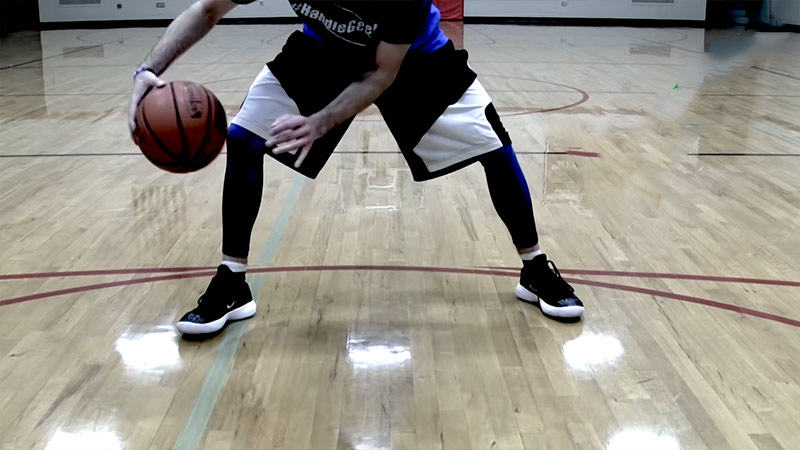
The crossover is the most common hand-switching move. Its effectiveness lies in its lateral speed. To keep this move legal, you must push the ball to the floor so it bounces toward the opposite hand in one fluid motion.
- The Technical Key: You must ensure your hand remains on top or to the side of the ball. If your hand slides underneath the ball (palming), an official will likely whistle for a carrying violation.
2. Between the Legs
Using your body as a shield, the between-the-legs dribble is an essential tool for protecting the ball from aggressive defenders.
- The Technical Key: This move requires high-level fingertip control. By using the pads of your fingers to guide the ball through the legs, you can ensure the exchange is crisp and the ball reaches the receiving hand without any “hiccups” in momentum that might look like a carry.
3. Behind the Back
Often used when a defender is cutting off the direct path of a crossover, the behind-the-back move allows the player to switch hands while keeping their body between the ball and the opponent. Like the previous moves, the ball must bounce once on the floor during the transition from the right hand to the left (or vice versa).
Navigating the “Whistle Zones”: Why Moves Get Called
Even when a player intends to switch hands legally, technical errors can lead to turnovers. Understanding these “whistle zones” is vital for any serious competitor.
- The Carrying (Palming) Trap: This is the most frequent violation during a hand switch. It occurs when the player’s hand resides under the equator of the ball, momentarily coming to a rest before the player continues the dribble or switches hands. To an official, this looks like the player is “carrying” the ball to a new location rather than dribbling it.
- The Double Dribble Trap: This occurs if a player becomes hesitant during the exchange. If the receiving hand touches the ball while the initial hand is still in contact—even for a fraction of a second—the dribble is dead.
The Importance of Fingertip Sensitivity
The difference between a legal exchange and a violation often comes down to millimeters of contact. This is why coaches emphasize fingertip control over palm contact. The fingertips provide the sensory feedback necessary to “feel” the ball’s rotation and momentum.
When you use your fingertips to guide the ball—especially during complex moves like the between-the-legs exchange—you maintain a “live” feel that allows for quicker adjustments.
This sensitivity ensures that the ball is pushed, not caught, keeping the motion continuous and the officials’ whistles silent.
Professional Training Insights: How to Practice the Switch
To build a “bulletproof” handle that stands up to the scrutiny of high-level officiating, your practice must focus on the physics of the bounce.
- The Continuous Motion Drill: Stand in a stationary athletic stance. Practice crossing the ball over from right to left, focusing entirely on the height of the bounce. The ball should reach the receiving hand at hip height or lower. If the ball bounces too high, you are more likely to “cup” the ball to bring it back down, leading to a carry.
- The “Top-Only” Constraint: Practice your crossover and between-the-legs moves while consciously keeping your palms facing the floor. This forces you to rely on the side and top of the ball for direction, which is the safest way to avoid carrying calls.
- Variable Speed Training: Start slow to master the mechanics of the “one-hand” rule, then gradually increase speed. A common mistake is trying to move the hands faster than the ball can bounce, which leads to the “two-hand touch” violation.
Frequently Asked Questions (FAQ)
Q: Can I switch hands in the air if I haven’t dribbled yet?
A: If you have just caught a pass and have not yet started your dribble, you can move the ball from one hand to the other. However, once the ball leaves your hand to start a dribble, the rules of the exchange apply.
Q: Is it a violation if the ball hits my foot during a switch?
A: If the ball accidentally hits your foot, it is generally considered a “kicked ball” only if the action was intentional. If it is accidental during a dribble exchange, it is often a loose ball. However, you cannot “switch hands” by bouncing the ball off your foot to yourself.
Q: Does the “two-hand” rule apply to the NBA and FIBA?
A: Yes. While some professional leagues are perceived to be more “lenient” with the rhythm of the dribble, the fundamental rule remains: touching the ball with both hands simultaneously ends the dribble across all major officiating bodies.
Conclusion: Precision Over Flash
Mastering the legal dribble exchange is a requirement for any player looking to compete at a high level. While the flashy nature of crossovers and between-the-legs moves makes for great highlights, their true value lies in their technical legality.
By focusing on continuous motion, fingertip control, and the one-hand-at-a-time rule, you ensure that your offensive game remains both effective and efficient.
The goal of every great ball handler is to make the difficult look effortless. By anchoring your skills in the fundamental rules of the game, you can navigate the court with the confidence that your moves will stand up to the highest level of competition.