The whistle blows, the play stops, and the crowd begins to murmur. On the court, a young player looks at the referee with wide-eyed confusion. It is a scene played out in gymnasiums around the world every weekend.
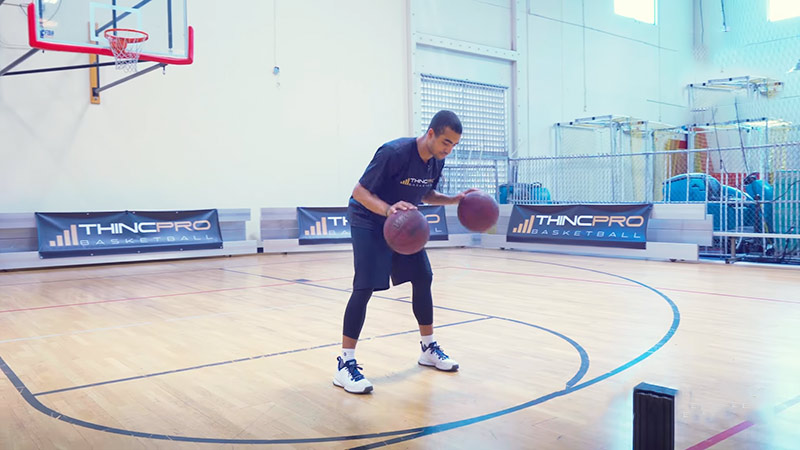
The infraction? A double dribble. While it is one of the foundational rules of basketball, it remains one of the most frequently misunderstood, especially regarding the use of two hands.
To understand the rhythm of the game, one must understand the mechanics of the dribble. The question of whether you can dribble with two hands is not a simple “yes” or “no” but rather a “when” and “how.”
Navigating these nuances is essential for players, coaches, and parents who want to truly grasp the strategic depth of the sport.
The Foundational Rule: Single-Handed Dominance
In the most general sense, dribbling in basketball is intended to be a single-handed act. The game’s rules are designed to balance the physical advantage of the offensive player with the tactical positioning of the defense.
If a player were allowed to use both hands to manipulate the ball continuously, it would be nearly impossible for a defender to poke the ball away or force a turnover.
Under the official guidelines of the NBA, FIBA, and NCAA, a double dribble violation occurs in two primary ways:
- Simultaneous Contact: Touching the ball with both hands at the exact same time during a continuous dribbling motion.
- The Stop and Restart: Once a player has voluntarily ended their first dribble by catching the ball or letting it come to rest in one or both hands, they cannot legally begin a second dribble.
Once that dribble is “picked up,” the player’s options are restricted: they must either pass the ball to a teammate or attempt a shot at the basket.
The Only Exception: The Power Dribble
There is one specific moment where the rules allow—and even encourage—the use of two hands: the start of the dribble. This is commonly referred to in coaching circles as the “power dribble”.
When a player first receives a pass or recovers a loose ball and is standing still, they are permitted to use both hands simultaneously to initiate their very first bounce.
This two-handed push provides maximum force and control, allowing the player to protect the ball from nearby defenders as they begin their drive to the basket.
However, the moment that ball leaves their hands and hits the floor, the “two-hand grace period” ends. Every subsequent bounce in that sequence must be performed with only one hand.
Why the Rules Prohibit Two-Handed Dribbling
To the casual observer, the double dribble might seem like a minor technicality. However, from a strategic standpoint, it is a pillar of game balance. The restriction exists to prevent an unfair advantage.
A player who has not yet used their dribble is a “triple threat”—they can shoot, pass, or drive. This uncertainty keeps the defense on its heels. Once a player starts and then stops their dribble, they have “used” their primary tool for repositioning.
At this point, the defense can legally apply more pressure, knowing the player is trapped in a fixed location. If players could stop and restart their dribble at will, elite ball-handlers could “hog” the ball for entire possessions, making the game less about teamwork and more about individual keep-away.
Legal Resets: When You Can Dribble Again
While the rules against restarting a dribble are strict, there are three specific scenarios where a player’s right to dribble is “reset,” even if they have already stopped once. These are the moments that often cause the most debate among fans and spectators.
1. The Defensive Deflection
If an opponent touches, pokes, or deflects the ball while you are dribbling or after you have stopped, the “clock” on your dribble resets.
Because the defender’s action forced the ball loose or disrupted your control, you are legally allowed to recover the ball and begin a completely new dribble.
A high-profile example occurred during the 2025 NBA Playoffs with Tyrese Haliburton; a late-game possession appeared to be a double dribble, but the official review confirmed a defender had deflected the ball, making his second dribble legal.
2. The Rim and Backboard Exception
If you attempt a shot and the ball strikes the rim or the backboard, you can recover the rebound and start a new dribble. This is because the shot attempt is considered a voluntary surrender of possession.
If the ball hits the hardware and comes back to you, the game views it as a new possession. It is important to note, however, that an “airball”—a shot that misses everything—does not reset the dribble.
3. Fumbles and Lost Control
There is a legal distinction between a controlled dribble and a fumble. If a player fails to establish initial control of a pass or a loose ball and it bounces off their hands, they can use both hands to gather it and then start their legal dribble.
Since the player never had “established control,” the fumble is not counted as the start of a dribble.
Double Dribble vs. Carrying: Clearing the Confusion
A common point of frustration for fans is the difference between a double dribble and a “carry” (also known as palming). While both result in a turnover, they are distinct mechanical errors.
- Double Dribble: This is a violation of the sequence. You stopped and then restarted, or you used both hands at once. The dribble was technically “ended” and then “resumed”.
- Carrying: This is a violation of the motion. A carry occurs when the player’s hand gets underneath the ball, causing it to come to a rest in an upturned palm during a continuous dribbling motion. The dribble never actually stopped, but the way the ball was handled gave the player an illegal advantage in changing direction or hesitation.
Referees use different signals to communicate these to the scorer’s table: alternating hands in a patting motion for a double dribble, and a palm-up rotation for a carry.
Enforcement Discrepancies: Youth vs. Professional Play
One of the most frequent complaints from fans is that “the pros never get called for it”. There is some truth to this observation, though the reasons are more complex than simple laziness on the part of officials.
In youth basketball, double dribbles are called constantly. Young players often “dribble to nowhere,” stopping their motion under pressure with no plan for a pass or shot, only to panic and start dribbling again when a lane opens up. Coaches at this level are encouraged to enforce the rule strictly to build foundational habits and composure.
At the professional level, the speed of the game makes these calls incredibly difficult. In the fast-paced flow of an NBA game, distinguishing between a legal, slowed-down hesitation dribble and an illegal stop is a split-second judgment.
Furthermore, professional players have such elite ball control that they rarely commit the “obvious” two-handed violations seen in junior leagues.
When a violation is missed in the pros, it is usually because the referee simply lost track of whether the player had already dribbled in that sequence.
The Penalties: What Happens After the Whistle?
When a referee identifies a two-handed dribble or a stop-and-start violation, the result is a turnover. The opposing team is awarded possession of the ball at the nearest out-of-bounds spot.
The specific location of the inbound pass varies by league:
- NBA: To give the defense a greater advantage, the ball is awarded at the sideline, but no closer to the baseline than the free-throw line extended.
- FIBA/NCAA/High School: The ball is typically awarded at the spot on the sideline or baseline closest to where the violation occurred.
Coaching Strategies: Eliminating the Habit
For coaches, teaching players to avoid the “two-hand trap” is a priority from day one. It is not just about avoiding turnovers; it is about encouraging teamwork and better decision-making.
The “Double Drenching” Drill
A common training technique involves forcing players into “limited-choice” scenarios. In these drills, a player must dribble to a specific spot, pick up the ball with both hands, and then be forced to make a pass or a shot within a two-second window. This teaches the player to have an “exit strategy” before they ever stop their dribble.
Film and AI Analysis
Modern coaching has moved beyond the whistle. Teams now use automated AI cameras to track player movements throughout entire practices.
By reviewing film, a coach can isolate the exact moments where a player habitually picks up the ball under defensive pressure. Seeing the violation on screen is often far more effective for a player’s development than simply being told they made a mistake.
Frequently Asked Questions
Can you switch hands while dribbling?
Yes. You can move the ball from your right hand to your left hand (a crossover), provided that only one hand is touching the ball at any given time and you do not “carry” the ball during the transition.
Is it a double dribble if the ball hits my foot?
If the ball accidentally strikes your foot and you recover it, it is generally treated as a fumble. You can gather the ball and start a dribble, provided the referees determine you did not intentionally kick it.
What if I trip while dribbling?
If a player trips and their hands touch the floor while still holding the ball, the dribble has ended. If they stand up and start dribbling again, it is a double dribble violation.
Can I use two hands to catch a pass?
Absolutely. You can catch the ball with two hands to establish control. Your dribble only begins when you intentionally push the ball to the floor.
Conclusion: Mastering the Mechanics
The “two-hand” rule in basketball is more than a simple restriction; it is the boundary that defines the flow and fairness of the game.
While you can use two hands for that initial “power dribble” to burst past a defender, the rest of your drive relies on the coordination and skill of a single-handed handle.
Understanding the exceptions—the defensive deflections, the rim resets, and the initial fumbles—separates the casual fan from the true student of the game. For players, mastering the legality of the dribble is a foundational step toward becoming a reliable offensive threat.
By focusing on composure and knowing exactly when those two hands can—and cannot—touch the ball, you ensure that the only thing stopping your drive to the basket is the final buzzer.