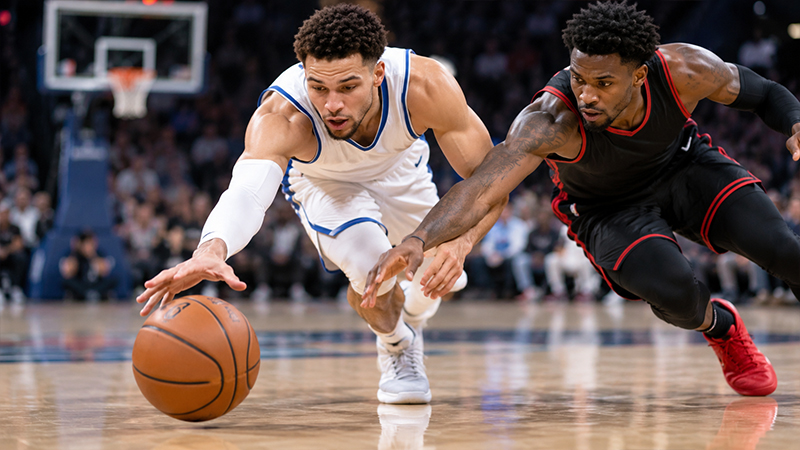
In the world of elite athletics, the difference between a championship-caliber performance and a frustrating loss often resides in the most granular details of the box score. For coaches, players, and stakeholders at every level, few metrics carry as much weight as turnover.
While shooting percentages fluctuate and rebounding numbers can be influenced by size, the turnover column remains one of the purest indicators of a team’s discipline, technical proficiency, and mental fortitude.
Understanding what constitutes a turnover is more than a simple exercise in rule-memorization; it is the foundation of high-level basketball IQ.
Every offensive possession represents a “golden opportunity” to influence the scoreboard. A turnover is, essentially, the voluntary or forced surrender of that opportunity before a shot can even be attempted.
The Fundamental Definition: What is a Turnover?
At its core, a turnover occurs when the offensive team loses possession of the ball to the opponent before a shot or free throw attempt is made.
This disruption in the offensive flow is considered a costly mistake because it simultaneously ends a scoring chance and frequently provides the opposition with a high-percentage transition opportunity.
Turnovers are not monolithic; they are the result of a diverse array of actions, from technical rule infractions to lapses in physical execution. Generally, these incidents are categorized into two primary classifications: Violations and Player Errors.
Technical Violations—The Rule-Based Possession Loss
Violations occur when a player breaches the specific rules governing how the game is played. In these instances, the official blows the whistle, the play stops, and possession is awarded to the defense. These are often the result of a lack of fundamental discipline or a lapse in on-court awareness.
1. Movement and Ball Handling Violations
- Traveling: Perhaps the most frequently called violation, traveling involves taking more than the permitted number of steps without a live dribble or moving the pivot foot illegally. It effectively negates any hard-earned advantage gained by the player.
- Double Dribble: This occurs when a player handles the ball with two hands simultaneously during a dribble or resumes a dribble after having already stopped it. This is a fundamental error often seen in developmental stages but can occur at any level under pressure.
- Carrying (Palming): Referees monitor for moments when a player’s hand goes beneath the ball during a dribble, momentarily interrupting its downward momentum. This is a technical violation of the rules regarding dribbling hands.
2. Spatial and Boundary Violations
- Out of Bounds: A simple yet devastating error, this occurs when a player in possession of the ball steps on or over the boundary lines. Even receiving a pass with “toes kissing the line” results in an automatic turnover.
- Backcourt Violation: Once a team establishes possession in the frontcourt, they are prohibited from bringing the ball back across the mid-court line. This is a strategic error that immediately gifts the ball to the opponent.
3. Temporal (Clock) Violations
The modern game is governed by time, and failing to respect these constraints leads to various “clock violations”.
- Three-Second Violation: An offensive player may not remain in the “key” or restricted painted area for more than three consecutive seconds while their team has possession in the frontcourt.
- Five-Second Violation: This occurs under two primary conditions: failing to inbound the ball within five seconds or being “closely guarded” in the frontcourt for five seconds without passing, shooting, or dribbling.
- Ten-Second (or Eight-Second) Violation: Teams are required to advance the ball past the half-court line within a specific timeframe (10 seconds in many leagues, 8 seconds in others).
- Shot Clock Violation: If the offensive team fails to attempt a shot that hits the rim before the shot clock expires, a turnover is recorded.
4. Foul-Related Turnovers
Not all fouls lead to free throws; some lead directly to a change in possession.
- Charging: When an offensive player illegally initiates contact with a defender who has established a legal guarding position, it is an offensive foul and a turnover.
- Illegal Screens: A screen must be set with a stationary base. If the screener moves or uses their arms to impede a defender, it is an illegal screen, resulting in a loss of possession.
Player Errors—The Execution-Based Possession Loss
While violations are clear-cut rule breaches, player errors are often referred to as “unforced mistakes” or “oh no” moments. These occur during the flow of play and are frequently the result of intense defensive pressure.
1. Passing Miscues
Passing is the primary vehicle for offensive movement, but it is also a significant source of turnovers.
- Interceptions: A defender reads the offensive player’s intent and steals the pass mid-air.
- Errant Passes: These are passes thrown with too much velocity, poor accuracy, or aimed at a player who has already moved, causing the ball to land out of bounds or in a defender’s hands.
- Fumbled Catches: Even a perfectly thrown pass can become a turnover if the receiver drops the ball or fails to secure it before a defender pokes it away.
2. Dribbling Miscues
Ball security is the hallmark of an elite guard, yet the “fine line between ball control and disaster” is always present.
- Stolen Ball: A defender directly pokes the ball away or takes it from the ball-handler.
- Losing Control: A player may simply lose their handle on the ball while attempting a move, leading to a scramble where the defense recovers possession.
3. Specialty Errors
- Offensive Goaltending: Interfering with a shot on its downward trajectory or while it is within the cylinder above the basket results in a turnover.
- Traveling on a Rebound: A player may successfully grab a rebound but take too many steps before releasing the ball, negating the effort of the board.
Live Ball vs. Dead Ball Dynamics
The impact of a turnover on a game is often determined by its “state” when the change of possession occurs. Understanding this distinction is vital for defensive transition strategy.
- Live Ball Turnovers: These occur during active play, such as a stolen pass or a lost dribble. These are the most dangerous turnovers because the defense gains immediate possession and can transition to offense instantly. This often leads to “easy fast-break opportunities” for the opponent.
- Dead Ball Turnovers: These follow a whistle for a violation. While the offense loses possession, the “penalty” is slightly mitigated because the defense must take the ball out of bounds at the nearest sideline or baseline. This allows the team that committed the turnover to set their defense and prevent an immediate score.
The Strategic Impact—Why Ball Security Dictates Victory
For any team, a high turnover rate is a “certain recipe for disaster”. Coaches prioritize this metric because it is a clear indicator of performance that is less susceptible to the “skews” of opponent style than shooting or rebounding.
1. The Mathematics of Defeat
Every turnover is a double-edged sword. It subtracts a potential scoring opportunity for the offense while adding an extra opportunity for the defense.
In close games, the team with more turnovers is statistically likely to lose, especially if those turnovers were forced by opponent pressure.
2. The Momentum Factor
Basketball is a game of runs and emotional energy. Turnovers are “momentum-shifting mistakes”. A live-ball steal leading to a dunk can energize a stadium and demoralize an opponent more than any half-court set could.
Advanced Training—Strategies to Minimize Turnover Rates
Reducing turnovers is not about playing timidly; it is about increasing skill and awareness so that aggressive play remains controlled. Elite coaching involves moving beyond stationary drills to prepare players for game-time pressure.
1. Comprehensive Ball-Handling Development
Players must master the basics of dribbling early on, but the goal is to translate those skills to a game environment.
- Weak Hand Proficiency: Defensive players will “sit on” a player’s dominant hand. Developing the weak hand allows a player to drive in either direction, which “automatically cuts down dribbling turnovers immensely”.
- Live Defense Training: Stationary drills have limits. Players must practice against live defenders to expose weaknesses and learn how to maintain control under physical duress.
2. Realistic Passing Scenarios
Passing is as much about timing and psychology as it is about physical technique.
- Pass Fakes: Training against a live defense teaches players the necessity of the pass fake, a tool that is difficult to master in a vacuum.
- Pressure Drills: Players learn what types of passes work and what don’t only when they are challenged by active hands in passing lanes.
3. The “Overloaded” Methodology
One of the most effective ways to build confidence is through overloaded drills—scenarios where the offense is outnumbered (e.g., 3-on-4 or 4-on-5).
- Constant Pressure: An extra defender ensures that there are no uncontested passes and that the ball-handler is under perpetual stress.
- Composure Building: By making practice situations more difficult than game situations, players remain composed and “confident” when facing standard game-day pressure.
Enhanced FAQ: Mastering the Nuances of the Turnover
Is a missed shot considered a turnover?
No. A turnover only occurs if the offense loses possession before attempting a shot. A missed shot that is rebounded by the defense is recorded as a defensive rebound, not an offensive turnover.
Does a foul always result in a turnover?
Only offensive fouls (like charging or illegal screens) are recorded as turnovers. Defensive fouls result in either a reset of the play or free throws for the offense.
What is the difference between a “stolen ball” and a “bad pass” in the box score?
A stolen ball is credited when a defender’s active intervention causes the turnover. A “bad pass” turnover is recorded when the offensive player throws the ball out of bounds or directly to a defender without the defender having to make a primary play on the ball-handler.
Why do coaches care more about live-ball turnovers?
Because they lead to immediate fast breaks. A dead-ball turnover allows you to set your defense; a live-ball turnover often results in an uncontested layup or dunk before your defense can react.
Conclusion: The Path to Elite Ball Security
In the pursuit of basketball excellence, the reduction of “oh no” moments is just as important as the mastery of the jump shot.
While it is impossible to eliminate turnovers, elite teams understand that minimizing preventable mistakes is the “difference between a win and a frustrating defeat”.
Developing on-court awareness, honing technical skills against live pressure, and appreciating the “golden” value of every possession are the hallmarks of a winning culture.
By treating ball security as a fundamental pillar of the game, players and coaches can ensure that their scoring opportunities are maximized and their opponents’ transition chances are neutralized.