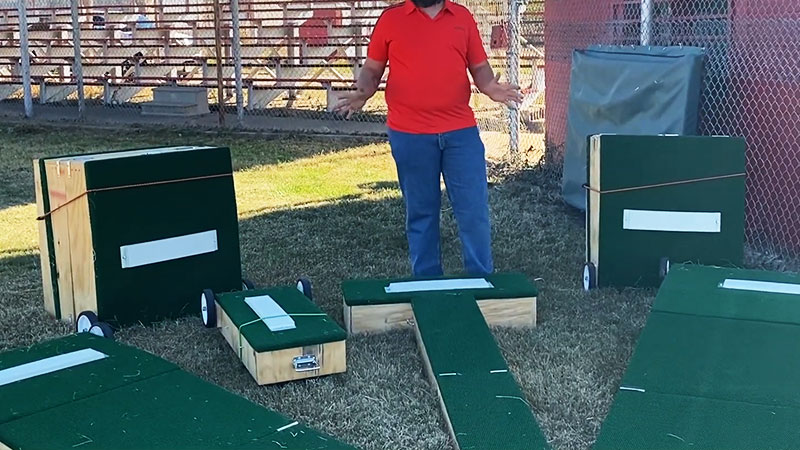
In the game of baseball, the pitching mound is often referred to as the “lonely island.” It is the stage where the most critical duels in sports take place—the confrontation between the pitcher and the hitter.
While fans often focus on the speed of a fastball or the break of a curveball, the physical architecture of the mound itself is governed by strict, precise measurements that ensure the integrity of the game.
If you have ever wondered how high the pitching mound is in baseball, the answer involves a specific blend of elevation, distance, and geometry.
The Golden Standard: 10 Inches of Elevation
For the highest levels of the sport, including high school, college, and professional leagues, a regulation baseball pitching mound must be exactly 10 inches higher than the level of home plate.
This height is not arbitrary; it is the result of decades of professional refinement to balance the advantage between the offense and the defense.
Maintaining this 10-inch height is critical for ground crews. Even a slight deviation can alter a pitcher’s “downward plane,” which is the angle at which the ball travels toward the strike zone.
A mound that is too high gives the pitcher an unfair advantage in leverage and perceived velocity, while a mound that is too low can strip a pitcher of their natural mechanical advantages.
Measuring the Distance: The 60′ 6″ Rule
While height is the primary focus, it cannot be discussed without its counterpart: distance. The standard distance from the pitcher’s mound to home plate is one of the most iconic numbers in sports—60 feet, 6 inches.
This distance is measured specifically from the front of the pitching rubber to the back tip of home plate.
This measurement ensures that every pitcher, regardless of the stadium they are playing in, is working with the exact same spatial constraints. The relationship between the 10-inch elevation and the 60′ 6″ distance creates the unique physics that define modern pitching.
The Geometry of the Slope: A Precision Angle
The pitching mound is not a simple pile of dirt; it is a carefully engineered slope designed for safety and performance. The “drop” of the mound must be uniform to prevent pitchers from tripping or landing awkwardly during their delivery.
Based on regulation standards, the mound features a 6-inch drop in elevation for every 1 foot of distance toward home plate. This creates a consistent decline that allows the pitcher to transfer their momentum forward efficiently.
However, this slope does not begin immediately at the rubber. To provide the pitcher with a stable, flat area to start their delivery, the front landing area has a uniform drop that starts 6 inches in front of the pitcher’s rubber.
This small flat area, often called the “plateau,” is essential for maintaining balance before the pitcher drives toward the plate.
The 18-Foot Circle: Understanding the Footprint
The total area of the pitching mound is defined by a large circle that separates the infield grass from the dirt of the pitching area. A regulation mound circle is 18 feet in diameter,.
This 18-foot footprint provides enough space for:
- The pitcher’s wind-up and follow-through.
- Defensive maneuvers, such as fielding bunts or covering first base.
- The gradual slope required to transition from 10 inches of height back down to the “zero” level of the rest of the infield.
Youth Baseball vs. The Pros: Height Variations
While 10 inches is the standard for high school and above, the dimensions change when you look at youth sports. For younger players whose bodies are still developing, a 10-inch mound would be unnecessarily steep and potentially taxing on their joints.
In youth leagues, such as Little League, the mound height is typically lower to accommodate smaller statures and shorter pitching distances.
These leagues may use 6-inch to 8-inch mounds for training and competitive play. These lower elevations help young athletes focus on mechanics and accuracy without the extreme downward plane required in the professional game.
The Physics of the Mound
The 10-inch height of the mound is a relatively recent standard in the long history of baseball. Prior to 1969, the Major League Baseball (MLB) mound was 15 inches high.
The “Year of the Pitcher” in 1968 saw such dominant pitching that the league decided to lower the mound to 10 inches to give hitters a better chance, effectively changing the geometry of the strike zone forever.
The height of the mound affects two major components of pitching:
- Release Point: A higher mound allows a pitcher to release the ball from a higher point, creating a steeper angle that is harder for hitters to track.
- Perceived Velocity: Because the pitcher is moving downhill, they can generate more force through their lower body. Additionally, a steeper angle can make a 95-mph fastball feel even faster to a hitter who is looking at the ball from a lower vantage point.
Construction and Maintenance: Building a Regulation Mound
Creating a mound that meets these exact specifications requires specialized materials and diligent upkeep.
1. The Foundation
Ground crews do not simply use standard infield dirt for the mound. Because the mound must withstand the high-impact force of a pitcher’s landing leg, it is usually constructed with a high-density packing clay. This clay is layered and tamped down to ensure it doesn’t shift or “hole out” during a game.
2. Placing the Rubber
The pitching rubber (or “plate”) is a whitened rubber slab. It must be positioned so that its front edge is exactly 60′ 6″ from the back of home plate. It is set flush with the ground on the plateau of the mound.
3. Maintaining the Slope
It specifies a 6-inch drop for every 1 foot of distance; ground crews must use a “mound slope board” or a transit level to ensure the decline remains uniform.
After every game, the landing area is typically raked, watered, and repacked with fresh clay to maintain the 10-inch height and the integrity of the slope.
Conclusion
The pitching mound is more than just a hill in the middle of the diamond; it is a precision-engineered component of the game.
From the 10-inch height used in professional leagues to the 6 to 8-inch mounds found in youth baseball, every measurement is designed to facilitate athletic performance and fair play.
Whether you are a coach building a backyard mound or a fan watching a game, understanding these dimensions—the 18-foot diameter, the 60′ 6″ distance, and the 6-inch slope—gives you a deeper appreciation for the “game of inches” that is baseball.