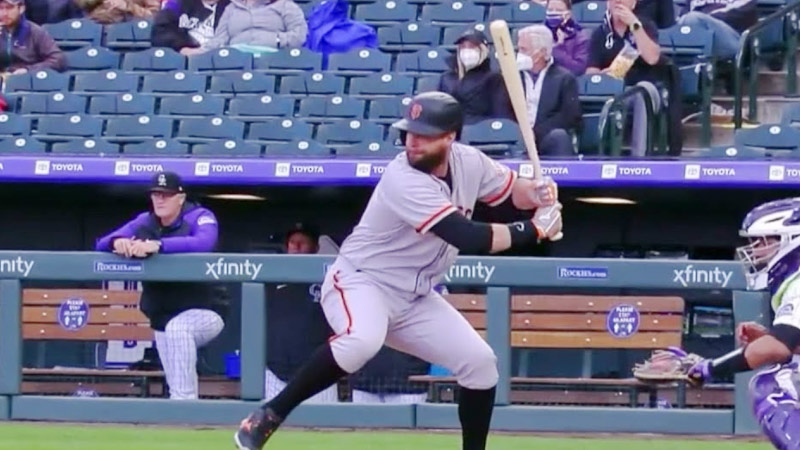
In the storied history of the San Francisco Giants, few players are as synonymous with “The Dynasty” as Buster Posey and Brandon Belt.
Posey, the stoic, three-time World Series champion catcher, was rarely known for public outbursts. Belt, the quirky, resilient first baseman, was often the subject of both fan adoration and scrutiny.
However, in May 2017, the baseball world saw a rare crack in the Giants’ professional veneer when Buster Posey was caught yelling at Brandon Belt on the field.
This moment became a focal point for fans and analysts alike, serving as a window into the high-pressure environment of Major League Baseball and the leadership dynamics of a team struggling to find its footing.
To understand why this confrontation happened, we must look at the specific strategic failures, the exhaustion of extra innings, and the heavy burden of leadership during a losing season.
The St. Louis Incident: A 13th-Inning Breakdown
The most famous instance of Posey’s frustration occurred on May 20, 2017, during a grueling game against the St. Louis Cardinals.
In a high-stakes 13th-inning scenario, the tension was palpable as both teams fought to break a tie in the middle of a marathon match.
The Strategic Disconnect: Defensive Positioning
The root cause of the yelling was a disagreement over defensive positioning. As the catcher, Posey was responsible for managing the entire field, which included ensuring his infielders were properly aligned to mitigate the threats posed by baserunners. During this specific play, Stephen Piscotty was on first base for the Cardinals.
Buster Posey wanted Brandon Belt to play closer to the bag to “hold” Piscotty, thereby limiting the runner’s lead and discouraging a stolen base attempt. From Posey’s perspective, Belt was playing too far off the bag, effectively giving Piscotty a significant advantage.
The Result: A Stolen Base and a Public Confrontation
Despite Posey’s repeated attempts to get his first baseman’s attention and adjust his position, Belt did not immediately comply. The consequences were immediate: Piscotty successfully stole second base, putting the winning run in scoring position for St. Louis.
Seeing the strategic failure play out exactly as he feared, Posey became visibly agitated. Rather than waiting for the privacy of the clubhouse, Posey confronted Belt directly on the field, a rare sight for a player typically known for his “cool under fire” demeanor.
Not an Isolated Event: The Dodgers Dugout Tiff
While the St. Louis incident was the most public, it wasn’t the first time that season that Posey’s frustration with Belt boiled over. Just a few weeks prior, the two were involved in another heated exchange, this time in the Giants’ dugout.
Baserunning Blunders
The earlier incident occurred during a game against the Giants’ arch-rivals, the Los Angeles Dodgers. In this instance, the issue wasn’t defense, but rather baserunning.
Cameras captured Posey yelling in the dugout after Belt failed to score from second base on a single.
For a team that historically relied on “torture”—winning close, low-scoring games—failing to capitalize on scoring opportunities was a cardinal sin. Posey’s outburst in the dugout signaled that his patience was wearing thin regarding fundamental execution.
The Weight of Leadership During a “Poor Start”
To analyze why Posey was yelling, one must consider the context of the San Francisco Giants’ 2017 season. The team was enduring a “poor start” to the year, a frustrating departure from the championship standards the core players had set over the previous decade.
Posey’s Dedication to Standards
According to reports from The Mercury News, these confrontations were actually a testament to Posey’s dedication to leading the team.
When a team is losing, the small details—like holding a runner at first or taking an extra base—become the difference between a turnaround and a lost season.
As the primary leader and “field general,” Posey likely felt that his teammates needed to be held to a higher level of accountability to stop the downward spiral.
The yelling wasn’t necessarily a sign of a personal feud, but rather a leader’s attempt to instill urgency in a squad that was underperforming.
The Professional Resolution: “In-Game Frustration”
Despite the headlines these incidents generated, the players themselves were quick to downplay any long-term animosity. Both Posey and Belt kept the specifics of their conversations private, choosing not to air dirty laundry in the media.
Handling Friction Behind Closed Doors
When asked about the friction, the players referred to these moments simply as “in-game frustration”. In the world of professional sports, where teammates spend nearly every day together for eight months, high-intensity arguments are often viewed as a byproduct of a shared desire to win.
The fact that Posey and Belt continued to be the cornerstones of the Giants’ infield for years to come suggests that these confrontations were constructive rather than destructive.
They were able to resolve their differences and maintain a professional relationship, understanding that the heat of the moment was fueled by the “grind” of the season.
Posey-Belt Conflict
| Feature | The St. Louis Incident (May 2017) | The Dodgers Incident (April/May 2017) |
|---|---|---|
| Location | On the field (St. Louis) | In the dugout |
| Primary Trigger | Defensive positioning (Holding the runner) | Baserunning failure (Not scoring from second) |
| The Result | Stephen Piscotty stole second base | Missed scoring opportunity against rivals |
| Posey’s Reaction | Visibly agitated and confrontational | Yelling caught on camera in the dugout |
| Underlying Theme | Accountability during a difficult season | Dedication to leadership and standards |
Conclusion: The Legacy of a Leader
The image of Buster Posey yelling at Brandon Belt remains one of the most striking visual metaphors for the Giants’ 2017 struggles. It reminds us that even in the most successful organizations, friction is often the price of high standards.
Posey wasn’t yelling because he disliked Belt; he was yelling because he cared about the precision required to win at the highest level.
While these moments were uncomfortable for fans to witness, they were a byproduct of a championship culture where “good enough” was never an acceptable answer.
Ultimately, the ability of these two icons to navigate these frustrations privately allowed them to remain the heart of the Giants’ infield for over a decade.