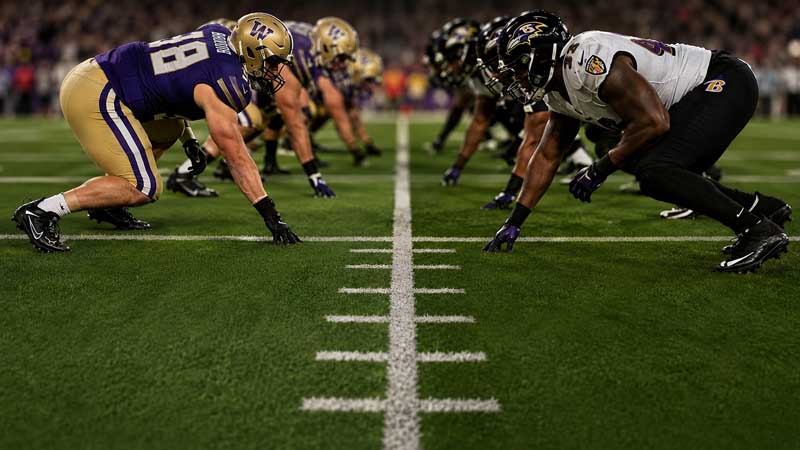
Football is a game of inches, but sometimes, it is a game of feet—specifically, the feet that separate the hash marks.
While casual fans might view the painted lines on a gridiron as merely decorative or convenient for spotting the ball, coaches, players, and analysts know them as the ultimate architects of playcalling strategy.
The differences between college (NCAA) and NFL hash marks change everything about how offenses attack and how defenses counter.
From the width of the field to the throwing windows available to a quarterback, these painted stripes dictate the geometry of modern football.
The Core Dimensions: Breaking Down the Numbers
To understand how strategy shifts between the collegiate and professional levels, we first need to look at the physical layout of the field.
While both football fields measure 100 yards long (excluding the end zones) and 53 and yards wide (160 feet), the placement of the hash marks varies drastically.
The NFL Layout
On an NFL field, the hash marks are placed 18 feet, 6 inches apart. Crucially, this width matches the exact distance between the professional goalposts.
Because of this centering, each hash mark is 70 feet, 9 inches away from the nearest sideline. This places the ball significantly closer to the center of the field on almost every single play, reducing the asymmetry of the playing surface.
The College (NCAA) Layout
In contrast, college hash marks are 40 feet apart. This wider spacing means that each hash mark is only 60 feet away from the nearest sideline.
When a ball is placed on a college hash mark, it creates a massive imbalance in the field geography, dividing the gridiron into two distinct territories: a wide side (the “field side”) and a short side (the “boundary side”).
Strategic Impact on the Game
The physical placement of the ball alters three foundational pillars of football strategy: field spacing, defensive coverages, and passing windows.
1. Field Spacing: The Battle of the Field Side vs. Boundary Side
The most immediate consequence of college hash marks is the creation of the boundary and field sides.
The College Game
When an offense breaks the huddle with the ball on the hash, more than half of the entire field sits on one side of the formation.
This structural imbalance encourages horizontal stretches, wide receiver screens, run-pass options (RPOs), and dynamic spread offenses.
Coordinators can isolate a premier athlete on the wide side of the field one-on-one, forcing defenders to cover vast expanses of grass.
The NFL Game
Because NFL hash marks are nearly centered, the field is balanced. Offenses cannot rely on massive expanses of open space to manufacture easy yards.
Every play happens closer to the middle of the field, neutralizing extreme spatial advantages and forcing offenses to attack through precision, timing, and interior leverage.
2. Defensive Coverages: Disguises and Spatial Control
Defense is fundamentally a math problem of defending space with limited personnel. The width of the hash marks alters how defenses solve that equation.
In the NFL
The narrower hash marks place the ball closer to the center, limiting extreme spatial advantages for the offense.
This symmetry allows defensive coordinators to run sophisticated, disguised coverages—such as complex split-field coverages and simulated pressures.
Because the wide receivers are closer to the heart of the defense, safety rotations and zone drops do not need to cover as much ground horizontally, making professional pass defenses notoriously stingy.
In the College Game
Defenses facing wide hash marks must cover an immense amount of ground quickly. If a defense over-commits to the boundary side, an offense can snap the ball and attack the wide side, where defenders are severely outnumbered.
Consequently, college defenses often rely on simpler structural rules or hyper-athletic space-players (such as hybrid safety-linebackers) to defend the entire width of the turf.
3. Passing Windows: Tight Telemetry vs. Open Grass
Throwing a football through a collapsing pocket requires elite arm talent, but completing the pass requires spatial awareness dictated entirely by the hash marks.
NFL Passing
Professional quarterbacks operate in tight, vertical throwing windows down the middle of the field. Because the ball starts near the center, linebackers and safeties can easily squeeze intermediate routes.
Quarterbacks must throw with anticipation, squeezing the ball into microscopic windows between zone defenders.
College Passing
Collegiate schemes can exploit immense amounts of open grass. A quarterback on a college hash can easily read a half-field progression, utilizing the wide side to stretch cornerbacks horizontally while deep crossing routes find vast voids behind linebackers.
This environment is exceptionally friendly to young signal-callers learning to process post-snap movement.
The Evolution and History of the Hash Marks
Why did these differences come to be? The hash mark was not part of original American football; it was introduced to solve a practical problem: geometry and sideline fairness.
Originally, if a team ran a play out of bounds, the next snap took place right at the spot where the ball went dead. This meant teams could get trapped right against the sideline, making it nearly impossible to run standard plays or kick field goals cleanly.
The Unified Era
Hash marks were introduced to the college game in the 1930s, initially placed 15 yards from the sidelines, then moved to 20 yards, and eventually adjusted to hash marks matching the goalpost width.
The Pro Split
When the American Football League (AFL) and the National Football League (NFL) rose to prominence and eventually merged, the professional game opted to align the hash marks with the goalposts for kicking consistency and balanced play design.
Meanwhile, the NCAA kept wider hashes to promote the open, high-scoring offensive style that fans grew to love.
How Transitioning Players Adapt
One of the most fascinating ripple effects of this dimensional difference is the transition period for players moving from the collegiate ranks to the professional league.
Quarterbacks
A rookie quarterback stepping onto an NFL field often feels claustrophobic. In college, they could rely on the wide side of the field to bail out a slow progression. In the professional ranks, that extra grass disappears.
Receivers are closer to the defenders, and passing windows close in a fraction of a second. The transition requires developing a faster internal clock and supreme accuracy.
Wide Receivers and Defensive Backs
Wide receivers must adjust their release packages and route stems. On a narrow NFL field, route pacing changes because the sideline arrives much faster.
Conversely, cornerbacks in the NFL deal with less horizontal ground to cover, but they face hyper-precise route runners who can exploit any leverage mistake in tight quarters.
Frequently Asked Questions
Why are NFL hash marks closer together than college hash marks?
Professional football aligned its hash marks with the width of the goalposts (18 feet, 6 inches apart).
This provides a balanced playing surface and ensures consistency for field goal kickers, who previously had to kick from severe angles when the ball was spotted near wide college-style hashes.
Do high schools use college or NFL hash marks?
Most high school football leagues in the United States follow National Federation of State High School Associations (NFHS) rules, which place hash marks even wider than college—specifically, 53 feet, 4 inches from each sideline, splitting the field into thirds.
How do hash marks affect field goal kicking?
The closer the ball is to the center of the field, the straighter the angle for the kicker. In the NFL, every field goal attempt benefits from being centered between the hash marks.
In college, a kick attempted when the ball ends a play on the extreme boundary hash requires the kicker to navigate a much sharper angular trajectory.
Conclusion
The dimensions of the gridiron dictate the pulse of modern football. While collegiate fields leverage wide boundaries to manufacture explosive, wide-open offensive schemes, professional stadiums rely on centered alignment to test precision, timing, and defensive discipline.
These contrasting measurements transform identical playbooks into entirely different tactical puzzles.
Ultimately, whether analyzing the vast spaces of a Saturday afternoon matchup or the razor-thin margins of a Sunday afternoon showdown, the distance between the lines remains the quiet architect of gridiron greatness, proving that football’s most compelling strategic battles are won in the geometry of the field.