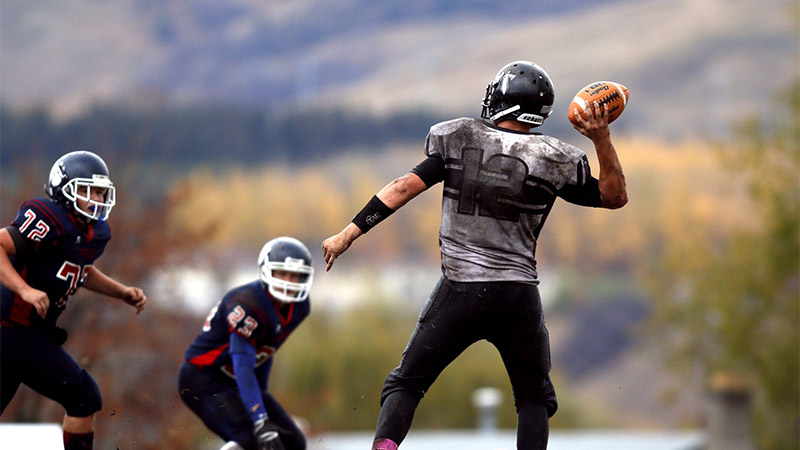
In the modern landscape of American football, the forward pass represents the most potent weapon in a team’s offensive arsenal. It is a high-stakes maneuver that requires precision, timing, and an intimate understanding of defensive coverage.
While the game has evolved from its rugby-style origins into a complex tactical battle, the fundamental question of who is authorized to distribute the ball through the air remains a cornerstone of the sport’s identity.
At the heart of every offensive unit is a single individual tasked with the immense responsibility of orchestrating these aerial attacks.
This exploration analyzes the primary and secondary roles of ball distribution, the strategic logic behind non-traditional passers, and the technical requirements for a successful passing game.
The Central Authority: The Role of the Quarterback
The quarterback (QB) serves as the primary player responsible for executing the forward pass. In a standard offensive scheme, the quarterback is the only player who handles the ball on nearly every passing play.
This centrality is not merely a matter of tradition; it is a necessity driven by the complexity of modern defensive systems.
The quarterback functions as the on-field general. Their role begins long before the ball is snapped, involving the analysis of defensive alignments and the communication of last-minute adjustments to the offensive line and receiving corps.
Once the play begins, the quarterback must balance physical execution with rapid cognitive processing.
Core Responsibilities of the Quarterback
- Pre-Snap Analysis: Identifying blitzes, coverage shells (such as Cover 2 or Cover 3), and mismatches.
- Ball Security: Ensuring the exchange from the center is clean and maintaining a firm grip amidst defensive pressure.
- Pocket Presence: Navigating the limited space provided by the offensive line to find a clear throwing lane.
- Progression Reading: Cycling through various targets—from the primary receiver to the check-down option—within a matter of seconds.
- Delivery: Executing a throw that accounts for the receiver’s speed, the defender’s position, and environmental factors like wind or rain.
Non-Traditional Passers: The Art of Strategic Deception
While the quarterback is the designated passer for the vast majority of a game, the rules of American football allow for significant creative flexibility.
Under specific “trick-play” circumstances, other players on the field are permitted to throw a pass. These moments are designed to exploit the defensive unit’s tendency to focus solely on the quarterback as the threat.
The use of non-traditional passers is often a calculated risk. By placing the ball in the hands of a running back or wide receiver, an offense can force the defense to abandon its disciplined coverage and react to an unexpected threat.
Common Personnel Involved in Secondary Passing
| Position | Typical Scenario | Strategic Objective |
|---|---|---|
| Running Back | Halfback Option | To draw the linebackers toward the line of scrimmage before throwing over their heads. |
| Wide Receiver | Reverse Pass | To utilize the receiver’s speed to pull the secondary out of position. |
| Punter/Kicker | Fake Special Teams Play | To gain a first down when the defense is expecting a standard kick. |
| Non-QB Specialist | Wildcat Formation | To create a numbers advantage in the run game that occasionally culminates in a pass. |
Technical Breakdown of Trick Plays
As indicated by the provided information, certain plays like the “option” or the “flea flicker” are specifically designed to involve players other than the quarterback in the passing game.
These plays require high levels of synchronization and are often practiced for weeks before being deployed in a game.
- The Flea Flicker: In this maneuver, the quarterback hands the ball to a running back, who then tosses the ball back to the quarterback before a pass is attempted. This creates the illusion of a running play, drawing the defensive backs closer to the line of scrimmage and leaving wide receivers open deep down the field.
- The Option Play: While frequently a running strategy, the option can evolve into a passing opportunity. A player, such as a running back or a mobile quarterback, moves toward the sideline and must decide whether to run the ball or throw it based on the movement of a specific “read” defender.
- The Double Pass: This involves a lateral or backward pass to a wide receiver, who then throws a forward pass to another teammate. This is legal as long as the first pass travels backward or parallel to the line of scrimmage.
The Regulatory Framework: What Defines a Legal Pass?
To understand who throws the ball, one must also understand the constraints of the forward pass. The rules are designed to prevent chaotic play and ensure a balance between offense and defense.
- The Line of Scrimmage: A forward pass can only be attempted if the passer’s entire body is behind the line of scrimmage at the moment of release.
- One Forward Pass per Down: Only one forward pass is permitted during a single play. If a player catches a pass, they cannot then throw the ball forward again.
- Eligible Receivers: While almost any offensive player (except certain linemen) can throw the ball, only specific players are eligible to catch a forward pass. This typically includes wide receivers, tight ends, and running backs.
- Ineligible Downfield: Offensive linemen are generally prohibited from moving more than a few yards past the line of scrimmage before a forward pass is thrown. This rule prevents the offense from using blockers to clear a path for a receiver before the ball is in the air.
Psychology of the Passing Game
The decision of who throws the ball is as much about psychology as it is about physical skill.
A team that never utilizes its wide receivers or running backs as passers becomes predictable. Conversely, a team that uses trick plays too frequently loses the element of surprise.
The most effective offenses use the threat of the quarterback’s arm to set up the run, and the success of the run game to set up the “play-action” pass.
When a defense is fully committed to stopping these standard movements, a trick play involving a non-traditional passer can be devastating.
Key Elements of Passing Success
- Anticipation: Throwing the ball to where a receiver will be, rather than where they currently are.
- Velocity Control: Knowing when to throw a “bullet” to fit the ball into a tight window and when to use a “touch” pass to loft it over a defender.
- Resilience: The ability of the passer to remain calm and accurate even when a 300-pound defensive lineman is charging toward them.
Historical Evolution: From the T-Formation to the Spread
The history of who throws the ball is a history of innovation. In the early days of American football, the pass was an afterthought, often considered a desperate measure.
The quarterback was primarily a blocker or a signal-caller for the running backs.
- The Early 1900s: The legalization of the forward pass in 1906 changed the game forever, though it was initially rarely used due to restrictive rules.
- The 1940s: The T-formation popularized the quarterback as the primary ball-handler and passer, moving away from the single-wing formations where the “tailback” often handled the ball.
- The 1980s: The West Coast Offense emphasized short, horizontal passing as an extension of the run game, further solidifying the quarterback’s role as a high-volume distributor.
- The Modern Era: The Spread and Air Raid offenses have pushed passing statistics to record highs, with quarterbacks often attempting 40 to 50 passes in a single game.
Summary of Positional Passing
For those analyzing the game from a high-level strategic perspective, the following table summarizes the distribution of passing attempts across a typical season for a professional team.
| Role | Percentage of Passes | Primary Goal |
|---|---|---|
| Starting Quarterback | 90% – 95% | Consistent execution of the offensive system and game plan. |
| Backup Quarterback | 4% – 8% | Relief of the starter due to injury or strategic rotation. |
| Position Players (RB/WR) | < 1% | High-impact deception and exploitation of defensive tendencies. |
| Special Teams (P/K) | < 0.5% | Converting fourth downs in unexpected situations. |
Conclusion: The Enduring Importance of the Passer
The mechanics of who throws the ball in American football are a blend of rigid positional roles and fluid strategic exceptions.
While the quarterback remains the undisputed commander of the aerial attack, the occasional intervention of a running back or wide receiver serves as a reminder of the game’s inherent unpredictability.
Understanding these roles provides a deeper appreciation for the tactical depth of the sport. Whether it is a perfectly placed deep ball from a franchise quarterback or a chaotic, game-changing trick play from a backup receiver, the forward pass remains the most thrilling element of the gridiron.
For organizations and analysts looking to deepen their understanding of offensive efficiency, the data is clear: success is found in the balance between the reliable arm of the quarterback and the calculated use of deceptive secondary passers.
The evolution of the game continues, but the central role of the passer remains the heartbeat of American football.