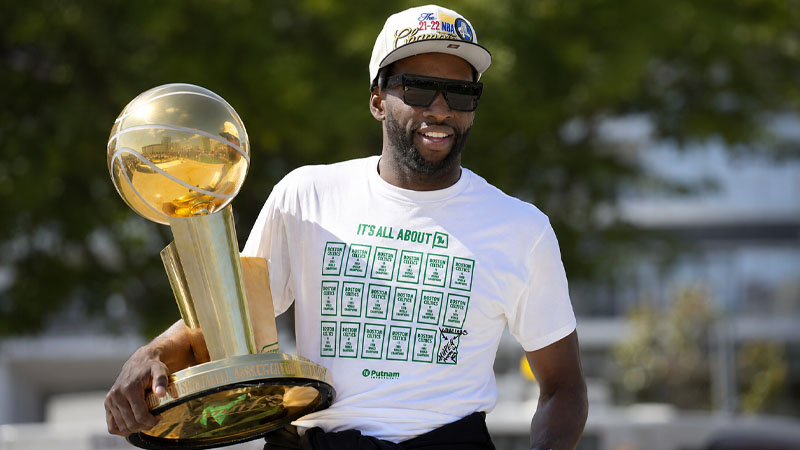
Draymond Green is the heartbeat of the Golden State Warriors dynasty, a defensive mastermind who has secured four NBA championships.
Despite his integral role in building one of the greatest runs in basketball history, fans often ask one specific question about his individual accolades.
While his teammates have frequently occupied the spotlight during trophy presentations, Green’s contributions are often measured by impact rather than individual hardware.
This analysis explores his career trajectory, the specific instances where he neared individual glory, and why his legacy remains secure despite the absence of a particular trophy in his cabinet.
Analyzing the Reality: Has Draymond Green Won Finals MVP?
To provide a direct answer to the central inquiry: No, Draymond Green has never won the NBA Finals MVP award. Throughout his tenure with the Golden State Warriors, he has been a foundational element of four championship-winning teams (2015, 2017, 2018, and 2022).
However, in each of those winning efforts, the Bill Russell NBA Finals MVP trophy was awarded to one of his high-scoring or high-impact teammates.
The distribution of these awards highlights the incredible talent density of the Warriors’ roster over the last decade. While Green provided the defensive anchor and playmaking necessary for victory, the voting panel consistently favored the offensive dominance or specific situational impact of other stars.
The following table outlines the Finals MVP winners during the years Green secured a championship ring:
| Year | Finals MVP Winner | Draymond Green’s Championship Achievement |
|---|---|---|
| 2015 | Andre Iguodala | Won 1st Championship |
| 2017 | Kevin Durant | Won 2nd Championship |
| 2018 | Kevin Durant | Won 3rd Championship |
| 2022 | Stephen Curry | Won 4th Championship |
The 2016 Near-Miss: Draymond’s Greatest Finals Performance
While Draymond Green does not have the trophy, he came remarkably close to securing it during the 2016 NBA Finals. This series is often remembered for the Warriors’ 3-1 lead collapse against the Cleveland Cavaliers, but it also featured what many consider to be the greatest individual game of Green’s career.
A Historic Game 7 Display
In the decisive Game 7 of the 2016 Finals, Green delivered a performance for the ages. He recorded a staggering stat line of 32 points, 15 rebounds, and 9 assists.
He was the most dominant player on the floor for Golden State, shooting 11-of-15 from the field and a blistering 6-of-8 from beyond the three-point arc. His 95.5% true shooting percentage in that game remains one of the most efficient high-volume performances in Finals history.
The Frontrunner Status
Prior to the final buzzer of Game 7, Green was widely considered the frontrunner for the Finals MVP award had the Warriors secured the victory. His performance throughout the series, capped by that historic Game 7, made him the logical choice.
However, because the award almost exclusively goes to a player on the winning team, the loss to the Cavaliers meant the trophy went to LeBron James instead. This remains the ultimate “what if” in Green’s individual career narrative.
Statistical Deep Dive: Draymond Green’s Career Finals Performance
To understand why Green is consistently in the conversation for “most valuable,” one must look beyond the scoring column. Over 25 career Finals games, Green has maintained averages that reflect a “point-forward” and defensive specialist role that few in history have emulated.
His cumulative impact across these championship rounds is a testament to his longevity and consistency at the highest level of competition.
A Masterclass in Versatility
Green’s career Finals averages include 11.5 points, 9.1 rebounds, and 6.6 assists per game. While 11.5 points might seem modest for an MVP candidate, his ability to nearly average a double-double with over six assists while serving as the primary defensive communicator is rare.
He has also contributed significantly on the defensive end, averaging 1.8 steals and 1.0 blocks per game across his Finals career.
The All-Around Threat
Green’s value is best exemplified by his ability to record triple-doubles on the biggest stage. For instance, in the clinching Game 6 of the 2015 NBA Finals, he posted 16 points, 11 rebounds, and 10 assists to help secure his first title.
His ability to control the pace of the game and facilitate for shooters like Stephen Curry and Klay Thompson often does not show up as “points,” but it is the engine that drives the Warriors’ offensive efficiency.
| Metric | Career Finals Average (25 Games) |
|---|---|
| Minutes Per Game | 38.5 |
| Points Per Game | 11.5 |
| Rebounds Per Game | 9.1 |
| Assists Per Game | 6.6 |
| Steals Per Game | 1.8 |
| Blocks Per Game | 1.0 |
Why the Finals MVP Award Often Eludes Defensive Specialists
The NBA Finals MVP award has historically trended toward the series’ leading scorer or the player who creates the most offensive gravity.
For Draymond Green, whose primary value lies in “the things that don’t show up in the box score,” winning this award requires a specific set of circumstances that rarely align for defensive-minded players.
The Scoring Bias in Voting
In most championship series, the narrative is driven by the player who hits the biggest shots or maintains the highest scoring average. In 2017 and 2018, Kevin Durant’s scoring efficiency was undeniable, and in 2022, Stephen Curry’s offensive masterclass was the clear focal point.
Green’s role—setting screens, directing defensive rotations, and making the “pass before the assist”—is often overshadowed by the highlight-reel buckets of his teammates.
The Andre Iguodala Exception
The 2015 Finals provided a unique case where a defensive specialist did win the award. Andre Iguodala was honored primarily for his defensive efforts on LeBron James. Some analysts argue that Green’s impact in that series was equally vital, especially given his triple-double in the clinching game.
However, the specific narrative of “stopping” the opposing team’s best player often carries more weight with voters than general defensive excellence and playmaking.
The Evolution of Draymond’s Role Through Four Titles
Draymond Green’s journey through the Warriors’ four championships shows an evolving player who learned to master different aspects of the game to ensure team success, even at the cost of individual accolades.
The Early Dynasty Years (2015-2016)
In the early years, Green was an emerging force. His 2015 Finals performance showed his potential as a triple-double threat, and his 2016 run (despite the loss) proved he could be the best player on a championship-caliber floor.
During this era, his shooting was more prominent, evidenced by his 38.8% three-point shooting in the 2016 Finals.
The Durant Era and Beyond (2017-2022)
With the arrival of Kevin Durant, Green’s scoring volume naturally decreased as he focused more on being the ultimate facilitator. By the 2018 Finals, he was averaging 9.0 assists per game, acting as the primary hub for the Warriors’ star-studded offense.
In the 2022 title run, his veteran leadership and defensive IQ were paramount in slowing down a young, athletic Boston Celtics team, allowing Stephen Curry to finally secure his elusive Finals MVP trophy.
Frequently Asked Questions: Draymond Green and NBA Awards
Has Draymond Green ever won any MVP award?
While Green has not won a Finals MVP or a regular-season MVP, he is a former NBA Defensive Player of the Year (2017) and a multi-time All-Star and All-Defensive Team selection.
Who has the most Finals MVPs on the Warriors?
Kevin Durant holds the most for the Golden State Warriors during the Draymond Green era, winning two (2017, 2018). Andre Iguodala (2015) and Stephen Curry (2022) each have one.
What was Draymond Green’s best Finals game statistically?
Statistically, Game 7 of the 2016 NBA Finals was his peak. He recorded 32 points, 15 rebounds, and 9 assists while shooting 73.3% from the field.
How many championships does Draymond Green have?
Draymond Green has won four NBA championships (2015, 2017, 2018, 2022).
Conclusion: A Legacy Defined by Winning
Draymond Green’s career serves as a powerful reminder that individual trophies like the Finals MVP do not always tell the full story of a player’s greatness.
While he lacks that specific hardware, his four championship rings and his status as one of the greatest defensive players in league history are indisputable.
His performance in the 2016 Finals remains a testament to his ceiling as a player, proving that he could go toe-to-toe with the legends of the game in the highest-stakes moments.
Ultimately, Green’s value is found in the culture of winning he helped establish in San Francisco—a legacy that transcends any single award.
For the Golden State Warriors, Draymond Green has always been an MVP in the ways that matter most: winning titles and anchoring a dynasty.