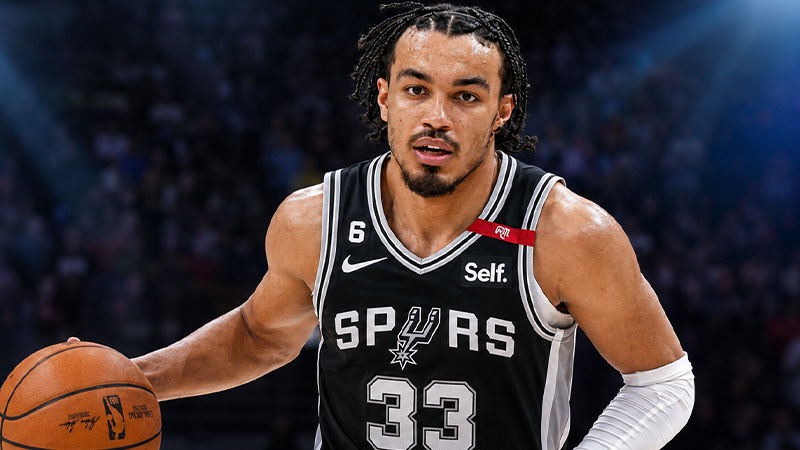
Determining whether is tre jones good has become a definitive litmus test for how modern basketball observers evaluate talent beyond the box score.
While high-volume scoring often dominates headlines, professional scouting and advanced analytics suggest that Jones is an elite, high-IQ floor general who prioritizes efficiency and game management.
Since his transition from the San Antonio Spurs to the Chicago Bulls, he has solidified his reputation as a “coach on the floor” who plays remarkably steady, mistake-free basketball.
This analysis investigates his evolution from a reliable backup to a historically efficient interior finisher, addressing the gap between his analytical dominance and his physical limitations.
The Litmus Test: Understanding the Polarization of Tre Jones
The debate surrounding Tre Jones often highlights a fundamental divide in basketball philosophy: the value of “safe” play versus the necessity of offensive aggression.
To his proponents, he is an elite role player who executes the “right” decisions and excels in screen navigation and ball protection. Conversely, critics argue that his “timid” approach to scoring and lack of a perimeter threat limit his ultimate ceiling as a starting point guard.
The Analytical Perspective vs. The Eye Test
Evaluating Jones requires balancing undeniable statistical efficiency with the visible limitations of his 6’1″ frame.
- The Case for Elite Role Play: Analysts point to his incredible career assist-to-turnover ratio, which sits at approximately 4.4 to 1, making him one of the safest ball-handlers of his generation.
- The Aggression Gap: Critics on platforms like Reddit have noted that while he avoids “bad shots,” this is often because he is hesitant to take any shots at all, particularly from distance.
- Tactical Reliability: Despite the debate over his ceiling, there is a consensus that he acts as a stabilizing “steward” for bench units, keeping the offense afloat when primary stars are resting.
2025–26 Season: The Chicago Bulls Statistical Breakout
The 2025–26 NBA season marked a turning point in Jones’s career, as his move to the Chicago Bulls provided the platform for a significant leap in offensive production.
Over 65 games, he proved that a non-shooting guard could remain highly effective by mastering high-percentage interior finishing and elite decision-making.
| Statistic | 2025–26 Season Average | NBA Ranking / Context |
|---|---|---|
| Points Per Game | 14.1 PPG | 67th Overall |
| Assists Per Game | 5.4 APG | 28th Overall |
| Field Goal % | 55.3% FG | 13th in the NBA |
| Turnovers Per Game | 1.42 TOV | Exceptionally Low |
| True Shooting % | 63.8% TS% | Elite Efficiency |
Mastering Interior Efficiency
The jump to a 55.3% field goal percentage is a historic feat for a point guard of his size. This efficiency is driven by a disciplined refusal to take mid-range jumpers in favor of attacking the rim.
Jones has utilized his exceptional speed to attack specific angles, allowing him to finish around the basket with surprising frequency.
In Chicago, he managed to maintain this efficiency even when asked to carry a larger offensive load, highlighted by a 20-point, 12-assist performance where he shot a perfect 7-for-7 from the floor.
Even in challenging losses, his efficiency remained constant, as evidenced by a 34-point game against Houston where he recorded a staggering 110% True Shooting percentage.
Year-by-Year Evolution: Tracking Professional Growth
Tracing the career of Tre Jones reveals a steady progression from a deep-bench reserve in San Antonio to an essential rotation piece in Chicago.
Each season has seen an incremental improvement in his ability to read professional defenses and exploit gaps in the paint.
Career Development and Statistical Trajectory
His journey highlights a player who has meticulously worked to overcome natural talent gaps through hard work and basketball intelligence.
| Season | Team | GP | PTS | AST | FG% | 3P% |
|---|---|---|---|---|---|---|
| 2025–26 | CHI | 65 | 14.1 | 5.4 | 55.3% | 31.5% |
| 2024–25 | SAS / CHI | 46 | 8.8 | 4.3 | 52.8% | 40.4% |
| 2023–24 | SAS | 77 | 10.0 | 6.2 | 50.5% | 33.5% |
| 2022–23 | SAS | 68 | 12.9 | 6.6 | 45.9% | 28.5% |
| 2021–22 | SAS | 69 | 6.0 | 3.4 | 49.0% | 19.6% |
| 2020–21 | SAS | 37 | 2.5 | 1.1 | 47.4% | 60.0% |
From San Antonio to Chicago
The transition from the Spurs system to the Bulls allowed Jones to refine his identity as an interior specialist.
While his 2024–25 season saw a brief, uncharacteristic spike in three-point shooting (40.4%), his 2025–26 campaign focused on what he does best: rim pressure.
By his sixth season, his career field goal percentage climbed to 50.3%, a testament to his elite shot selection and “no bad shots” philosophy.
Core Strengths: Mastery of the High-IQ Guard Archetype
The argument for why is tre jones good rests primarily on his intangibles and his ability to function as a low-risk, high-reward playmaker.
Coaches and analysts frequently praise his competitive drive and his knack for making crucial plays in late-game situations.
Key Pillars of His Impact
Rather than relying on verticality or raw power, Jones utilizes a specific set of technical skills to navigate the complexities of the NBA game.
- Elite Decision Making: He is a master of ball security, rarely forcing passes and maintaining one of the best assist-to-turnover ratios in the league.
- Exceptional Rim Finishing: Last season, he ranked in the 91st percentile among point guards for finishing at the rim, with 41% of his total attempts coming in that zone.
- Tactical Intelligence: He is known for “400 IQ” plays, such as throwing the ball high into the air to bleed the clock during closing seconds to secure a victory.
- Off-Ball Defense: While physically limited, he remains an intelligent off-ball team defender who uses his anticipation to disrupt passing lanes.
Addressing the Gaps: Shooting and Physical Limitations
To provide a comprehensive answer to the question of his value, one must acknowledge the significant barriers that prevent him from entering the elite tier of NBA guards. These “holes” are the primary drivers of the skepticism surrounding his role as a long-term starter.
The Perimeter Shooting Barrier
The most glaring issue in Jones’s profile is his lack of a consistent three-point threat. In an era defined by spacing, a guard shooting 31.2% career from deep allows defenses to “sag off,” potentially clogging the lane for his teammates.
This lack of gravity often leads to a phenomenon described as offensive “kryptonite,” where the team consistently shaves the first ten seconds off the shot clock because defenses are not pressured to respect the perimeter shot.
This “timidity” from deep is cited as the main reason he doesn’t receive more minutes on some rosters, as a guard with no three-point threat remains a structural problem in the modern game.
Defensive Vulnerability and Size
At 6’1″ and 185 lbs, Jones faces physical disadvantages that are difficult to overcome through intelligence alone.
- 1-on-1 Defending: While he is a great help-side defender who thrives on steals, he is frequently “torched” in 1-on-1 situations and is viewed as a liability when switched onto larger shooting guards.
- Comparison to Elite Undersized Guards: Observers have noted that while he is solid, his hands and tenacity are not in the same “universe” as defensive legends like Chris Paul.
- The Screen Navigation Debate: While some praise his navigation as “elite,” other fans argue he “dies on screens” more than almost any other player, leading to a polarizing view of his defensive utility.
FAQ: Breaking Down the Tre Jones Evaluation
Is Tre Jones a starting-caliber NBA point guard?
The consensus is that Jones is an “elite reserve” or a “spot starter”. On a rebuilding team, he is a perfect transition point guard to run the offense. However, for a championship contender, his lack of spacing usually limits him to a high-end backup role.
Why is his field goal percentage so high for a small guard?
Jones maintains a 55.3% FG% because he focuses almost exclusively on shots at the rim, where he is in the 91st percentile for accuracy. He uses skill, patience, and his body to shield the ball from larger defenders.
How does he compare to his brother, Tyus Jones?
While both are elite caretakers of the ball, their scoring styles are vastly different. Tre’s shots almost all come at the basket, whereas Tyus is primarily a jump shooter.
What is Tre Jones’s biggest impact on winning?
His primary impact is organizational stability. He rarely turns the ball over (1.42 TOV per game) and makes sure the team gets into its sets, acting as a “steward” for the offense.
Conclusion: The Verdict on a High-Efficiency Floor General
In summary, is tre jones good? The data and professional consensus suggest the answer is “yes,” but with clear caveats regarding his role.
He is a premier example of a high-IQ role player who excels in specific, high-value areas: ball protection, interior finishing, and game management.
His 2025–26 breakout in Chicago proved that his efficiency is not a statistical anomaly but a byproduct of elite decision-making and a deep understanding of his own physical limitations.
While he may never be the primary scoring threat on a title-contending team, his ability to finish at the rim at a 91st-percentile rate and his 4.4 assist-to-turnover ratio make him an invaluable asset.
For organizations that value organization over highlights, Tre Jones remains one of the most effective and reliable professionals in the league today.