The NBA often oscillates between high-scoring guards and versatile wings, but the fundamental value of a dominant interior anchor remains undisputed.
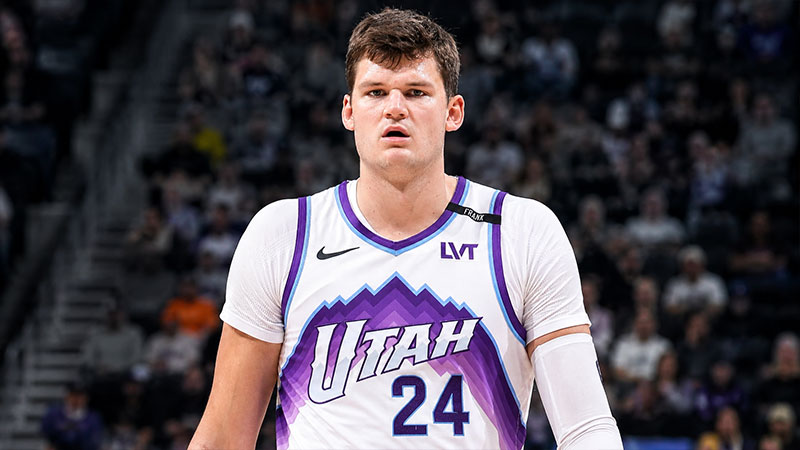
Walker Kessler, affectionately known as “The Sheriff,” has rapidly emerged as one of the league’s most intriguing defensive specialists.
Since being drafted, Kessler has anchored the Utah Jazz defense with a blend of elite rim protection and high-efficiency finishing. However, as he approaches a critical stage in his career, questions regarding his offensive ceiling and recent durability have surfaced.
This analysis explores his statistical dominance, defensive impact, and overall value to determine his standing in today’s modern game.
The Defensive Foundation: Why Kessler is an Elite Asset
To answer the question of whether Walker Kessler is truly good, one must look at the defensive side of the ball, where his impact is most profound and undeniable.
He isn’t just a shot-blocker; he is a structural deterrent that forces opposing offenses to rethink their entire strategy when approaching the paint.
Premier Rim Protection and Shot Blocking
Walker Kessler’s primary identity in the NBA is that of a premier rim protector. From the moment he stepped onto an NBA floor, his timing and reach have made him a nightmare for slashing guards and finishing bigs alike.
During his rookie campaign, he finished 4th in the entire league in blocked shots, a feat rarely seen from first-year players. This isn’t merely about the blocks that show up on the stat sheet; it is about the “deterrence factor.”
When Kessler is patrolling the interior, opponents frequently abort drives or settle for lower-percentage mid-range jumpers rather than challenging him at the cup.
Mastering the Pick-and-Roll Defense
In the modern NBA, a center’s value is often determined by their ability to survive in pick-and-roll scenarios. Kessler possesses exceptional footwork for a player standing 7’2″, which allows him to execute drop coverage at an elite level.
He is recognized as one of the best screen defenders in the league, specifically because he can track the ball-handler while simultaneously keeping an eye on the roll-man, effectively neutralizing the most common offensive play in basketball.
His ability to recover and protect the paint after a screen is a cornerstone of the Utah Jazz defensive identity.
Dominance on the Glass and Interior Efficiency
While defense is his calling card, Kessler’s contributions to rebounding and offensive efficiency are equally vital to his status as a high-value asset. His physical profile allows him to control the air space in a way few other centers can match.
A Monster on the Boards
Kessler is a relentless rebounder, particularly during stretches where he sees high-volume minutes. He has demonstrated the ability to average over 10 rebounds per game, providing his team with the security needed to finish defensive possessions.
Perhaps more importantly, he is a significant threat on the offensive glass. By using his 7’2″ frame to generate second-chance opportunities, he creates “extra” possessions that are demoralizing for opponents and high-value for his own team.
High-Percentage Finishing
Offensively, Kessler is the definition of “low usage, high efficiency.” He does not demand the ball to be effective, yet he consistently shoots approximately 70% from the field.
This elite efficiency stems from his role as a premier lob threat and his knack for put-back finishes following offensive rebounds.
By operating almost exclusively in the restricted area, he ensures that every shot he takes is a high-probability bucket, making him the perfect complementary piece for high-volume scoring guards.
Analyzing the Statistical Evolution
Understanding Kessler’s value requires a deep dive into his year-over-year progression. Despite injury setbacks, his per-game averages show a player who was on the verge of a massive breakout before his most recent health struggle.
| Season | Points Per Game (PPG) | Rebounds Per Game (RPG) | Blocks Per Game (BPG) | Field Goal % (FG%) |
|---|---|---|---|---|
| 2022–23 | 8.3 | 7.6 | 2.1 | 68.1% |
| 2023–24 | 6.3 | 5.9 | 1.9 | 65.4% |
| 2024–25 | 11.1 | 12.2 | 2.4 | 66.3% |
| 2025–26 (5 Games) | 14.4 | 10.8 | 1.8 | 70.3% |
As the data suggests, the 2024-25 season was a landmark year for Kessler, where he averaged a double-double and maintained elite rim protection at 2.4 blocks per game.
His brief stint in the 2025-26 season showed even more promise, with a scoring average that jumped to 14.4 points per game while shooting a career-high 70.3% from the floor before his injury occurred.
Addressing the Gaps: Where Kessler Must Improve
No player is without weaknesses, and for Kessler, the limitations are primarily found in his offensive versatility and his perimeter mobility. To transition from an “elite specialist” to a “superstar center,” these are the areas that require development.
Offensive Range and Ball Handling
Currently, Kessler lacks a reliable post-up game, meaning he cannot be a primary hub for an offense when the shot clock is winding down. He is also prone to turnovers when asked to handle the ball or facilitate from the high post.
Furthermore, his free-throw shooting remains a significant liability; hovering around 60%, he becomes a target for “Hack-a-Shaq” strategies in late-game situations, which can limit his availability during winning time.
Perimeter Switches and Versatility
While he is mobile for his height, the NBA’s shift toward “small ball” presents challenges for traditional drop-coverage bigs. Faster, elite guards can exploit Kessler if he is forced to switch out onto the perimeter.
In a playoff series where teams hunt mismatches, his ability to stay on the floor depends on how well he can contain ball-handlers in space without giving up an easy drive or a step-back three-pointer.
The 2025–26 Injury and the Path to Recovery
The most significant “red flag” regarding Kessler’s current status is not his skill set, but his recent health. The 2025-26 season was cut short by a devastating injury that has clouded his immediate future.
The Torn Labrum Setback
Just five games into what looked like a career-best season, Kessler suffered a serious shoulder injury—a torn labrum. This injury required season-ending surgery, halting the momentum he had built during his early-season surge.
Before the injury, he was not only dominating the paint but was also beginning to experiment with his game, even attempting corner three-pointers to stretch the floor.
- Injury Impact: Season-ending surgery after only 5 games.
- Performance Peak: Averaged 14.4 PPG and 10.8 RPG before the setback.
- Developmental Loss: Interrupted his transition into a floor-spacing threat.
Market Demand and the Future of “The Sheriff”
Despite his recent injury, the league-wide consensus on Walker Kessler remains incredibly high. His status as a restricted free agent makes him one of the most talked-about names in NBA front offices.
High League Demand and Trade Interest
Kessler is a highly coveted asset. The Utah Jazz have already demonstrated how much they value him by turning down multiple first-round draft picks from rival teams looking to acquire his services.
Organizations like the Los Angeles Lakers and the Chicago Bulls are expected to be aggressive in their pursuit of Kessler, recognizing that elite rim protection is the rarest commodity in the NBA.
Utah’s Long-Term Strategy
The Jazz view Kessler as a foundational cornerstone of their franchise. Their vision involves pairing him long-term with star forward Lauri Markkanen and defensive standout Jaren Jackson Jr. to create one of the most formidable frontcourts in basketball.
Because Kessler is entering restricted free agency, Utah maintains the right to match any offer sheet he receives, and current indications suggest they are prepared to pay a premium to keep him in a Jazz uniform.
Frequently Asked Questions About Walker Kessler
How good is Walker Kessler compared to other NBA centers?
Kessler is considered an elite defensive specialist. While he may not have the offensive versatility of a Nikola Jokić or Joel Embiid, his rim protection and rebounding rank him among the top tier of defensive anchors like Rudy Gobert.
What is Walker Kessler’s injury status for the upcoming season?
Kessler is recovering from surgery to repair a torn labrum suffered in the 2025-26 season. His return to form will be closely monitored, as shoulder injuries can occasionally impact a player’s shooting mechanics and rebounding physicality.
Will the Utah Jazz trade Walker Kessler?
While teams like the Lakers and Bulls have shown interest, the Jazz have previously declined multiple first-round picks for him. They currently view him as a long-term core piece alongside Lauri Markkanen.
Can Walker Kessler shoot three-pointers?
While he is primarily an interior finisher, he began experimenting with corner threes during the start of the 2025-26 season. This is a developing part of his game that was unfortunately paused due to his shoulder injury.
Conclusion: The Verdict on Walker Kessler
Is Walker Kessler good? The answer is a resounding yes, with the caveat that his “goodness” is currently weighted toward elite defensive utility rather than offensive stardom.
He is a transformative presence in the paint, a dominant rebounder, and a highly efficient finisher who understands his role perfectly.
The primary hurdles remaining for Kessler are his health and the development of a semi-reliable outside shot or improved free-throw consistency.
If he returns from his shoulder surgery with the same verticality and defensive instincts he displayed before the injury, he will remain one of the most valuable young players in the NBA.
For any team looking to build a championship-level defense, “The Sheriff” is exactly the kind of player you want protecting your basket.