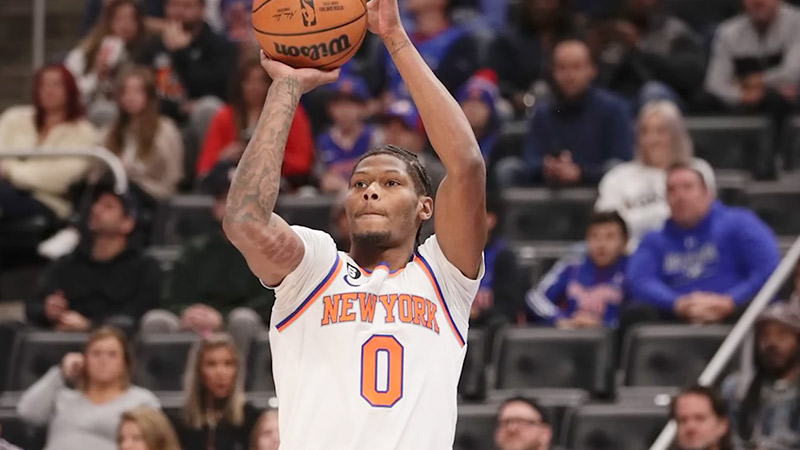
The evaluation of Cam Reddish remains one of the most polarizing exercises in modern basketball scouting. To the casual observer, Reddish possesses the prototypical frame and fluid movement of a perennial All-Star; however, the statistical record suggests a different reality altogether.
While he entered the league as a highly touted prospect with immense physical gifts, his professional career has been defined by a significant disconnect between aesthetic potential and tangible on-court impact.
Currently, the consensus among analysts is that Reddish has failed to meet the expectations of a top-ten pick, transitioning from a lottery prize to a G League reclamation project.
The Paradox of Elite Physicality and Low Efficiency
When scouts discuss the “eye test,” Cam Reddish is often the primary example used to illustrate the dangers of prioritizing physical tools over functional production. He stands as a 6’7” wing with a 7’1” wingspan, a combination that should, in theory, allow him to dominate both ends of the floor.
This physical profile is often referred to as the “modern wing prototype,” designed to switch defensively and shoot over smaller defenders.
The Ideal Modern Wing Prototype
Reddish’s physical attributes were the primary reason he was selected 10th overall in the 2019 NBA Draft out of Duke University.
In a league that prizes length and mobility, his ability to move effortlessly across the perimeter gave front offices hope that he could develop into a versatile two-way threat.
His shooting stroke is frequently described as “picture-perfect,” possessing the high release and smooth mechanics that usually correlate with high-level perimeter accuracy.
Analyzing the Inefficient Reality
Despite the visual appeal of his game, the efficiency metrics paint a bleak picture of his professional tenure. Reddish has struggled with extreme inconsistency throughout his career, which has prevented him from securing a permanent spot in a starting rotation.
His “picture-perfect” stroke has not translated into reliable scoring, as his career field goal percentage sits at a highly inefficient 39.8%.
For a wing player in the modern era, failing to break the 40% threshold is a significant red flag that indicates poor shot selection and a struggle to adapt to the speed of professional defenses.
Statistical Breakdown: Why the Numbers Tell a Different Story
To understand why Reddish is generally not considered a “good” NBA player in his current state, one must look past the occasional highlights and examine the cumulative data. Efficiency is the currency of the modern NBA, and Reddish has consistently operated at a deficit.
Scoring and Shooting Splits
The primary metric used to evaluate offensive value is the ability to score efficiently relative to volume. Reddish’s career averages—8.5 points, 2.7 rebounds, and 1.2 assists—suggest a player who provides below-average production for a lottery selection.
Furthermore, his shooting splits are particularly damaging to a team’s offensive flow. With a career three-point average of 32.4%, he does not provide the “gravity” necessary to stretch defenses, often allowing opponents to sag off him and clog the paint for his teammates.
The Impact on Offensive Flow
Beyond the raw percentages, Reddish’s offensive process often hinders team success. He frequently settles for low-percentage, contested mid-range jumpers rather than utilizing his athleticism to attack the basket.
Even when he does reach the rim, he struggles mightily to finish through contact, which often results in empty possessions or transition opportunities for the opposing team. This inability to finish effectively mitigates the advantages his 6’7″ frame should provide in the paint.
The Developmental Disconnect: From Duke to the G League
The trajectory of Reddish’s career highlights a common issue in player development: the struggle to transition from a primary “alpha” scorer to a specialized role player.
| Metric | NBA Career Output | The Reality of Performance |
|---|---|---|
| Traditional Stats | 8.5 PTS, 2.7 REB, 1.2 AST | Below-average production for a lottery pick. |
| Shooting Splits | 39.8% FG, 32.4% 3PT | Severely hurts a team’s offensive efficiency. |
| Team Journey | 4 Teams in 6 Years | Traded or let go by Atlanta, NY, Portland, and LA. |
| Current Status | San Diego Clippers | Currently playing in the NBA G League. |
The Flash Dilemma: Why the “Bust” Label Sticks
The most frustrating element for coaches and fans alike is the “Flash” dilemma. Reddish is infamous for occasional outbursts that hint at his latent potential, only to disappear for long stretches afterward.
The All-Star Performance Peaks
Every so often, Reddish will have a game where everything clicks. He is capable of scoring 25 to 30 points on high efficiency, looking every bit like the All-Star he was projected to be.
These games often involve him hitting difficult step-back threes and gliding to the rim with ease. These “flashes” are precisely what kept him in the league for six years across four different teams, as coaches convinced themselves they could be the ones to finally unlock his consistency.
The Passive Follow-up Patterns
Unfortunately, these peak performances are rarely sustained. Typically, a high-scoring night is followed by weeks of passive play, high turnover rates, and poor shooting nights.
This lack of emotional or physical consistency makes it nearly impossible for a head coach to rely on him in high-stakes situations.
In the NBA, a player who provides a predictable 10 points is often more valuable than a player who provides 30 points one night and zero the next three.
Tactical Misalignment: The Failed Transition to 3-and-D
The modern NBA requires wings to excel in the “3-and-D” role—hitting spot-up triples and defending the opponent’s best player. Reddish, however, has never fully adjusted to this identity.
During his high school and AAU years, Reddish excelled as a primary on-ball shot creator, a role that allowed him to control the tempo and rhythm of the game.
In the NBA, teams already have primary stars (like Trae Young in Atlanta or LeBron James in LA), requiring Reddish to thrive without the ball in his hands. He has struggled to adapt to this “spot-up” style, often appearing out of rhythm when he isn’t the primary focus of the offense.
This identity crisis has led to his frequent movement between teams, as Atlanta, New York, Portland, and Los Angeles all eventually decided he was not a viable long-term fit for their systems.
The Current Crossroads: A Career at Risk
As of the current season, Reddish finds himself at a critical juncture in his professional journey. After being waived by the Los Angeles Lakers, he moved to the San Diego Clippers in the NBA G League.
Moving from a high-profile roster like the Lakers to the G League is a sobering reality for a former top-ten pick. It signifies that the league, at large, no longer views him as an immediate rotation-level player.
The G League stint is likely his final opportunity to reinvent himself. If he can prove that he can defend at an elite level and shoot a respectable percentage from the corners, he may find a way back into a training camp.
However, if he continues to prioritize the “on-ball creator” style that has failed him thus far, his time in professional basketball may be nearing its end.
Frequently Asked Questions About Cam Reddish
Is Cam Reddish still in the NBA?
Technically, he is currently playing for the San Diego Clippers in the NBA G League after being waived by the Los Angeles Lakers.
While he is not currently on an active NBA roster, the G League is the primary pathway for players looking to earn a “call-up” back to the association.
What was Cam Reddish’s draft position?
Reddish was the 10th overall pick in the 2019 NBA Draft. He was part of a highly touted Duke class that included Zion Williamson and RJ Barrett, making him one of the most anticipated prospects of that year.
Why is Cam Reddish considered a “bust”?
The “bust” label is applied because his production has not matched his draft capital or his physical potential. Averaging under 10 points per game and shooting below 40% from the field over six seasons is considered a significant failure for a player selected in the top ten.
What are Cam Reddish’s biggest weaknesses?
His primary weaknesses include extreme shooting inconsistency, poor finishing at the rim through contact, and an inability to settle into a defined role as a “3-and-D” player.
Additionally, his high turnover rate and passive play between high-scoring games have been major concerns for every team he has played for.
Conclusion: A Cautionary Tale of NBA Potential
The story of Cam Reddish serves as a vital reminder that physical tools and “potential” are only the foundation of a professional career, not a guarantee of success.
While he possesses the height, wingspan, and shooting mechanics that every scout dreams of, he has lacked the efficiency and role-clarity necessary to survive in the most competitive league in the world.
His journey through four different teams in six years—Atlanta, New York, Portland, and Los Angeles—demonstrates that while the NBA is willing to give multiple chances to elite athletes, those chances eventually run out if the box score doesn’t reflect the talent.
Whether Reddish can use his time in the G League to finally bridge the gap between his “picture-perfect” form and his statistical output remains to be seen, but for now, he remains one of the league’s most prominent examples of unrealized potential.
For any organization looking to learn from the Reddish experience, the takeaway is clear: efficiency and mental adaptability are just as important as a 7-foot wingspan.