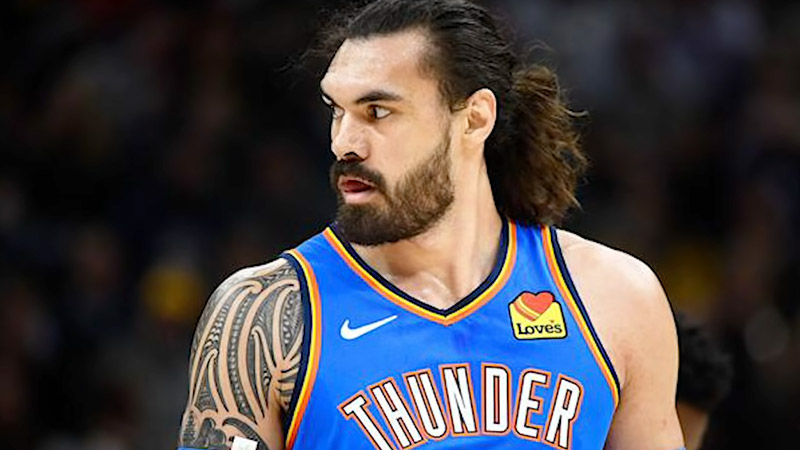
Steven Adams remains one of the most intriguing figures in professional basketball, often sparking debate among fans who prioritize flashy scoring versus those who value internal grit.
While he may not fit the archetype of a modern, floor-spacing center, his influence on the game is profound and often immeasurable by standard box scores alone.
Known as the “strongest force” in the league, Adams serves as a cultural anchor and a master of the “dirty work” that winning teams require.
This analysis explores his statistical evolution, his elite specialized skills, and the durability concerns that currently define his late-career outlook.
The Statistical Evolution of a Specialized Interior Anchor
To understand how good Steven Adams is today, one must first analyze the trajectory of his career from a burgeoning prospect in Oklahoma City to a veteran leader in Houston.
Analyzing the Early Growth in Oklahoma City
During his early years with the Oklahoma City Thunder, Adams transformed from a raw athletic talent into a double-digit scoring threat. Between the 2016-17 and 2018-19 seasons, he consistently increased his output, peaking at 13.9 points per game for two consecutive years.
During this era, he played over 30 minutes per night, serving as a reliable pick-and-roll partner and a defensive deterrent in the paint.
His ability to stay on the floor for 80 games a season during this stretch highlighted a level of durability that made him a foundational piece for a perennial playoff contender.
The Shift to a Possession-Based Specialist
As his career progressed into stints with the New Orleans Pelicans, Memphis Grizzlies, and Houston Rockets, Adams’ role shifted. While his scoring averages dipped to 5.8 points per game by the 2025-26 season, his rebounding impact remained elite.
In Memphis, he reached a career-high of 11.5 rebounds per game during the 2022-23 season, showcasing that his value had decoupled from his ability to put the ball in the hoop.
He became a specialist whose primary objective was to control the glass and create extra opportunities for high-volume shooters.
Why Offensive Rebounding is Adams’ Greatest Asset
Steven Adams is arguably the most dominant offensive rebounder of his generation, a skill that fundamentally alters the math of a basketball game.
The Impact of Second-Chance Opportunities
On a per-minute basis, Adams consistently leads the league in tracking down missed shots, providing his team with invaluable second-chance possessions. In the 2025-26 season with the Houston Rockets, he averaged a massive 4.5 offensive boards in just 22.8 minutes of play.
This level of efficiency is nearly unprecedented; it ensures that even on off-shooting nights, his team maintains a competitive edge by simply having more chances to score than the opponent. His presence alone helped elevate the Rockets into the top-rebounding tier of the league.
A Comparison of Rebounding Efficiency
| Season | Team | Rebounds Per Game | Minutes Per Game | Rebounding Impact Category |
|---|---|---|---|---|
| 2025–26 | Houston Rockets | 8.6 | 22.8 | Elite Efficiency |
| 2024–25 | Houston Rockets | 5.6 | 13.7 | Limited Minutes |
| 2023–24 | Memphis Grizzlies | 0 (Injured) | — | Sidelined |
| 2022–23 | Memphis Grizzlies | 11.5 | 27.0 | Career High |
| 2021–22 | Memphis Grizzlies | 10.0 | 26.3 | Double-Digit Average |
| 2020–21 | New Orleans Pelicans | 8.9 | 27.7 | Interior Anchor |
| 2019–20 | Oklahoma City Thunder | 9.3 | 26.7 | High Volume |
| 2018–19 | Oklahoma City Thunder | 9.5 | 33.4 | Peak Workload |
| 2017–18 | Oklahoma City Thunder | 9.0 | 32.7 | Physical Prime |
| 2016–17 | Oklahoma City Thunder | 7.7 | 30.4 | Defensive Focus |
| 2015–16 | Oklahoma City Thunder | 6.7 | 25.2 | Developing Force |
| 2014–15 | Oklahoma City Thunder | 7.5 | 25.3 | Rising Talent |
| 2013–14 | Oklahoma City Thunder | 4.1 | 14.8 | Rookie Campaign |
| Career | Multiple Teams | 8.0 | 25.7 | Consistent Force |
The Art of the Screen: Setting the NBA Standard
Beyond the glass, Adams’ most significant contribution to winning basketball is his ability to free up teammates through physical play.
Creating Space for Elite Ball-Handlers
Consistently voted by his peers as the strongest player in the NBA, Adams sets what players describe as “bone-crushing” screens. These screens are not merely tactical; they are physical roadblocks that generate open looks for guards and force defensive rotations that compromise the opponent’s strategy.
By prioritizing these unselfish actions over his own personal statistics, Adams acts as a “force multiplier” for his team’s offensive efficiency.
Building a Culture of Unselfishness
Adams is highly regarded as a culture-setter who thrives in doing the “dirty work”. In an era where many players focus on individual branding and highlights, his willingness to engage in the physical grind of the post serves as a blueprint for younger teammates
. This unselfishness is a key component of why he is considered a premier role-playing center; he understands that his value lies in making the four other players on the court more effective.
Understanding the Limitations of the Traditional Big Man
While his strengths are elite, no assessment of Steven Adams is complete without acknowledging the gaps in his modern-day toolkit.
Offensive Constraints and Shooting Range
Adams has a limited post-up game and does not provide the floor-spacing that many modern NBA offenses crave. He does not shoot three-pointers, which can sometimes lead to congested lanes for his teammates.
Furthermore, his free-throw shooting remains a significant liability, historically hovering between 50% and 55% from the line. These factors mean that while he is an asset, he must be paired with specific types of players to maximize team spacing.
Defensive Versatility and Rim Protection
On the defensive end, Adams is an immovable post defender against traditional, back-to-the-basket big men. However, he lacks the elite vertical rim-protection capabilities found in more explosive centers.
Additionally, his massive frame can be a disadvantage when forced to defend speedy, perimeter-oriented guards in a switch-heavy defensive scheme. Teams often have to hide these limitations by playing a “drop” coverage or ensuring they have secondary shot-blockers on the floor.
The Durability Dilemma and Future Outlook
The most pressing concern regarding Steven Adams’ current standing in the league is his ability to stay healthy and available.
The Toll of a Physical Playstyle
Following past knee surgeries, Adams suffered a severe Grade 3 left ankle sprain in January 2026, which required season-ending surgery. This injury cut short a productive campaign in Houston where he was averaging 8.6 rebounds in limited minutes.
Over the past four seasons, he has been sidelined for over half of his teams’ possible games, including a 2023-24 season with the Memphis Grizzlies where he did not play a single minute.
Assessing Availability as a Metric of Value
| Metric | Detail | Impact on Team |
|---|---|---|
| Games Played (Last 4 Years) | Sidelined for >50% of games | High volatility for roster planning |
| 2023–24 Season | 0 Games Played (Injured) | Missing interior presence |
| 2025–26 Season | 32 Games (Season-ending ankle surgery) | Disruption of Houston’s rotation |
| Career Total | 796 Games | Significant veteran experience |
Strategic Fit: How Teams Maximize Adams’ Value
To get the most out of Adams, a team must view him as a specialized luxury asset rather than a primary option.
The Perfect Environment for Success
Adams flourishes when surrounded by high-volume shooters and dynamic playmakers who can capitalize on the space his screens create.
In Houston and Memphis, his presence as an interior anchor allowed wings to play more aggressively on the perimeter, knowing that Adams would likely secure any long rebounds or missed attempts. H
e is most effective in a system that values possession control and physicality over pure pace-and-space aesthetics.
The Role of a Playoff Contender’s Luxury Asset
For a playoff contender, Adams is a player who can swing the momentum of a series through sheer physicality. Whether it is neutralizing an opponent’s star rebounder or wearing down a defense with constant screening, his impact is felt by the opposition’s coaching staff.
Even at this stage of his career, when healthy, he remains one of the few players who can dictate the physical terms of a professional basketball game.
Frequently Asked Questions About Steven Adams
Is Steven Adams still the strongest player in the NBA?
Yes, he is consistently voted by his peers as the strongest player in the league. This strength is his primary tool for setting devastating screens and dominating the offensive glass.
Why are his scoring numbers so low?
Adams focuses on unselfish play and “dirty work” rather than hunting his own shots. At this stage of his career, he averages under 6 points per game, as his primary role is to create opportunities for others through offensive rebounding and screening.
Can he shoot three-pointers?
No, Adams does not shoot three-pointers and lacks a modern floor-spacing game. His offensive utility is strictly confined to the painted area and the high-post screening hubs.
How has injury affected his career?
Injuries have been the biggest drawback to his value in recent years. He has missed more than half of his games over the last four seasons due to knee and ankle surgeries, including a Grade 3 ankle sprain in 2026.
What is his career rebounding average?
Throughout his career across multiple teams, Adams has maintained a steady average of 8.0 rebounds per game despite fluctuations in his playing time.
The Final Verdict on Steven Adams’ Value
In conclusion, Steven Adams is a premier role-player whose value is deeply rooted in his elite specialization. While his lack of shooting and recent health struggles are significant caveats, his status as a world-class rebounder and screen setter remains undisputed when he is on the floor.
He is not an All-Star in the traditional sense, but he is an elite interior anchor who provides the physical identity necessary for a team to compete at the highest levels.
If he can overcome his recent durability issues, he will continue to be one of the most impactful “luxury assets” in the NBA.