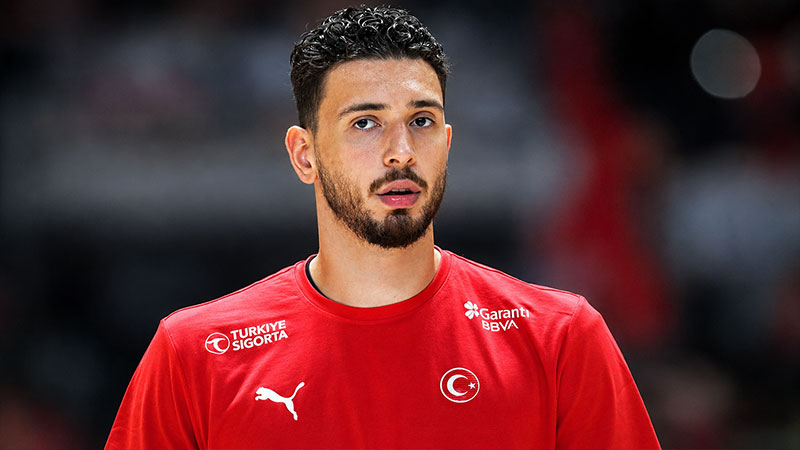
Alperen Şengün has rapidly ascended from a mid-first-round pick to a central pillar of the Houston Rockets’ franchise.
Now a two-time NBA All-Star, the 23-year-old Turkish center represents a unique archetype in the modern league: a high-usage offensive hub who blends vintage post-up artistry with elite, vision-based playmaking.
Averaging roughly 20 points, 9 rebounds, and 6 assists per game, Şengün has established a statistical floor that few big men in history have touched at his age.
While he faces scrutiny regarding his defensive foot speed and perimeter shooting, his impact on winning remains undeniable.
The Statistical Evolution of a Modern Hub
To understand how good Alperen Şengün is, one must first look at the sheer volume of his production. Over five seasons, he has transformed from a bench spark plug into a perennial All-Star candidate.
His 2025-26 campaign solidified his status as one of the most productive centers in the league, ranking 28th in points and 12th in rebounding league-wide.
Consistent Growth Across All Metrics
Şengün’s development has been linear and impressive. Below is a breakdown of his statistical progression over his career:
| Season | Points | Rebounds | Assists | FG% | Awards |
|---|---|---|---|---|---|
| 2021-22 | 9.6 | 5.5 | 2.6 | 47.4% | — |
| 2022-23 | 14.8 | 9.0 | 3.9 | 55.3% | — |
| 2023-24 | 21.1 | 9.3 | 5.0 | 53.7% | — |
| 2024-25 | 19.1 | 10.3 | 4.9 | 49.6% | All-Star |
| 2025-26 | 20.4 | 8.9 | 6.2 | 51.9% | All-Star |
This growth trajectory highlights his increasing importance to the Rockets’ offensive structure. His jump to 6.2 assists per game in the 2025-26 season signifies his total command of the team’s half-court sets.
Offensive Mastery: The Post and the Pass
Alperen Şengün’s offensive repertoire is often described as “idiosyncratic and improvisatory”. He does not rely on raw vertical athleticism but rather on a sophisticated understanding of angles, leverage, and timing.
Elite Low-Post Scoring Mechanics
Şengün possesses one of the deepest “bags” of post moves in the NBA. He utilizes elite footwork, drop steps, and spin moves to manipulate defenders who are often taller or more explosive.
Peer observations suggest that despite not being the most physically imposing center, he is “very annoying to guard” because he knows how to use his body to create contact that “genuinely looks like it hurts” the defender.
He has also incorporated veteran tricks, such as the “elbow trick” learned from Hakeem Olajuwon, to create space in crowded paint areas.
A Playmaking Visionary at Center
What truly separates Şengün from traditional big men is his creative playmaking. Operating from the high post, low block, or as a short-roll threat, he functions as the Rockets’ primary facilitator.
His court vision allows him to deliver flashy, no-look dishes that catch defenses off guard. In the 2025-26 season, he tied for 17th in the NBA in assists per game, a staggering feat for a 6’11” player.
This ability to orchestrate the offense has earned him the nickname “Baby Jokić,” as he shares the Serbian superstar’s knack for reacting and thinking a step faster than the opposition.
The Rebounding Engine of a Top-Tier Defense
While his scoring and passing garner headlines, Şengün’s rebounding is a critical component of his value. He is not a high-flyer, but he compensates with expert anticipation and ball-tracking.
Dominating the Glass
During the 2025-26 season, Şengün averaged 8.9 rebounds, ranking 12th in the league. More importantly, he anchors a Houston team that has consistently ranked as one of the top rebounding units in the NBA.
His ability to secure defensive boards and ignite the break is essential for the Rockets’ transition game. He also excels on the offensive glass, where his 3.0 offensive rebounds per game provide vital second-chance opportunities.
Navigating the “Overrated” Narrative
Despite his gaudy statistics and All-Star appearances, Şengün faces a peculiar challenge: the perception of his peers. In a May 2026 poll conducted by The Athletic, Şengün was voted the “most overrated” player by other NBA players, receiving 12.3% of the vote.
Peer Perception vs. Performance
This “overrated” label likely stems from a few specific areas of his game that draw professional scrutiny. First, there is a noted dip in his postseason efficiency. While he is a force in the regular season, his True Shooting percentage has historically fallen during the playoffs.
Additionally, his on-court mannerisms—including frequent complaints to officials and a reputation for flopping—have made him a polarizing figure among opponents. However, many analysts argue that this criticism overlooks the immense offensive burden he carries for a young team.
Critical Gaps: The Perimeter and the Paint
To reach the “superstar” tier occupied by the players he is often compared to, Şengün must address two glaring weaknesses: his outside shot and his defensive lateral mobility.
The Three-Point Shooting Hurdle
In the modern NBA, a center who cannot stretch the floor creates spacing challenges. Şengün currently hits below 31% from three-point range. Defenses often “sag off” him on the perimeter, daring him to shoot while clogging the driving lanes for his teammates.
While his shooting stroke is described as repeatable and mechanically sound, the results have yet to match the form consistently.
Defensive Consistency and Foot Speed
Under head coach Ime Udoka, Şengün has made significant strides in his defensive positioning and anticipation.
However, he still struggles with average foot speed, making him a frequent target in pick-and-roll switches. Elite guards often look to pull him out to the perimeter, where his lack of lateral quickness can be exploited.
While he is a capable help defender and has improved his shot-blocking—averaging 1.1 blocks in 2025-26—he remains more of a positional defender than a traditional rim protector.
A Career at the Crossroads
As of 2026, Alperen Şengün is at a pivotal juncture. He has proven he can produce All-Star numbers and lead a team to the postseason. The question is no longer “is he good?” but rather “how high is his ceiling?”
The Oklahoma City “What If”
The NBA world often reflects on the 2021 Draft, where the Oklahoma City Thunder traded the 16th pick—which became Şengün—to the Houston Rockets.
Many analysts now view this as a significant miscalculation by OKC, as Şengün has blossomed into a player whose skillset is nearly impossible to find in the draft.
His ability to serve as an “Aaron Gordon” style connector or a “Jokić-lite” hub makes him a versatile piece for any roster construction.
Comparative Analysis: The “Baby Jokić” Label
The most frequent comparison for Şengün is Nikola Jokić, but many also see shades of Pau Gasol or Domantas Sabonis in his game.
Defining His Own Identity
While he shares Jokić’s vision and Sabonis’s physicality, Şengün is arguably more flexible and agile than both were at the same age. He is a “bulldog” in the post, mixing finesse with a high motor.
As he continues to refine his game, he is moving away from being a “lite” version of other stars and establishing his own identity as a premier Turkish talent—potentially the best the NBA has ever seen from that region.
Enhanced FAQ: Everything You Need to Know
How old is Alperen Şengün?
Alperen Şengün is 23 years old (born July 25, 2002).
What are his career-high statistics?
Şengün has recorded career highs of 45 points, 21 rebounds, and 14 assists. He also has 12 career triple-doubles as of mid-2026.
Why is he called “Baby Jokić”?
The nickname comes from his ability to facilitate the offense from the center position using elite passing and high basketball IQ, much like 3x MVP Nikola Jokić.
What is his current contract status?
As of 2025, he was making approximately $5.4 million per year, though he has since become eligible for significant extensions due to his All-Star status.
Is he a good defender?
He is a vastly improved positional defender with good anticipation, but he lacks elite lateral quickness, which can be a liability against smaller, faster guards on the perimeter.
Summary of the Şengün Impact
Alperen Şengün is an exceptional talent who has redefined the center position for the Houston Rockets. His combination of 20.4 PPG, 8.9 RPG, and 6.2 APG places him in elite company.
While he must improve his 30.5% three-point shooting and answer critics regarding his postseason efficiency, his foundation as a 23-year-old two-time All-Star suggests he is only scratching the surface of his potential.
For fans of technical basketball and high-IQ play, Şengün remains one of the most compelling players to watch in the league today.