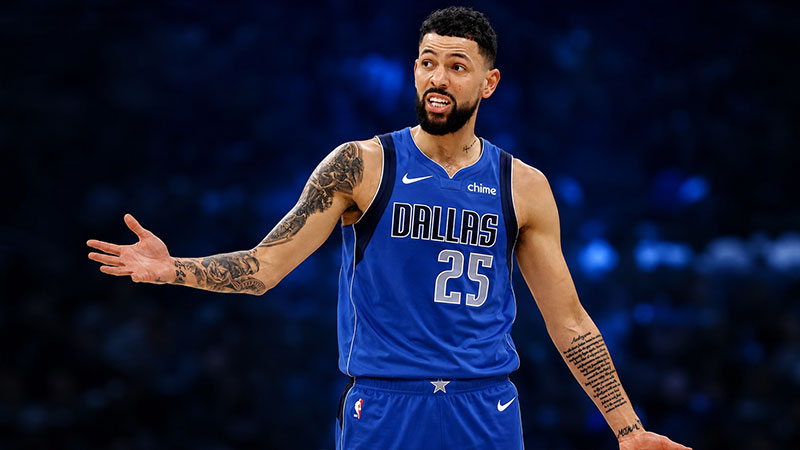
Austin Rivers remains one of the most polarizing figures in modern basketball, serving as a lightning rod for criticism throughout his 11-year career.
While he carved out a respectable tenure as a defensive role player, his reputation is inextricably linked to narratives of unearned privilege and unmet expectations.
The public disdain is a complex intersection of perceived nepotism, a disconnect between legendary high school hype and professional output, and a persistent persona that many find abrasive.
To understand this antagonism, one must look beyond the box score to the unique circumstances surrounding his career trajectory.
The Nepotism Narrative: The “Doc’s Son” Factor
The primary driver of the public’s frustration with Austin Rivers is the perceived favoritism he received due to his father, Doc Rivers. This sentiment reached its peak during their shared tenure with the Los Angeles Clippers.
Perceived Favoritism and Locker Room Tension
Backlash intensified when Austin was traded to the Clippers, where Doc Rivers served as both head coach and president of basketball operations.
High-profile teammates, most notably Chris Paul, reportedly grew frustrated with the dynamic, alleging that Doc held other players to a strict standard while treating Austin with leniency.
This professional overlap created a perception that Austin was a “protected” member of the roster, which naturally bred resentment among veterans who felt the father-son relationship compromised the team’s meritocracy.
Former teammate Matt Barnes even suggested this dynamic contributed to breaking up the “Lob City” era.
The Financial Narrative and the “Bailout” Label
A significant point of contention involves the lucrative contracts Rivers signed while playing for his father. Specifically, his three-year, $35 million contract extension in 2016 triggered widespread claims that he was handed a “bailout”.
Critics point out that he was averaging only 8.9 to 9 points per game at the time, yet he received a deal that many felt exceeded his market value.
Draymond Green famously labeled this contract the “biggest bailout in US history,” reinforcing the narrative that Austin’s career was “saved” by family ties rather than his own performance.
The Weight of Expectation: Mixtape Hype vs. NBA Reality
Austin Rivers was a digital-era pioneer of basketball hype, and the disappointment of his professional transition remains a focal point for his detractors.
The Legend of the YouTube Mixtape
Before entering the NBA, Rivers was a legendary prospect known for one of the most iconic high school mixtapes in history. As a top-five recruit who played for the polarizing Duke Blue Devils, he was projected as a future superstar with elite scoring capabilities.
This early fame set a nearly impossible bar; when he eventually transitioned into a defensive-minded role player, fans who expected a perennial All-Star viewed his career as a failure. The gap between the “mixtape legend” and the “NBA journeyman” fueled a permanent “bust” label.
Historical Struggles and the “Circlejerk” of Hate
Rivers’ early professional years provided ample ammunition for critics. His rookie season with the New Orleans Hornets statistically ranked as one of the worst rookie campaigns in modern NBA history.
This period is where many believe the online “circlejerk” of hate began, as stats consistently showed he was underperforming relative to his high draft position.
While some fans argued he was “legit” because of his confidence and willingness to handle pressure in big moments, the statistical reality of his early career made him an extremely easy target for ridicule.
Hubris and the “Fake Tough Guy” Reputation
Beyond his family ties and statistics, the way Austin Rivers carries himself on the court has played a central role in his status as a sports villain.
The “10-Time All-Star” Swagger
Rivers’ on-court demeanor has frequently rubbed both peers and fans the wrong way. Former teammate Matt Barnes publicly stated that Rivers “carries himself like he’s a 10-time All-Star, and he’s not that”.
This perceived arrogance is often viewed as “all flash and no substance,” with many observers finding his swagger mismatched with his actual production as a rotational player.
His confidence—once described as being like a “junior Maximus”—is seen by his supporters as a strength, but by his detractors as a sign of unearned hubris.
Confrontations and Modern Media Beefs
Even in retirement, Rivers has maintained his polarizing reputation through a vocal media presence. He has engaged in public feuds with active players like Draymond Green and has been criticized for “talking too loose” on various platforms.
Furthermore, Rivers alienated a large segment of the online basketball community by dismissively criticizing “YouTube 1v1 culture,” a move many found hypocritical given that his own legend was built on those very platforms.
These ongoing conflicts ensure that he remains a relevant, if disliked, figure in the basketball discourse.
Comparing Nepotism: Why Ryan Saunders Gets a Pass
A recurring theme in the debate over Austin Rivers is the comparison to other “legacy” figures in the NBA, such as former Minnesota Timberwolves coach Ryan Saunders.
The Role of Public Sentiment and Tragedy
While both Rivers and Saunders are products of NBA lineages, Saunders largely escaped the vitriol aimed at Rivers. Several factors contribute to this discrepancy:
- Optics of Employment: Doc Rivers actively traded for his son and signed him to a large contract, whereas Ryan Saunders was already on the Wolves’ staff before his father, Flip Saunders, passed away.
- The Sympathy Factor: Many fans felt that because Ryan’s father was deceased, he was not actively “pulling strings” in the same way Doc was perceived to be doing for Austin.
- Public Demeanor: Saunders was viewed as a well-respected, quieter figure, while Rivers’ perceived arrogance and trash-talking made him a more “obnoxious” target for those frustrated by nepotism.
Data Comparison: The “Nepotism Tag” in Perspective
The following table highlights the differences in how nepotism narratives are applied across different high-profile cases.
| Individual | Relation | Primary Criticism | Public Sentiment |
|---|---|---|---|
| Austin Rivers | Son of Doc Rivers | High contract ($35M) + On-court arrogance | Highly Negative / Polarizing |
| Ryan Saunders | Son of Flip Saunders | Youngest HC / Inherited position | Generally Sympathetic |
| Bronny James | Son of LeBron James | Draft position / Developmental status | Mixed / Actively Debated |
| Kirk Lacob | Son of Joe Lacob | Front office influence | Neutral / Insular |
Analyzing the Utility: Was the Hate Justified?
Despite the intense backlash, a segment of the basketball community has long argued that the disdain for Rivers overlooks his actual utility as an NBA player.
Defensive Contributions and Longevity
While he never became a superstar, Rivers developed into a “serviceable” and eventually “solid” role player. His ability to stay in the league for over a decade suggests that he possessed skills—specifically perimeter defense and secondary playmaking—that NBA scouts valued, independent of his last name.
Supporters often point to his playoff performances, where he “single-handedly” influenced games and showed a refusal to shrink away from pressure, as proof that he belonged on a professional roster.
The Reality of NBA Meritocracy
Defenders of Rivers argue that even if Doc Rivers “saved” his career by bringing him to the Clippers, Austin still had to perform well enough to stay in the rotation.
Some analysts suggest that the NBA is full of nepotism at the ownership and front-office levels, and Austin is simply the most visible target because he played on the court.
The argument is that while family ties might open the door, they cannot keep a player in an 11-year career if they are truly “butt” or “subpar”.
Enhanced FAQ: Understanding the Rivers Antagonism
Why do fans specifically point to the $42 million figure?
While his 2016 contract was technically a 3-year, $35 million deal, Draymond Green popularized the “$42 million” figure during their public feud.
This higher number has become shorthand in the basketball community for the perceived “overpayment” Austin received under his father’s management.
Was there actual proof of teammate resentment?
Yes, reports and comments from former teammates like Chris Paul and Matt Barnes indicate that the father-son dynamic created tension.
The primary issue was not necessarily Austin’s talent, but the perception that he wasn’t held to the same accountability standards as the rest of the “Lob City” roster.
How does his rookie season compare to other “busts”?
Statistically, Rivers’ rookie year was historically inefficient, which established a “circlejerk” of negativity that followed him for the rest of his career.
Because he was a top-10 pick and a high school legend, this slow start cemented the idea that he only remained in the league due to his pedigree.
Why is he still talked about in retirement?
Rivers has successfully transitioned into sports media, where his vocal opinions on current players and “1v1 culture” continue to spark controversy. His willingness to engage in “beefs” ensures that his polarizing reputation remains active in the social media era.
Conclusion: A Legacy Defined by Perspective
The collective antagonism toward Austin Rivers is unlikely to dissipate, as it is rooted in deep-seated cultural frustrations regarding nepotism and the “unfair” advantages of the elite.
However, a clinical look at his career reveals a player who, despite his advantages, demonstrated enough resilience and defensive utility to survive in the world’s most competitive league for eleven years.
Whether one views him as a “spoiled son” or a “gritty role player” depends entirely on which lens they choose: the legendary hype of his past or the practical contributions of his present.
Ultimately, Rivers serves as the definitive case study on how perception, pedigree, and personality can overshadow a decade of professional work.