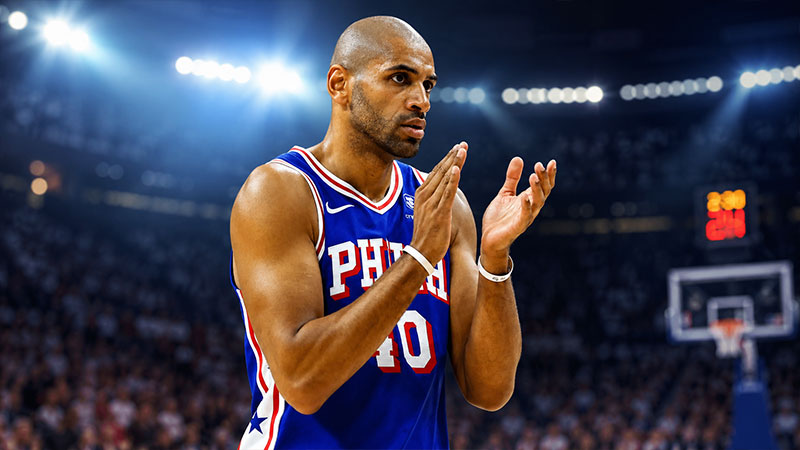
Nicolas Batum has become one of the wealthiest non-superstars in NBA history, accumulating over $209 million in career earnings.
To the casual observer, his box score statistics might not seem to justify such a massive fortune, leading many fans to ask: why does Nicolas Batum make so much money?
The answer is a complex blend of historic market timing, the high value placed on versatile “point-forward” wings, and strategic financial maneuvers like the NBA’s stretch provision.
This analysis explores how Batum maximized his earning potential through three distinct and highly lucrative phases of his professional career.
The 2016 Salary Cap Spike: A Financial Gold Rush
The primary catalyst for Batum’s massive wealth was the five-year, $120 million contract he signed with the Charlotte Hornets in 2016.
This deal is often cited as a turning point in his financial trajectory, but it did not happen in a vacuum; it was the result of a “perfect storm” in NBA economics.
The $24 Million Overnight Salary Cap Jump
In the 2016 offseason, the NBA’s salary cap experienced an unprecedented explosion, jumping by $24 million overnight. This was driven by a massive new television deal that flooded every team in the league with liquid capital.
Suddenly, teams that were previously cash-strapped had tens of millions of dollars to spend, and they scrambled to secure high-tier free agents before the market settled.
This “gold rush” meant that players like Batum, who were entering their prime, were positioned to command salaries that would have been reserved for top-five superstars just 24 months prior.
Supply and Demand for the “Point-Forward” Skillset
At age 27, Batum was the archetype of the modern NBA player. He possessed a highly coveted “point-forward” skillset: he could defend multiple positions, shoot three-pointers at a high clip, and serve as a primary playmaker.
Key market drivers for his 2016 valuation included:
- Positional Scarcity: Large wings who can handle the ball and shoot are the rarest and most valuable assets in professional basketball.
- Peak Production: Batum was coming off a season where he averaged 15.1 points, 6.2 rebounds, and 5.9 assists.
- Offensive Versatility: He was one of the few players on the Charlotte roster capable of controlling the offense, which allowed star guard Kemba Walker to play more effectively off the ball.
The Small Market Premium and the “Kemba Effect”
While the 2016 cap spike provided the money, the Charlotte Hornets’ specific organizational needs provided the motivation for such a high-paying deal.
Small-market teams often operate under different economic pressures than large-market franchises like the Lakers or Knicks.
Retaining Talent in a Competitive Landscape
Charlotte recognized that as a small-market team, they could not easily attract big-name free agents. Therefore, they felt compelled to pay a premium to prevent their existing talent from leaving.
Batum had expressed a genuine desire to stay in Charlotte, and the front office viewed him as an essential pillar of a team that had just won 48 games and nearly advanced in the playoffs.
Letting him walk would have meant a significant step backward for the franchise with no clear path to replacing his production.
Quantifying Batum’s Tactical Value
Advanced metrics at the time supported Batum’s high valuation, even if his raw scoring wasn’t “superstar level.” His presence on the floor had a direct correlation with the success of the team’s best player, Kemba Walker.
By serving as a secondary playmaker, Batum reduced the defensive pressure on Walker, turning Charlotte into a top-10 unit on both ends of the floor during the 2015-16 season.
This “force multiplier” effect made him worth more to Charlotte than he might have been to a team with an established wing rotation.
The Economics of the Stretch Provision: Getting Paid Not to Play
One of the most fascinating aspects of Batum’s earnings is that he continued to make millions from the Charlotte Hornets long after he had stopped playing for them. This was made possible by the NBA’s stretch provision.
The $27 Million Player Option
By 2020, injuries and changes in the team’s coaching staff and direction had diminished Batum’s role in Charlotte. However, because of his 2016 contract, he held a player option worth $27.1 million for the 2020-21 season.
Naturally, he exercised this option. To move forward with a youth movement and clear immediate cap space, Charlotte chose to waive him.
The “Double-Dip” Revenue Stream
Instead of paying the full $27.1 million in one year, Charlotte used the stretch provision to spread the remaining balance over multiple years. This resulted in Batum receiving approximately $9 million per year through 2023 while being a free agent.
This allowed Batum to “double-dip”—he collected his massive Charlotte checks while simultaneously signing new multi-million dollar contracts with the Los Angeles Clippers and the Philadelphia 76ers.
Transitioning into the “Luxury” Role Player Category
In the latter stage of his career, Batum has maintained his high earning power by successfully pivoting from a primary option to what is known as a “luxury role player.” Even in his mid-30s, he remains highly compensated relative to his raw box score output.
The Veteran Minimum vs. High-Level Mid-Level Exception
While many veterans are forced to play for league-minimum contracts, Batum has consistently commanded higher figures. For example, he signed a two-year, $11.5 million deal to return to the Clippers.
Why teams continue to compete for his services:
- High-IQ Positional Defense: He understands defensive rotations at an elite level, making him invaluable in playoff scenarios.
- Efficiency: His “no-dip” three-point shot has become a staple of his game, allowing him to space the floor for superstars like Kawhi Leonard or James Harden.
- Locker Room Leadership: Batum is widely regarded as a stabilizing veteran presence and a “connector” who helps team chemistry.
| Phase of Career | Team(s) | Primary Income Source | Financial Strategy |
|---|---|---|---|
| The Prime (2016-2020) | Charlotte Hornets | 5-Year, $120M Deal | Market Timing (Cap Spike) |
| The Transition (2020-2023) | Hornets / Clippers | $27M Opt-in + Stretch | Double-Dipping Revenue |
| The Veteran (2023-Present) | Clippers / 76ers | Multi-year Mid-level Deals | Luxury Role Player Pivot |
Addressing the “Worst Contract” Narrative
Throughout his career, particularly during his final years in Charlotte, Batum was often criticized for having “the worst contract in the NBA”. From a management perspective, the deal did not yield the playoff success Charlotte hoped for.
However, from a wealth-building perspective, Batum’s career is a masterclass in professional sports economics.
The “French Army Knife” Impact
Batum’s nickname, the “French Army Knife,” highlights his ability to do “the things that don’t show up in the box score”. Coaches and GMs value his versatility more than the average fan who focuses on points per game.
He is a player who scales well; the better his teammates are, the more valuable his specific set of skills becomes. This is why contending teams like the 76ers and Clippers have consistently been willing to pay millions for a player who may only take five shots a game.
Career Longevity as a Value Multiplier
By remaining a high-IQ contributor, Batum has extended his career well past the average NBA lifespan. This longevity has allowed him to continue adding to his $209 million total long after his “star” years ended.
His ability to adapt from a primary playmaker in Charlotte to a defensive specialist in Los Angeles is the hallmark of a player who understands the business of basketball as well as the game itself.
Enhanced FAQ: Understanding NBA Salaries
Q: Did Nicolas Batum actually sign a “max” contract?
A: Technically, no. While his $120 million deal was massive, a true “max” for a player of his tenure at that time would have been approximately $33 million more over the life of the contract. However, it was the highest possible amount Charlotte was willing to pay to secure his loyalty.
Q: Why do teams keep signing him if he doesn’t score much?
A: NBA teams value “connectors”—players who make everyone else better without needing the ball. Batum’s elite three-point shooting (specifically his “no-dip” technique) and his ability to guard multiple positions make him a plug-and-play asset for any contender.
Q: Is he still being paid by the Charlotte Hornets?
A: No. The final “stretch” payment from the Hornets concluded in 2023, officially clearing him from their salary cap sheet.
Conclusion: The Legacy of a Financial Powerhouse
Nicolas Batum’s journey to $209 million is a fascinating study of market dynamics and positional value.
By hitting free agency at the exact moment the salary cap exploded and maintaining a skillset that is perpetually in high demand (the versatile wing), he secured a level of generational wealth that rivals many Hall of Fame players.
While fans may continue to debate his “value” on the court, his ability to leverage the NBA’s economic structure—from small-market desperation to the complexities of the stretch provision—remains unparalleled for a non-superstar.
He didn’t just play the game; he played the market, and the result is one of the most financially successful careers in modern sports history.