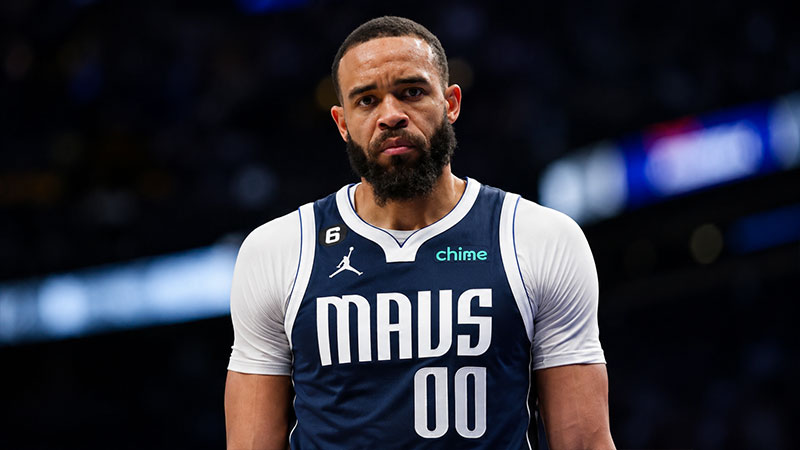
JaVale McGee remains one of the most polarizing defensive figures in modern basketball history, representing a unique intersection of world-class athleticism and fundamental inconsistency.
Over a career spanning 16 seasons and three NBA championships, the 7-foot center has built a reputation that oscillates between elite rim protection and head-scratching positional errors.
While his shot-blocking highlights are legendary, critics often question if these statistics are misleading indicators of his true value.
Analyzing his impact requires looking past the “Shaqtin’ a Fool” clips to examine advanced metrics, physical dimensions, and his specialized role within championship-level defensive infrastructures.
The Physical Blueprint: An Unmatched Defensive Frame
JaVale McGee’s defensive utility is rooted in a physiological profile that few players in NBA history can match. Standing 7’0″ tall with a wingspan measured at an extraordinary 7’6″, he possesses the natural length to alter the geometry of the court simply by standing in the paint.
This biological “architecture” allows him to provide elite verticality, a trait that remains his most significant contribution to any defensive scheme.
Throughout his career, he has utilized this length to become a premier deterrent at the basket, forcing opponents to reconsider drives into the interior.
His efficiency in these physical tasks is clearly reflected in his career per-minute production. Despite averaging only 17.1 minutes per contest across 909 games, he managed to maintain a career average of 1.4 blocks per game.
This staggering rate suggests that while he may not have the stamina for 35 minutes of play, his impact during his time on the floor is concentrated and potent.
When he is positioned strictly as a rim deterrent in drop-coverage schemes, he significantly lowers the field goal percentages of opposing players at the rim.
| Defensive Metric | Career Average | Peak Performance (10-11 Season) |
|---|---|---|
| Blocks Per Game | 1.4 | 2.4 |
| Defensive Rating | 104.3 | 106.0 |
| Blocks Per 36 Mins | 3.1 | 3.2 |
| Block Percentage | 6.9% | 6.7% |
The Efficiency Paradox: Per-Minute Dominance vs. Sustainability
Understanding JaVale McGee’s defensive value requires a deep dive into the contrast between his raw totals and his per-minute efficiency. While many view him as a role player, his advanced data often paints the picture of a high-impact specialist who dominates short stints.
The Per-36 Perspective
When his statistics are normalized to a 36-minute average, McGee’s defensive impact becomes even more evident. For his career, he averages 3.1 blocks per 36 minutes, a figure that rivals some of the greatest defensive anchors in the game.
During the 2011-12 season with the Denver Nuggets, this number reached as high as 4.4 blocks per 36 minutes in the playoffs, demonstrating his ability to elevate his rim protection in high-stakes environments.
This per-minute dominance is a key reason why elite teams like the Warriors and Lakers consistently sought his services to anchor their second units or start in limited roles.
Conditioning Constraints and the 15-Minute Rule
A critical factor in McGee’s defensive legacy is his struggle with asthma, which has historically limited his ability to sustain high-intensity impact over long stretches. Because he often “gets winded really fast,” he is rarely tasked with playing starter-level minutes.
This constraint has actually worked in his favor in later years, as teams realized he is most effective in 10-to-15 minute bursts. In these windows, he can play with maximum energy and utilize his 7’6″ wingspan without the diminishing returns caused by fatigue.
This specialization makes him an “elite rim protector in structured, limited minutes” rather than a traditional workhorse center.
High-Risk, High-Reward: The Discipline Gap
Despite his physical gifts, the narrative of McGee being a “bad” defender often stems from his early-career reputation for poor discipline. In his developmental years with the Washington Wizards, he was frequently criticized for “chasing blocks” at the expense of sound team defense.
This tendency to gamble on every available shot often led to fundamental breakdowns that frustrated coaches and analysts alike.
The Chase for the Highlight
Critics point out that McGee’s large number of blocks can be misleading because he frequently “gambles and bites on fakes”.
By attempting to swat everything in his vicinity, he often falls out of rebounding position, allowing opponents to secure easy second-chance opportunities.
This “block hunter” mentality also results in a high number of goaltends and unnecessary fouls, which can negate the positive impact of his actual rejections. This is why some observers claim he is only “DPOY if you only watch his highlights”.
Positional Lapses and Defensive IQ
Beyond gambling, McGee has been noted for having “bad positioning” and being a “disaster on the perimeter”. In defensive schemes that require complex rotations, his lapses can leave the middle of the floor wide open.
Unlike elite defensive anchors who prioritize being in the right place to prevent a shot, McGee’s style is reactive, relying on his “Hakeem feet plus Shaq body” athleticism to recover from errors.
While this makes for incredible blocks, it doesn’t always translate to the defensive stability that championship teams require from their primary anchor.
System Synergy: Why McGee Needs Elite Infrastructure
A fascinating aspect of JaVale McGee’s career is how his defensive effectiveness changed based on the “defensive infrastructure” surrounding him.
He is often described as a player who is a “very good defender on a bad defensive team” but potentially “meh” on a team that is already locked-in.
However, his championship success suggests that he is actually a perfect “force multiplier” when placed in the right system.
Thriving with the Warriors and Lakers
McGee’s most effective defensive seasons occurred when he played alongside elite defensive navigators like Draymond Green and Anthony Davis. In these environments, his role was simplified: protect the rim and finish lobs.
During the 2016-17 championship run with the Golden State Warriors, he posted a defensive rating of 103.0 in just 9.9 minutes per game, proving that in a high-IQ system, his length is a devastating weapon.
Similarly, with the 2019-20 Lakers, he was considered a “net positive” on defense because the team’s structure prevented him from having to make complex perimeter decisions.
The Synergy of the Drop-Coverage Specialist
When utilized strictly as a drop-coverage rim deterrent, McGee’s weaknesses are largely mitigated. By keeping him near the basket, teams prevent him from being exposed in space, where his “lateral mobility limitations” become a liability.
In this specialized role, he doesn’t need to be a defensive mastermind; he simply needs to be a 7-foot wall. His career defensive rating of 104.3 is a testament to how effective he can be when his responsibilities are narrowed to rim protection and high-energy interior defense.
Modern Defensive Challenges: Space and the Pick-and-Roll
As the NBA has shifted toward a perimeter-oriented game, the demands on centers have evolved significantly. This evolution has highlighted both the strengths and the glaring vulnerabilities in JaVale McGee’s defensive repertoire.
Perimeter Vulnerabilities
In the modern game, elite guards frequently target centers in “pick & roll switches,” pulling them away from the basket and into the open court.
This is where McGee is at his most vulnerable. His height and length, while assets at the rim, make it difficult for him to navigate the “pick & roll and the open court” against smaller, faster players.
When forced to defend on the perimeter, his over-eagerness is easily exploited, leading to him being “abused” in space by savvy playmakers.
Adapting to the Switch-Everything Era
Because he is not a “complete or versatile elite defender,” McGee can be played off the floor in certain playoff matchups where switching is mandatory. However, his ability to provide “great help defense” remains a valuable counter-strategy.
By playing him in shorter rotations, teams can use him to disrupt an opponent’s rhythm before they can successfully adjust their offensive sets to exploit him.
He remains an “alright, not great” defender in a vacuum, but his specific utility as a shot-blocker still has a place in the modern league’s tactical landscape.
Legacy Beyond the NBA: A Global Defensive Force
JaVale McGee’s defensive journey did not end with his 16-season NBA tenure. Since leaving the league in 2024, he has continued to demonstrate his interior dominance on the international stage.
His recent accolades and continued play prove that his defensive gifts are transferable across different styles of basketball.
Defensive Player of the Year in Puerto Rico
After his NBA career, McGee moved to the Puerto Rican league, where he earned Defensive Player of the Year honors.
This achievement reinforces the idea that while he may have had flaws at the highest level of basketball, his rim protection remains world-class in almost any other context.
His ability to showcase “interior defensive dominance globally” serves as a final validation of his career-long impact.
Signing with the Illawarra Hawks
Most recently, McGee signed with the Illawarra Hawks in Australia’s NBL, continuing his career as a high-level defensive asset. Even at age 38, his “spectacular athletic highlights” and length remain valuable commodities for professional teams.
His longevity in the sport, fueled largely by his defensive specialization, suggests that his value was far more than just “misleading” block numbers.
Frequently Asked Questions
Is JaVale McGee a good defender?
Yes, he is a highly effective rim protector when used in a structured role, though he lacks the versatility to be a true elite all-around defender.
What is JaVale McGee’s career defensive rating?
His career-wide NBA Defensive Rating is a very strong 104.3.
How many blocks does JaVale McGee average per game?
He has a career average of 1.4 blocks per game in only 17.1 minutes of play.
Why was McGee often criticized for his defense early in his career?
Critics pointed to his lack of discipline, noting that he frequently chased highlight-reel blocks, bit on pump fakes, and was out of position for rebounds.
How many NBA championships has JaVale McGee won?
He is a three-time NBA Champion, winning titles with the Golden State Warriors and the Los Angeles Lakers.
Final Verdict: The Value of a Specialist
In the final analysis, JaVale McGee is the quintessential defensive specialist. He is not a “one-man defense” like Rudy Gobert or Hakeem Olajuwon, but he is a devastating weapon when deployed correctly.
His career serves as a case study in role optimization; while his “positioning is still bad” and he can be a “disaster on the perimeter,” his elite rim protection is a rare and valuable commodity.
By providing world-class verticality in short, high-energy bursts, McGee proved to be a “net positive” for championship teams.
Whether he was swatting shots for the Lakers or winning Defensive Player of the Year honors in Puerto Rico, his impact remained consistent: he altered the game by simply being 7 feet tall and very, very long.
While he may not be a “complete” defender, his legacy as a premier rim protector is firmly established in the architecture of modern basketball history.