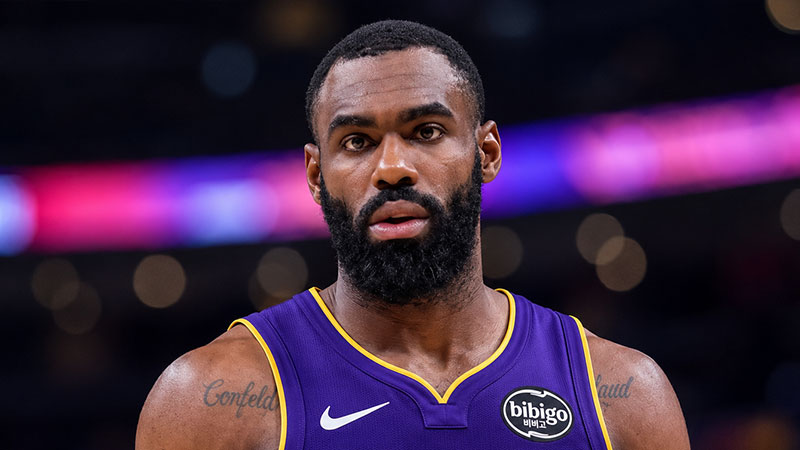
Tim Hardaway Jr. (THJ) has become a masterclass in professional longevity, evolving from a high-flying rookie in New York into one of the most reliable perimeter engines in the modern NBA.
Over 13 seasons and nearly 900 regular-season games, he has established himself as a premier floor spacer whose value transcends traditional shooting percentages.
His recent 2025–26 campaign with the Denver Nuggets, where he finished third in the Sixth Man of the Year voting, served as a definitive performance profile of his elite utility as a high-volume bench scorer.
By analyzing his statistical peaks, his synergy with generational playmakers, and the “gravity” he provides on the court, we can objectively answer how good Tim Hardaway Jr. truly is in the context of winning basketball.
The Mile High Renaissance: Tim Hardaway Jr.’s Denver Peak
The 2025–26 season represented a significant turning point for Hardaway, as he found an ideal tactical home within the Denver Nuggets’ “five-out” offensive system.
Playing alongside Nikola Jokic provided Hardaway with the highest-quality looks of his career, leading to a massive spike in his efficiency metrics.
This late-career surge proved that when placed in a system that prioritizes ball movement and elite playmaking, Hardaway remains one of the most dangerous off-ball threats in the league.
Unlocking Efficiency in the Nuggets’ System
During his tenure in Denver, Hardaway achieved a career-high 40.7% from three-point range, a testament to the “Jokic Effect” and his own refined shot selection.
Unlike previous stints where he was occasionally asked to be a secondary creator—a role he historically struggled with—Denver utilized him strictly as a “sixth starter” and elite play finisher.
This clarity of role allowed him to focus on his primary strength: catch-and-shoot volume. In the 2025–26 season, he averaged 13.5 points per game while attempting 6.9 triples per contest, making him one of the most efficient high-volume shooters in the NBA.
Record-Breaking Bench Production
Hardaway’s impact off the bench was not merely anecdotal; it was record-breaking for the Nuggets franchise.
He led the NBA in three-pointers made off the bench during the 2025–26 season and became only the third player in Denver’s storied history to hit over 200 triples in a single regular-season campaign.
His ability to provide “instant offense” allowed Denver to maintain leads or quickly erase deficits when the primary starters rested, fundamentally altering game momentum with rapid scoring bursts.
| 2025–26 Regular Season Metric | Value | NBA Context / Ranking |
|---|---|---|
| Points Per Game (PPG) | 13.5 | 76th Overall in NBA |
| 3-Point Percentage (3P%) | 40.7% | Career-High Efficiency |
| 3-Pointers Made | 2.8 | Top 15 in the NBA |
| Win Shares (WS) | 4.4 | Significant Contribution for a Bench Player |
| Effective FG% (eFG%) | 59.1% | Elite Scoring Efficiency |
The Hidden Mechanics of NBA Longevity
To understand how good Tim Hardaway Jr. is, one must look at his remarkable durability. Spanning 13 years and five different franchises, he has played 893 regular-season games, showcasing a level of availability that is rare for high-usage perimeter players.
This longevity is built on more than just shooting; it is predicated on a high basketball IQ regarding team systems and a professional reputation that makes him a “roster-ready” asset for any contender.
Professionalism and Playbook Mastery
One of the primary reasons Hardaway has remained a fixture in the league is his ability to learn playbooks rapidly and integrate into new locker rooms without friction.
Coaches value his “NBA-ready body,” which allows him to step into high-pressure rotations and relieve starters without the team losing its tactical edge.
This “plug-and-play” capability has made him a favorite for coaches like Jason Kidd and Michael Malone, who require veterans capable of executing complex offensive sets with minimal transition time.
The Geometry of Spacing and High-Volume Gravity
The most misunderstood aspect of Hardaway’s game is the difference between “league average” shooting and “high-volume” spacing.
While critics often point to his career 36.5% three-point average as being close to the league mean, they fail to account for the sheer volume of his attempts. Defenses react differently to a player who shoots seven triples a game compared to a player who shoots two.
Hardaway’s willingness to take difficult, contested shots forces defenders to stay “glued” to him on the perimeter, which opens up driving lanes for stars like Luka Doncic and Nikola Jokic.
This “gravity” is a primary reason his on-off net ratings are frequently positive, even on nights when his individual shot isn’t falling.
Re-Evaluating the “Streaky” Label and Impact
The most common criticism of Hardaway is that he is a “streaky” or “microwave” scorer who can occasionally shoot his team out of games.
While the variance in his shooting is real—he has had games where he goes 3-of-14 from deep—the aggregate data suggests that his “hot” nights are significant drivers of team wins.
Over his career, his teams have historically performed better when he is given the green light to maintain his volume, as his presence alone stretches the defense to its breaking point.
Defense and Effort Metrics
Despite a narrative that he is a defensive liability, advanced metrics and net ratings often paint a different picture.
During his time in Dallas, he was often a net positive defensively compared to other rotation guards, frequently leading the team in charges taken and showing a high level of effort in transition.
In the 2022–23 season, his defensive rating was actually better than several reputed wing defenders on the Mavericks’ roster. While he is not a “lockdown” defender, he is a disciplined system player who understands rotations and rarely misses assignments.
Managing Statistical Variance
Hardaway’s career is a testament to the “shooter’s life,” where injury, rust, and psychological “yips” can cause temporary dips in performance.
For instance, after returning from a major foot injury in the 2022–23 season, he struggled initially before finding a rhythm and shooting nearly 40% for a significant stretch.
This ability to “shoot oneself out of a slump” is a characteristic of elite shooters, and his 13-year career proves that coaches trust his long-term averages over short-term variance.
Elite Synergy: From Luka Doncic to Nikola Jokic
The definitive proof of Hardaway’s quality lies in his two-man lineup data with the world’s best players. He has consistently served as the “perfect prop” for generational creators, providing the necessary release valve for their playmaking.
Whether it was his historic offensive rating with Luka Doncic or his efficiency peak with Nikola Jokic, Hardaway has proven that he maximizes the talents of those around him.
The Dallas Duo: A Historic Offensive Rating
During his tenure with the Dallas Mavericks, Hardaway and Luka Doncic shared a staggering 122.1 two-man offensive rating.
To put this in perspective, that number was higher than almost any other duo in the league at the time, including several star pairings in Denver.
This synergy was born from Hardaway’s fearlessness; because he was never afraid to take a shot, defenses could not double-team Doncic without risking a “nuclear” scoring burst from the perimeter.
Comparison of Career Impact vs. Specialty Shooters
Analysts often compare Hardaway to elite “pure” shooters like Luke Kennard, noting that Kennard has a higher career percentage.
However, Hardaway has consistently played more minutes and maintained a higher role utility because he offers more than just stationary shooting.
His ability to shoot off the move, his veteran presence, and his durability have allowed him to outlast many “specialists” who lack his physical profile or professional consistency.
| Career Phase | Games Played | PPG | 3P% | Context/Legacy |
|---|---|---|---|---|
| New York (4 Yrs) | 254 | 13.8 | 34.1% | All-Rookie; Primary Scorer Attempt |
| Atlanta (2 Yrs) | 130 | 11.3 | 35.2% | Development into a Winning Role Player |
| Dallas (6 Yrs) | 352 | 15.2 | 37.3% | Historic Synergy with Luka Doncic |
| Denver (1 Yr) | 80 | 13.5 | 40.7% | 6MOY Finalist; Career Efficiency Peak |
Frequently Asked Questions About Tim Hardaway Jr.
Is Tim Hardaway Jr. a good defender?
While not an elite perimeter stopper, Hardaway is a disciplined system defender who consistently puts in high effort. Advanced stats often show him as a net positive on the defensive end, particularly due to his ability to take charges and follow defensive rotations.
He is far from the “liability” that some critics suggest, as evidenced by his superior defensive rating compared to other rotation wings in various seasons.
Why has he lasted 13 years in the NBA?
His longevity is the result of three factors: elite high-volume floor spacing, durability, and a professional locker-room presence.
Teams value his 38.2 career Win Shares and his ability to contribute double-digit scoring without requiring a high number of plays to be run for him. He is a “plug-and-play” veteran who enhances the geometry of any offense he joins.
How does his Denver performance compare to his time in Dallas?
In Dallas, Hardaway was often the second or third offensive option, leading to higher scoring averages (15.2 PPG) but slightly lower efficiency (37.3% 3P%).
In Denver, his role was narrowed to a primary bench scorer, which resulted in a lower scoring average (13.5 PPG) but a career-high efficiency of 40.7% from deep. Denver effectively “unlocked” the most efficient version of THJ by pairing him with Nikola Jokic.
Conclusion: The Blueprint for a Modern Role Player
So, how good is Tim Hardaway Jr.? He is an elite, high-volume floor spacer who represents the gold standard for modern NBA role players.
While he may not be the primary star of a championship team, his presence as a “perimeter engine” makes him an indispensable asset for any contender.
His 13-year journey from an All-Rookie selection to a Sixth Man of the Year finalist in Denver proves that he has the adaptability and skill set to thrive in any environment.
By providing elite “gravity” and a fearless scoring mentality, Hardaway Jr. has solidified his legacy as one of the most impactful bench weapons of his generation.
For teams looking to maximize their star creators, there are few players more qualified to stretch a defense and change the scoreboard than Tim Hardaway Jr.